Department of Psychology, University of Victoria, Victoria, BC, Canada.
Department of Biobehavioral Health, Edna Bennett Pierce Prevention Research Center, 303 Biobehavioral Health, The Pennsylvania State University, University Park, PA, USA.
Addiction. 2019 Feb;114(2):278-293. doi: 10.1111/add.14459. Epub 2018 Nov 16.
We tested the age-varying associations of cannabis use (CU) frequency and disorder (CUD) with psychotic, depressive and anxiety symptoms in adolescent and adult samples. Moderating effects of early onset (≤ 15 years) and sex were tested.
Time-varying effect models were used to assess the significance of concurrent associations between CU and CUD and symptoms of psychosis, depression and anxiety at each age.
Adolescent data (V-HYS; n = 662) were collected from a randomly recruited sample of adolescents in Victoria, British Columbia, Canada during a 10-year period (2003-13). Adult cross-sectional data (NESARC-III; n = 36 309) were collected from a representative sample from the United States (2012-13).
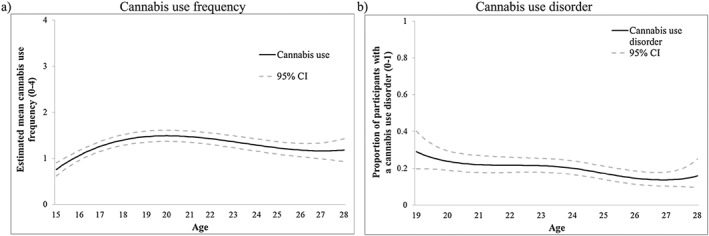
Mental health symptoms were assessed using self-report measures of diagnostic symptoms. CU was based on frequency of past-year use. Past-year CUD was based on DSM-5 criteria.
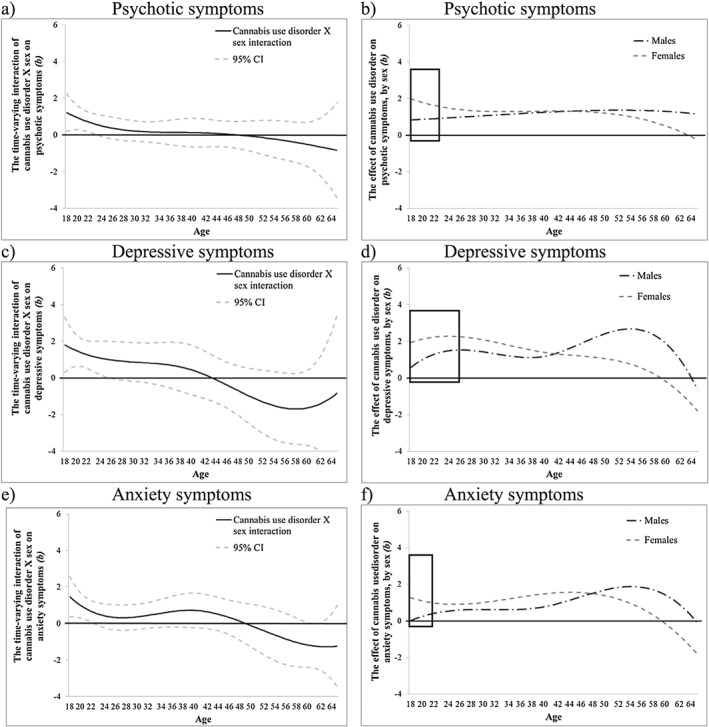
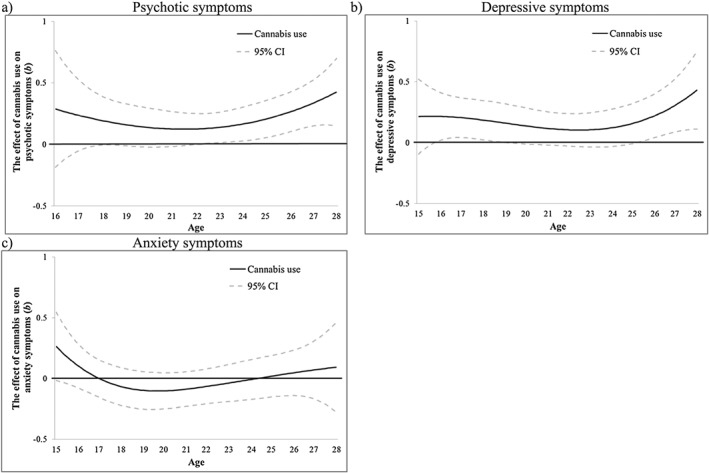
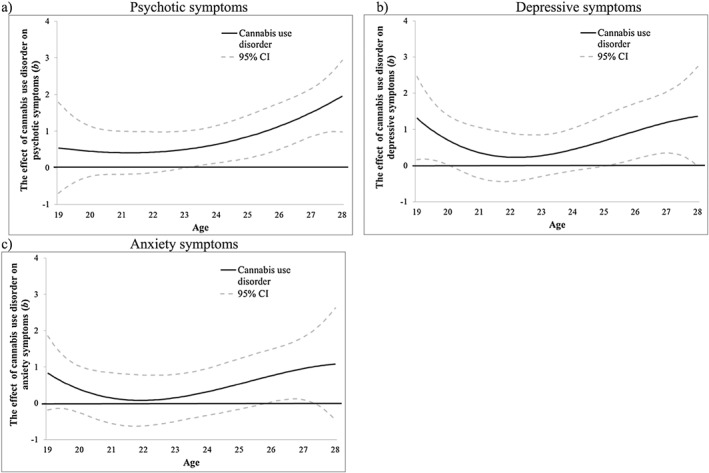
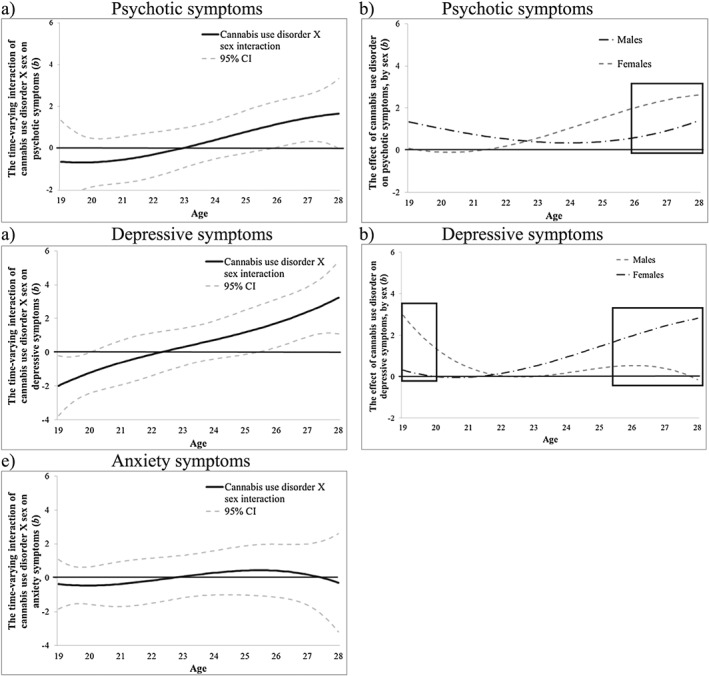
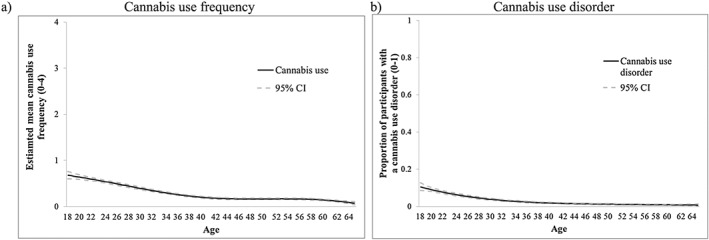
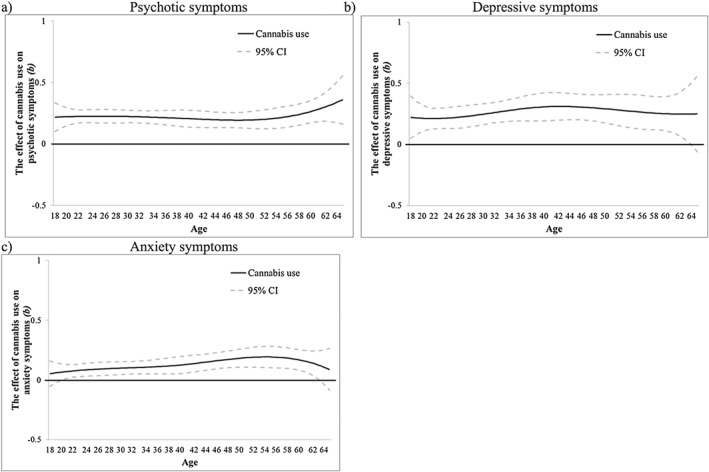
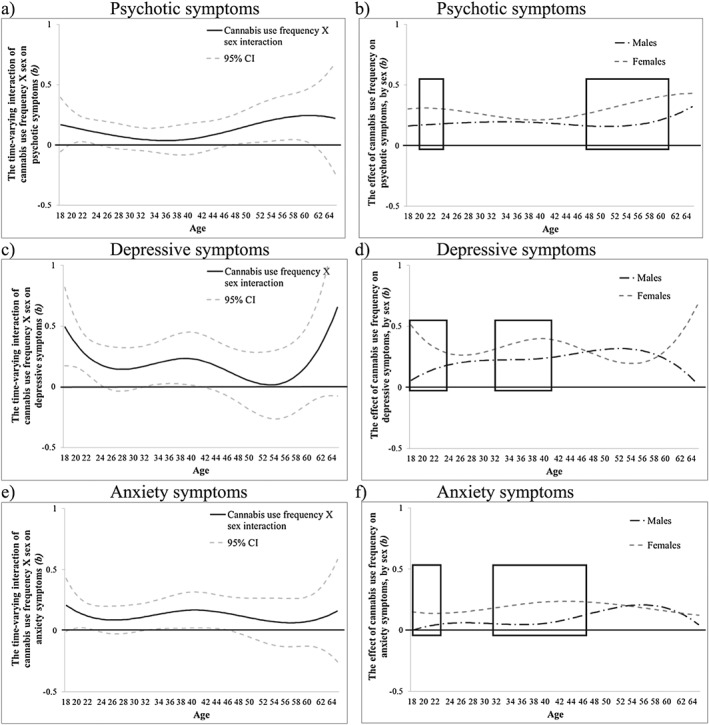
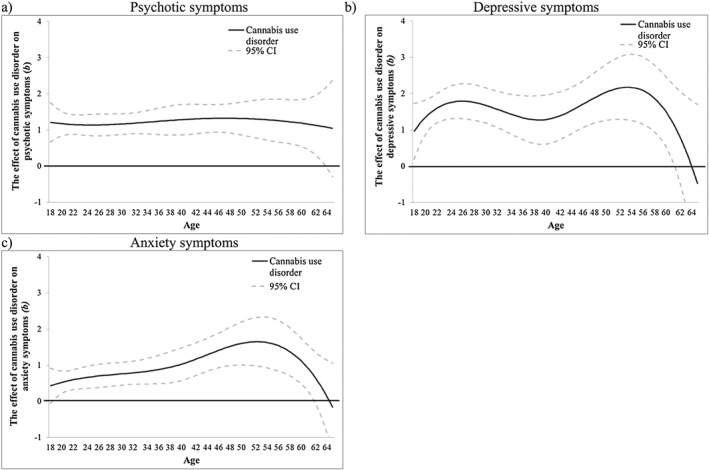
For youth in the V-HYS, CU was associated with psychotic symptoms following age 22 [b = 0.13, 95% confidence interval (CI) = 0.002, 0.25], with depressive symptoms from ages 16-19 and following age 25 (b = 0.17, 95% CI = 0.003, 0.34), but not with anxiety symptoms. CUD was associated with psychotic symptoms following age 23 (b = 0.51, 95% CI = 0.01, 1.01), depressive symptoms at ages 19-20 and following age 25 (b = 0.71, 95% CI = 0.001, 1.42) and anxiety symptoms ages 26-27 only. For adults in the NESARC-III, CU was associated with mental health symptoms at most ages [e.g. psychotic symptoms; age 18 (b = 0.22, 95% CI = 0.10, 0.33) to age 65 (b = 0.36, 95% CI = 0.16, 0.56)]. CUD was associated with all mental health symptoms across most ages [e.g. depressive symptoms; age 18 (b = 0.96, 95% CI = 0.19, 1.73) to age 61 (b = 1.11, 95% CI = 0.01, 2.21)]. Interactions with sex show stronger associations for females than males in young adulthood [e.g.
V-HYS: CUD × sex interaction on psychotic symptoms significant after age 26 (b = 1.12, 95% CI = 0.02, 2.21)]. Findings were not moderated by early-onset CU.
Significant associations between cannabis use (CU) frequency and disorder (CUD) and psychotic and depressive symptoms in late adolescence and young adulthood extend across adulthood, and include anxiety.
我们测试了青少年和成年样本中,大麻使用(CU)频率和障碍(CUD)与精神病、抑郁和焦虑症状的随年龄变化的关联。测试了早发性(≤15 岁)和性别对这些关联的调节作用。
时间变化效应模型用于评估 CU 和 CUD 与每个年龄的精神病、抑郁和焦虑症状的同时关联的显著性。
青少年数据(V-HYS;n=662)来自加拿大不列颠哥伦比亚省维多利亚市随机招募的青少年样本,收集时间为 10 年(2003-13 年)。成人横断面数据(NESARC-III;n=36309)来自美国具有代表性的样本(2012-13 年)。
使用诊断症状的自我报告测量来评估心理健康症状。CU 基于过去一年的使用频率。过去一年的 CUD 基于 DSM-5 标准。
对于 V-HYS 中的年轻人,22 岁以后 CU 与精神病症状相关(b=0.13,95%置信区间(CI)0.002,0.25),16-19 岁和 25 岁以后与抑郁症状相关(b=0.17,95%CI=0.003,0.34),但与焦虑症状无关。CUD 与 23 岁以后的精神病症状相关(b=0.51,95%CI=0.01,1.01),19-20 岁和 25 岁以后与抑郁症状相关(b=0.71,95%CI=0.001,1.42),26-27 岁仅与焦虑症状相关。对于 NESARC-III 中的成年人,CU 与大多数年龄的心理健康症状相关[例如,精神病症状;18 岁(b=0.22,95%CI=0.10,0.33)至 65 岁(b=0.36,95%CI=0.16,0.56)]。CUD 与大多数年龄的所有心理健康症状相关[例如,抑郁症状;18 岁(b=0.96,95%CI=0.19,1.73)至 61 岁(b=1.11,95%CI=0.01,2.21)]。性别的交互作用显示,在年轻成年期,女性的关联比男性更强[例如,V-HYS:CUD×性别对精神病症状的交互作用在 26 岁后显著(b=1.12,95%CI=0.02,2.21)]。早期 CU 并未调节这些发现。
在青少年晚期和成年早期,大麻使用(CU)频率和障碍(CUD)与精神病和抑郁症状的显著关联延伸至成年期,包括焦虑。