a Department of Nephrology , Tianjin Medical University General Hospital , Tianjin , China.
b Department of Hematology , Tianjin Medical University General Hospital , Tianjin , China.
Ren Fail. 2018 Nov;40(1):554-560. doi: 10.1080/0886022X.2018.1487865.
Heavy proteinuria in antineutrophil cytoplasmic antibody (ANCA)-associated glomerulonephritis (GN) is usually considered to be associated with immune deposits in renal biopsy. Nephrotic ANCA GN without immune deposits (pauci-immune) is rare and has not been studied specially. In this study characteristics of these patients are to be investigated.
Clinical and pathological characteristics from 20 kidney biopsy-proven pauci-immune anti-myeloperoxidase antibody-associated GN patients with nephrotic proteinuria were analyzed and were compared with ANCA GN patients without nephrotic proteinuria.
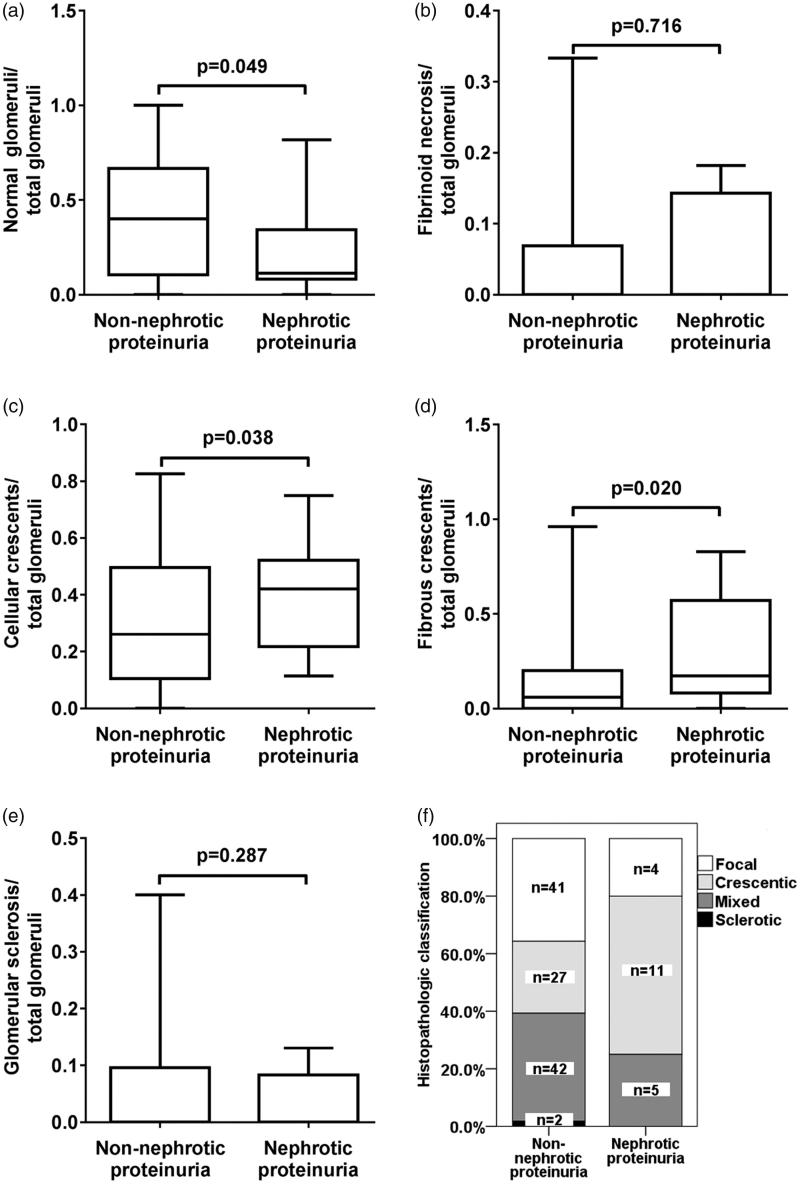
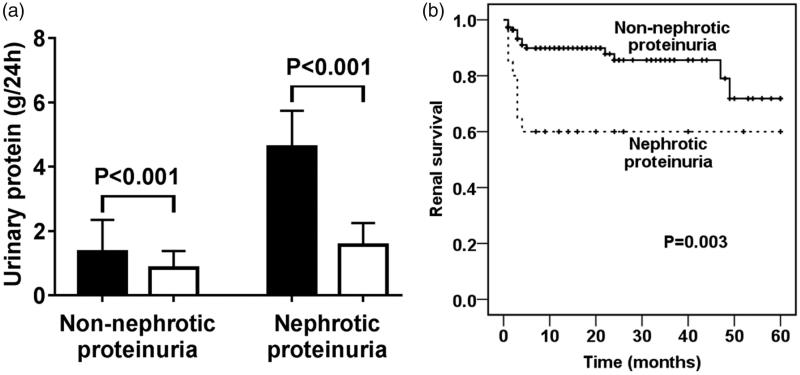
Acute kidney injury (AKI) and gross hematuria were much prevalent but extra-renal involvement was less prevalent in pauci-immune ANCA GN with nephrotic proteinuria than in pauci-immune ANCA GN without nephrotic proteinuria. No more severe hypoalbuminemia, hypercoagulability, hyperlipidemia or higher thrombosis incidence were found between two groups. Compared with patients without nephrotic proteinuria, patients with nephrotic proteinuria had more prevalent crescentic category in histopathology. Proteinuria decreased quickly after treatment but much poorer renal prognosis was found in pauci-immune ANCA GN with nephrotic proteinuria. The results of urinary albumin to total protein ratio and urinary protein electrophoresis showed pauci-immune ANCA GN with nephrotic proteinuria had obvious non-selective proteinuria.
Pauci-immune ANCA GN with nephrotic proteinuria do not have more severe hypoalbuminemia, hypercoagulability or hyperlipidemia than patients without nephrotic proteinuria. Non-selective proteinuria might be the reason. However, pauci-immune ANCA GN with nephrotic proteinuria have more prevalent crescentic category in histopathology, higher incidence of AKI, gross hematuria and poorer renal prognosis despite of good sensitivity to therapy of proteinuria.
抗中性粒细胞胞浆抗体(ANCA)相关性肾小球肾炎(GN)患者出现大量蛋白尿通常与肾活检中的免疫沉积物有关。不伴有免疫沉积物的肾病型 ANCA GN(寡免疫性)较为罕见,尚未得到专门研究。本研究旨在分析此类患者的临床和病理特征。
分析了 20 例经肾活检证实的伴有肾病性蛋白尿的寡免疫性抗髓过氧化物酶抗体相关性 GN 患者的临床和病理特征,并与不伴有肾病性蛋白尿的 ANCA GN 患者进行比较。
与不伴有肾病性蛋白尿的寡免疫性 ANCA GN 患者相比,伴有肾病性蛋白尿的寡免疫性 ANCA GN 患者更易发生急性肾损伤(AKI)和肉眼血尿,但肾脏外表现较少。两组患者间并未发现更严重的低白蛋白血症、高凝状态、高脂血症或更高的血栓形成发生率。与不伴有肾病性蛋白尿的患者相比,伴有肾病性蛋白尿的患者在组织病理学上更易出现新月体类别。经治疗后蛋白尿迅速下降,但伴有肾病性蛋白尿的寡免疫性 ANCA GN 患者的肾脏预后更差。尿白蛋白/总蛋白比值和尿蛋白电泳结果表明,伴有肾病性蛋白尿的寡免疫性 ANCA GN 存在明显的非选择性蛋白尿。
伴有肾病性蛋白尿的寡免疫性 ANCA GN 患者并不比不伴有肾病性蛋白尿的患者有更严重的低白蛋白血症、高凝状态或高脂血症。非选择性蛋白尿可能是原因之一。然而,伴有肾病性蛋白尿的寡免疫性 ANCA GN 患者在组织病理学上更易出现新月体类别,AKI、肉眼血尿的发生率更高,尽管对蛋白尿的治疗反应良好,但肾脏预后更差。