Department of Pathophysiology and Immunology, National Institute of Geriatrics, Rheumatology and Rehabilitation, Spartanska 1, 02-637, Warsaw, Poland.
Inflammation. 2019 Feb;42(1):375-386. doi: 10.1007/s10753-018-0901-9.
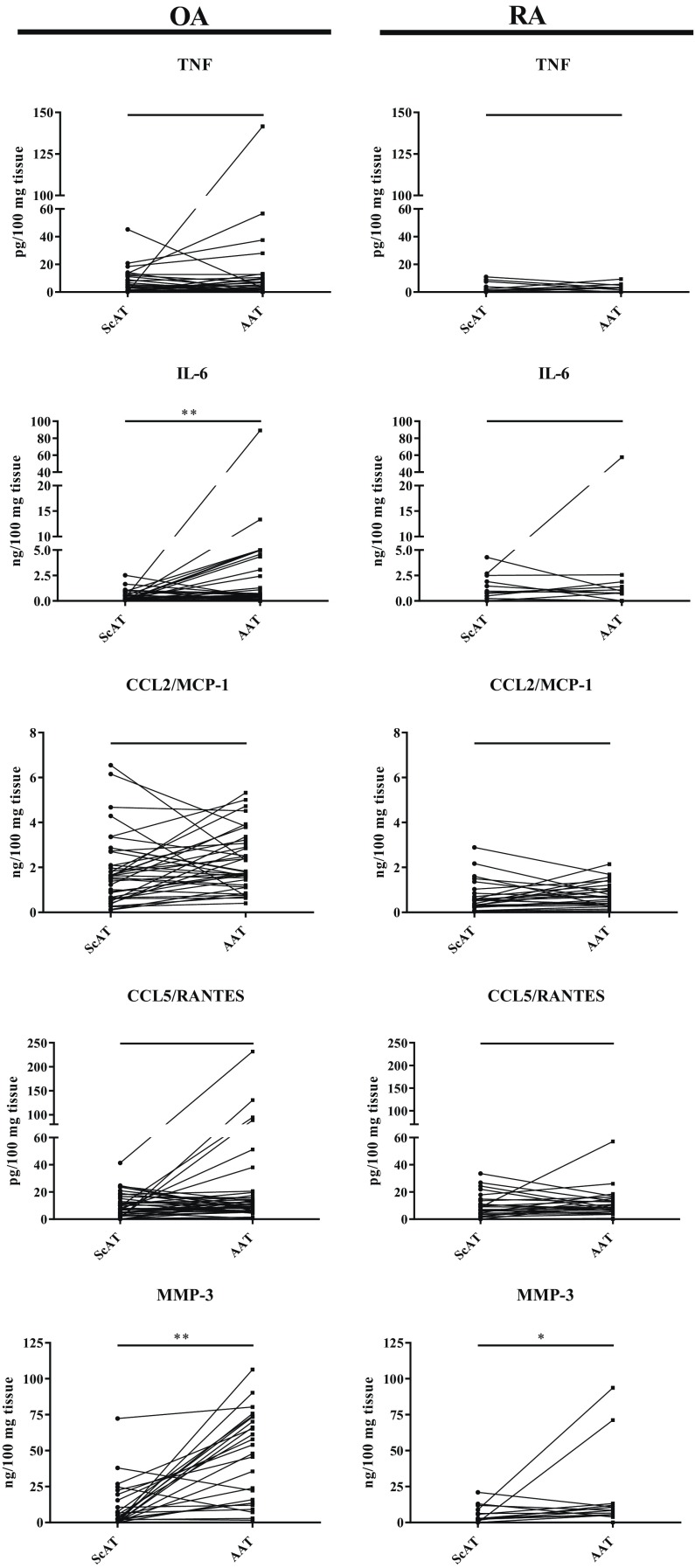
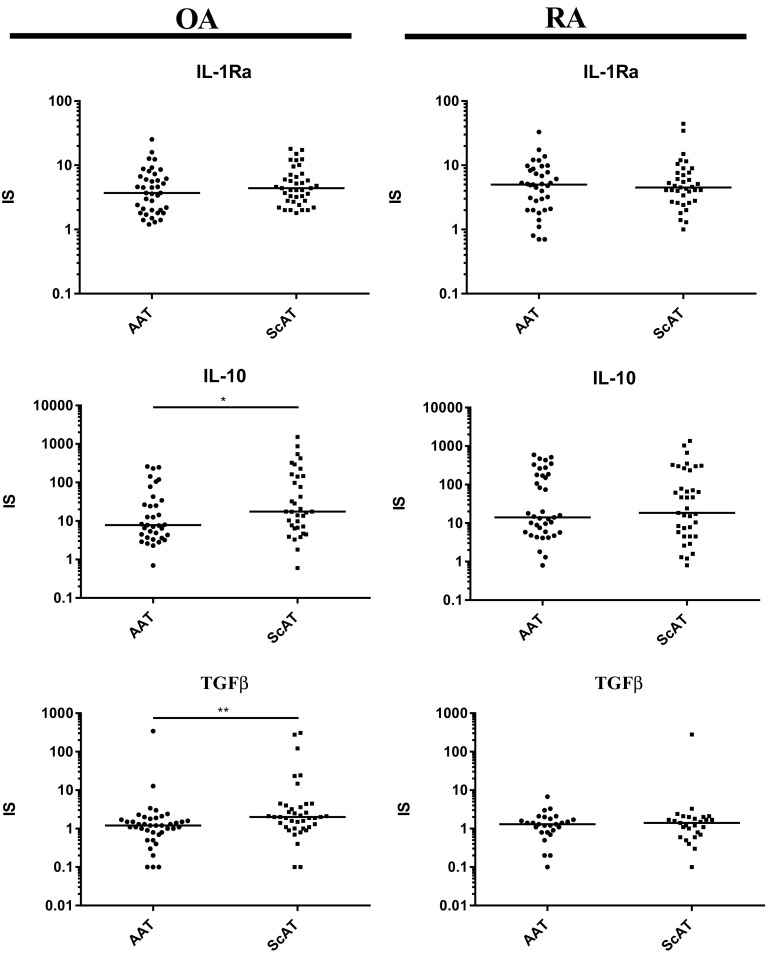
Rheumatoid arthritis (RA) and osteoarthritis (OA) are characterized by joint and systemic high- or low-grade inflammation, respectively. Adipose tissue (AT) may contribute to the pathogenesis of these diseases. To address this issue, we investigated whether basal and pro-inflammatory cytokine (IL-1β)-triggered release of adipocytokines (TNF, IL-6, IL-10, IL-1Ra, TGFβ, CCL2/MCP-1, CCL5/RANTES, MMP-3) from subcutaneous (ScAT) and intraarticular (AAT) adipose tissues of RA and OA patients mirror differences between these diseases in an intensity of systemic and local inflammation. We found that in both diseases basal adipocytokine release was usually higher from AAT than ScAT, reflecting stronger local than systemic inflammation. However, ScAT secreted considerable amounts of pro- and anti-inflammatory factors as well. Spontaneous secretion of some adipocytokines (MMP-3 and/or TNF, CCL2/MCP-1, IL-1Ra) was higher in osteoarthritis than rheumatoid ATs and probably caused by weaker anti-inflammatory treatment of OA patients. By contrast, reactivity of ATs to IL-1β was significantly lower in OA than RA and IL-1β antagonist (IL-1Ra) could be responsible for this because we found its overproduction in OA ATs. Interestingly, higher reactivity of ScAT than AAT to IL-1β was a characteristic for OA while reactivity of rheumatoid ScAT and AAT to this stimulus was equal. We conclude that differences between OA and RA in reactivity of AAT and ScAT to pro-inflammatory stimulus mimicking in vivo condition reflect dissimilarity in an intensity of disease-specific inflammation and thus support contribution of ATs to these pathological processes. Moreover, we propose that more efficient anti-inflammatory mechanism(s) are preserved in ATs of OA than RA patients.
类风湿关节炎 (RA) 和骨关节炎 (OA) 的特征分别为关节和全身的高低级别炎症。脂肪组织 (AT) 可能有助于这些疾病的发病机制。为了解决这个问题,我们研究了 RA 和 OA 患者的皮下 (ScAT) 和关节内 (AAT) 脂肪组织中的基础和促炎细胞因子 (IL-1β) 触发的脂肪细胞因子 (TNF、IL-6、IL-10、IL-1Ra、TGFβ、CCL2/MCP-1、CCL5/RANTES、MMP-3) 的释放是否反映了这些疾病在全身和局部炎症强度上的差异。我们发现,在这两种疾病中,基础脂肪细胞因子的释放通常来自 AAT 高于 ScAT,反映了局部炎症强于全身炎症。然而,ScAT 也分泌了相当数量的促炎和抗炎因子。一些脂肪细胞因子 (MMP-3 和/或 TNF、CCL2/MCP-1、IL-1Ra) 的自发分泌在 OA 脂肪组织中高于 RA 脂肪组织,这可能是由于 OA 患者的抗炎治疗较弱。相比之下,OA 脂肪组织对 IL-1β 的反应性明显低于 RA,这可能是由于 OA 脂肪组织中 IL-1β 拮抗剂 (IL-1Ra) 的过度产生所致。有趣的是,ScAT 对 IL-1β 的反应性高于 AAT 是 OA 的特征,而 RA ScAT 和 AAT 对这种刺激的反应性相等。我们得出的结论是,在模拟体内条件的促炎刺激下,AAT 和 ScAT 对 RA 和 OA 的反应性之间的差异反映了疾病特异性炎症强度的不同,因此支持 AT 对这些病理过程的贡献。此外,我们提出,与 RA 患者相比,OA 患者的 AT 中保留了更有效的抗炎机制。