Laboratory for Biomedical Microtechnology, Institute of Microsystem Technology (IMTEK), University of Freiburg, Georges-Koehler-Allee 102, D-79110, Freiburg, Germany.
Cluster of Excellence BrainLinks-BrainTools, University of Freiburg, Georges-Koehler-Allee 80, 79110, Freiburg, Germany.
Sci Rep. 2018 Oct 3;8(1):14749. doi: 10.1038/s41598-018-33083-w.
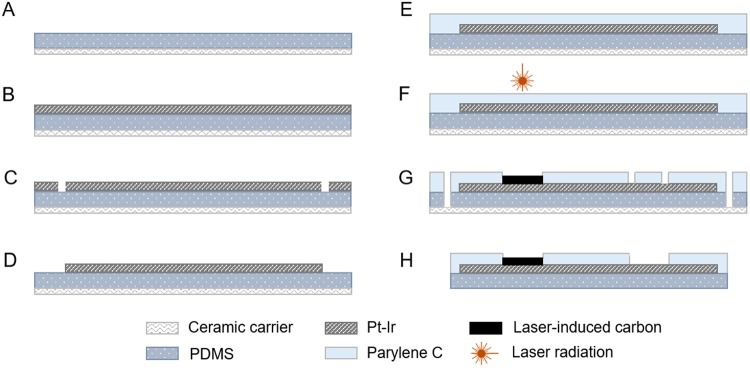
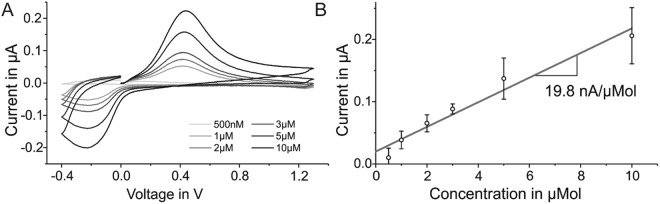
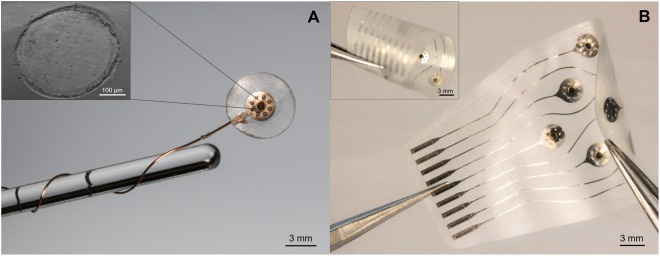
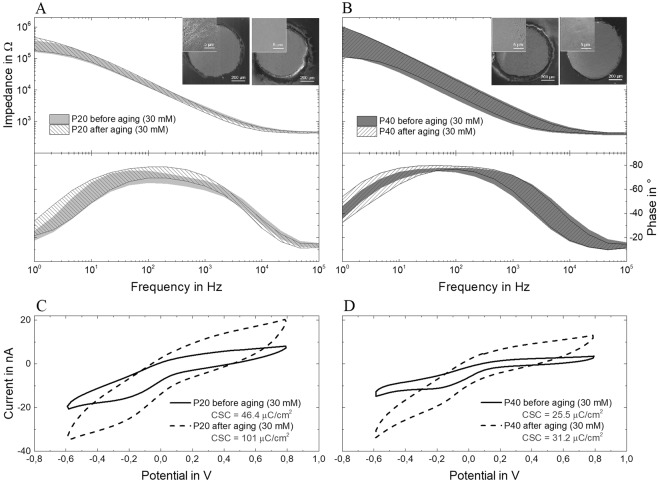
Neural interfaces for neuroscientific research are nowadays mainly manufactured using standard microsystems engineering technologies which are incompatible with the integration of carbon as electrode material. In this work, we investigate a new method to fabricate graphitic carbon electrode arrays on flexible substrates. The devices were manufactured using infrared nanosecond laser technology for both patterning all components and carbonizing the electrode sites. Two laser pulse repetition frequencies were used for carbonization with the aim of finding the optimum. Prototypes of the devices were evaluated in vitro in 30 mM hydrogen peroxide to mimic the post-surgery oxidative environment. The electrodes were subjected to 10 million biphasic pulses (39.5 μC/cm) to measure their stability under electrical stress. Their biosensing capabilities were evaluated in different concentrations of dopamine in phosphate buffered saline solution. Raman spectroscopy and x-ray photoelectron spectroscopy analysis show that the atomic percentage of graphitic carbon in the manufactured electrodes reaches the remarkable value of 75%. Results prove that the infrared nanosecond laser yields activated graphite electrodes that are conductive, non-cytotoxic and electrochemically inert. Their comprehensive assessment indicates that our laser-induced carbon electrodes are suitable for future transfer into in vivo studies, including neural recordings, stimulation and neurotransmitters detection.
用于神经科学研究的神经接口目前主要使用标准的微系统工程技术制造,而这些技术与将碳作为电极材料集成不兼容。在这项工作中,我们研究了一种在柔性衬底上制造石墨碳电极阵列的新方法。该器件使用红外纳秒激光技术制造,既能对所有组件进行图案化,也能对电极部位进行碳化。使用两种激光脉冲重复频率进行碳化,以寻找最佳碳化效果。对器件原型进行了体外评估,在 30mM 过氧化氢中模拟手术后的氧化环境。将电极经受 1000 万次双相脉冲(39.5μC/cm),以测量其在电应力下的稳定性。在磷酸盐缓冲盐溶液中不同浓度的多巴胺条件下评估了它们的生物传感性能。拉曼光谱和 X 射线光电子能谱分析表明,制造的电极中的石墨碳的原子百分比达到了 75%的显著值。结果证明,红外纳秒激光产生的活性石墨电极具有导电性、非细胞毒性和电化学惰性。它们的综合评估表明,我们的激光诱导碳电极适合未来转移到体内研究,包括神经记录、刺激和神经递质检测。