Schluter Renée S, Daams Joost G, van Holst Ruth J, Goudriaan Anna E
Department of Psychiatry and Amsterdam Institute for Addiction Research, Amsterdam UMC, University of Amsterdam, Amsterdam, Netherlands.
Medical Library, Amsterdam UMC, University of Amsterdam, Amsterdam, Netherlands.
Front Neurosci. 2018 Sep 19;12:642. doi: 10.3389/fnins.2018.00642. eCollection 2018.
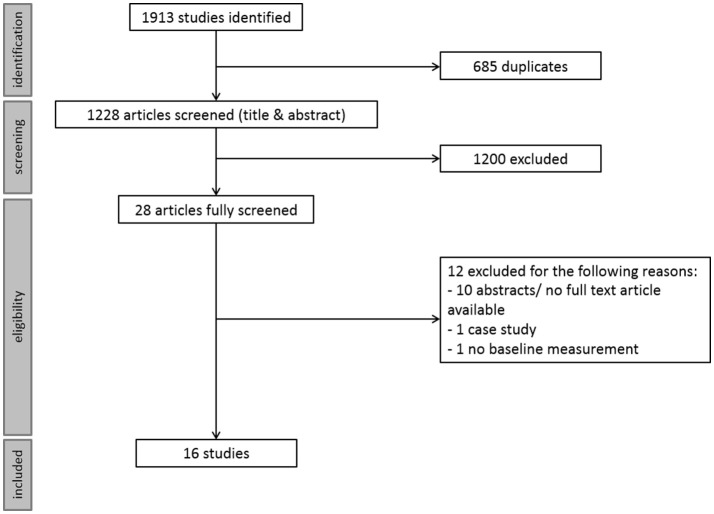
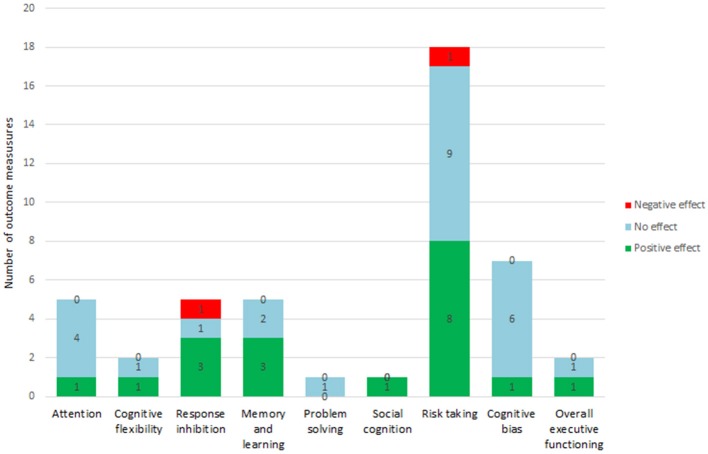
In order to improve the current treatment of addictive disorders non-invasive neuromodulation over the dorsolateral prefrontal cortex (DLPFC) has gained attention. The DLPFC is crucially involved in executive functioning, functions which are related to the course of addictive disorders. Non-invasive stimulation of the DLPFC may lead to changes in executive functioning. Currently an overview of effects of neuromodulation on these functions is lacking. Therefore, this systematic review addresses the effects of non-invasive neuromodulation on executive functioning in addictive disorders. The current review is conducted and reported in accordance with the Preferred Reporting Items for Systematic reviews and Meta-Analyses for Protocols 2015 (PRISMA-P 2015) guidelines and has been registered in PROSPERO International Prospective Register of Systematic Reviews (https://www.crd.york.ac.uk/prospero/, registration number: CRD42018084157). Original articles were searched using the Ovid MEDLINE, Embase and PsycINFO database. The systematic search resulted in 1,228 unique studies, of which sixteen were included in the current review. Some of these studies do not address the classic definition of executive functions, but another cognitive function. However, they were included in this review since the field is small and still under development and we aim to give an inclusive overview in its broadest sense. The following executive and other cognitive functioning domains were assessed: attention, cognitive flexibility, response inhibition, memory and learning, problem solving, social cognition, risk taking, cognitive bias modification and overall executive functioning. The executive function domain most positively affected was social cognition followed by memory & learning, response inhibition, cognitive flexibility and attention. The studies addressed in the current review used a large variability of stimulation protocols and study designs which complicates comparability of the results. Nevertheless, the results of these studies are promising in light of improvement of current treatment. Therefore, we recommend future studies that compare the effect of different types of stimulation, stimulation sides and number of stimulation sessions in larger clinical trials. This will significantly increase the comparability of the studies and thereby accelerate and clarify the conclusion on whether non-invasive neuromodulation is an effective add-on treatment for substance dependence.
为了改善当前对成瘾性障碍的治疗,经颅直流电刺激背外侧前额叶皮质(DLPFC)已受到关注。DLPFC在执行功能中起着关键作用,这些功能与成瘾性障碍的病程相关。对DLPFC进行非侵入性刺激可能会导致执行功能的改变。目前缺乏对神经调节对这些功能影响的概述。因此,本系统评价探讨了非侵入性神经调节对成瘾性障碍患者执行功能的影响。本系统评价按照系统评价和Meta分析的首选报告项目:方案2015(PRISMA-P 2015)指南进行实施和报告,并已在国际前瞻性系统评价注册库PROSPERO(https://www.crd.york.ac.uk/prospero/,注册号:CRD42018084157)中注册。使用Ovid MEDLINE、Embase和PsycINFO数据库检索原始文章。系统检索产生了1228项独特的研究,其中16项纳入了本系统评价。其中一些研究并未涉及执行功能的经典定义,而是涉及另一种认知功能。然而,由于该领域规模较小且仍在发展中,我们旨在从最广泛的意义上给出一个全面的概述,因此将它们纳入了本系统评价。评估了以下执行功能和其他认知功能领域:注意力、认知灵活性、反应抑制、记忆与学习、问题解决、社会认知、冒险、认知偏差修正和整体执行功能。受积极影响最大的执行功能领域是社会认知,其次是记忆与学习、反应抑制、认知灵活性和注意力。本系统评价中涉及的研究使用了多种刺激方案和研究设计,这使得结果的可比性变得复杂。尽管如此,鉴于当前治疗的改善,这些研究的结果很有前景。因此,我们建议未来的研究在更大规模的临床试验中比较不同类型刺激、刺激侧和刺激次数的效果。这将显著提高研究的可比性,从而加快并明确关于非侵入性神经调节是否是物质依赖有效辅助治疗的结论。