
丰富和稀少的微生物生物圈对西藏温泉中的环境和空间因素反应不同。
Abundant and Rare Microbial Biospheres Respond Differently to Environmental and Spatial Factors in Tibetan Hot Springs.
作者信息
Zhang Yanmin, Wu Geng, Jiang Hongchen, Yang Jian, She Weiyu, Khan Inayat, Li Wenjun
机构信息
State Key Laboratory of Biogeology and Environmental Geology, China University of Geosciences, Wuhan, China.
State Key Laboratory of Biocontrol and Guangdong Provincial Key Laboratory of Plant Resources, School of Life Sciences, Sun Yat-sen University, Guangzhou, China.
出版信息
Front Microbiol. 2018 Sep 19;9:2096. doi: 10.3389/fmicb.2018.02096. eCollection 2018.
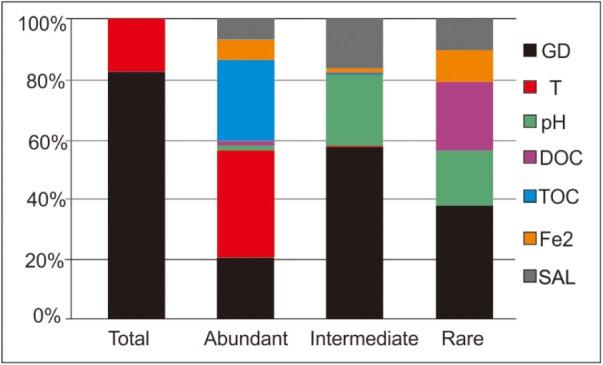
Little is known about the distribution and ecological functions of abundant, intermediate, and rare biospheres and their correlations with environmental factors in hot springs. Here, we explored the microbial community composition of total, abundant, intermediate, and rare biospheres in 66 Tibetan hot springs (pairwise geographic distance 0-610 km, temperature 32-86°C, pH 3.0-9.5, and salinity 0.13-1.32 g/L) with the use of Illumina MiSeq high-throughput sequencing. The results showed that the abundant sub-communities were mainly composed of , and . In contrast, the rare sub-communities mainly consisted of most newly proposed or candidate phyla of , and . However, the abundant and rare sub-communities shared some common phyla (e.g., , and ), which were composed of different OTUs. The abundant, intermediate, and rare sub-communities were mainly influenced by different environmental variables, which could be ascribed to the fact that they may have different growth and activity and thus respond differently to these variables. Spatial factors showed more contribution to shaping of the intermediate and rare communities than to abundant sub-community, suggesting that the abundant taxa were more easily dispersed than their rare counterparts among hot springs. Microbial ecological function prediction revealed that the abundant and rare sub-communities responded differently to the measured environmental factors, suggesting they may occupy different ecological niches in hot springs. The rare sub-communities may play more important roles in organic matter degradation than their abundant counterparts in hot springs. Collectively, this study provides a better understanding on the microbial community structure and potential ecological functions of the abundant and rare biospheres in hot spring ecosystems. The identified rare taxa provide new opportunities of ecological, taxonomic and genomic discoveries in Tibetan hot springs.
关于温泉中丰富、中等和稀有生物圈的分布、生态功能及其与环境因素的相关性,人们了解甚少。在此,我们利用Illumina MiSeq高通量测序技术,探究了66个西藏温泉(两两之间地理距离为0 - 610公里,温度为32 - 86°C,pH值为3.0 - 9.5,盐度为0.13 - 1.32克/升)中总、丰富、中等和稀有生物圈的微生物群落组成。结果表明,丰富亚群落主要由 ,以及 组成。相比之下,稀有亚群落主要由大多数新提出的或候选的 门、 门和 门组成。然而,丰富和稀有亚群落共享一些常见门类(例如 、 和 ),它们由不同的操作分类单元(OTU)组成。丰富、中等和稀有亚群落主要受不同环境变量的影响,这可能归因于它们可能具有不同的生长和活性,因此对这些变量的反应不同。空间因素对中等和稀有群落形成的贡献比对丰富亚群落的贡献更大,这表明丰富的分类群比稀有分类群在温泉之间更容易扩散。微生物生态功能预测表明,丰富和稀有亚群落对所测环境因素的反应不同,这表明它们可能在温泉中占据不同的生态位。在温泉中,稀有亚群落在有机物降解方面可能比丰富亚群落发挥更重要的作用。总体而言,本研究更好地理解了温泉生态系统中丰富和稀有生物圈的微生物群落结构及潜在生态功能。所鉴定出的稀有分类群为西藏温泉的生态、分类学和基因组发现提供了新机会。




 Zotero 插件