Leale Alanna M, Kassen Rees
Department of Biology University of Ottawa Ottawa Ontario K1N 6N5 Canada.
Evol Lett. 2018 Mar 17;2(2):134-143. doi: 10.1002/evl3.43. eCollection 2018 Apr.
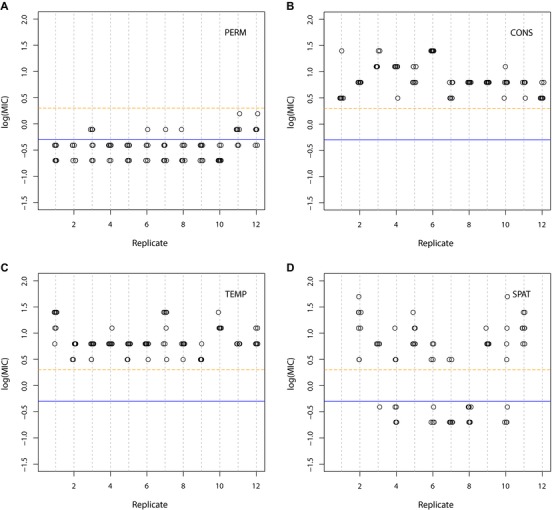
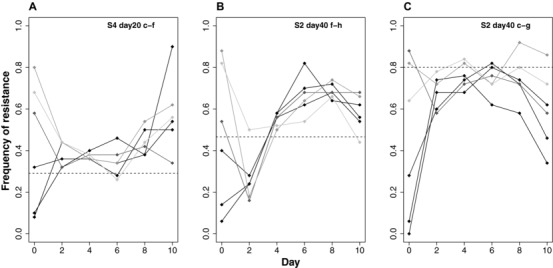
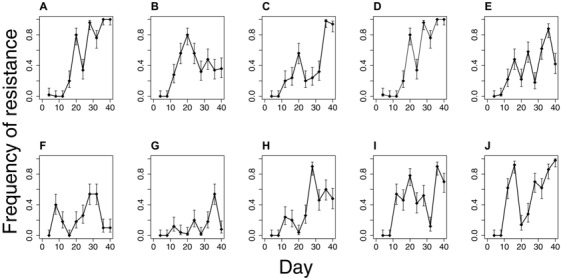
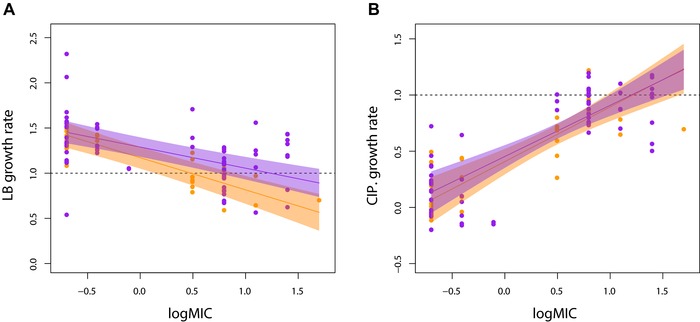
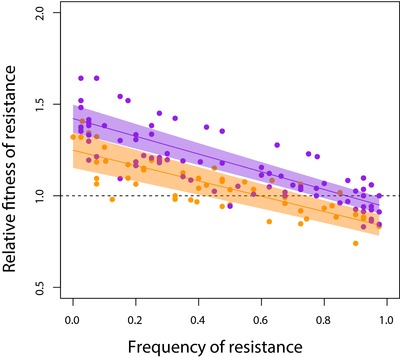
Antimicrobial resistance (AMR) is a growing global threat that, in the absence of new antibiotics, requires effective management of existing drugs. Here, we use experimental evolution of the opportunistic human pathogen to explore how changing patterns of drug delivery modulates the spread of resistance in a population. Resistance evolves readily under both temporal and spatial variation in drug delivery and fixes rapidly under temporal, but not spatial, variation. Resistant and sensitive genotypes coexist in spatially varying conditions due to a resistance-growth rate trade-off which, when coupled to dispersal, generates negative frequency-dependent selection and a quasi-protected polymorphism. Coexistence is ultimately lost, however, because resistant types with improved growth rates in the absence of drug spread through the population. These results suggest that spatially variable drug prescriptions can delay but not prevent the spread of resistance and provide a striking example of how the emergence and eventual demise of biodiversity is underpinned by evolving fitness trade-offs.
抗菌药物耐药性(AMR)是一个日益严重的全球威胁,在缺乏新型抗生素的情况下,需要对现有药物进行有效管理。在此,我们利用机会性人类病原体的实验进化来探究药物递送模式的变化如何调节耐药性在群体中的传播。在药物递送的时间和空间变化下,耐药性都很容易进化,并且在时间变化而非空间变化下迅速固定。由于耐药性与生长速率之间的权衡,耐药和敏感基因型在空间变化条件下共存,这种权衡与扩散相结合时,会产生负频率依赖性选择和准保护多态性。然而,共存最终会丧失,因为在无药物情况下生长速率提高的耐药类型会在群体中扩散。这些结果表明,空间可变的药物处方可以延缓但不能阻止耐药性的传播,并提供了一个显著的例子,说明生物多样性的出现和最终消亡是如何由不断演变的适应性权衡所支撑的。