Centre for Research Ethics & Bioethics, Department of Public Health and Caring Sciences, Uppsala University, Box 564, 751 22, Uppsala, Sweden.
Institute of Health Policy and Management, Erasmus University, Bayle (J) building - Campus Woudestein, Burgemeester Oudlaan 50, 3062 PA, Rotterdam, The Netherlands.
BMC Public Health. 2018 Oct 3;18(1):1153. doi: 10.1186/s12889-018-6047-8.
High consumption of antibiotics has been identified as an important driver for the increasing antibiotic resistance, considered to be one of the greatest threats to public health globally. Simply informing the public about this consequence is insufficient to induce behavioral change. This study explored beliefs and perceptions among Swedes, with the aim of identifying factors promoting and hindering a judicious approach to antibiotics use. The study focused primarily on the medical use of antibiotics, also considering other aspects connected with antibiotic resistance, such as travelling and food consumption.
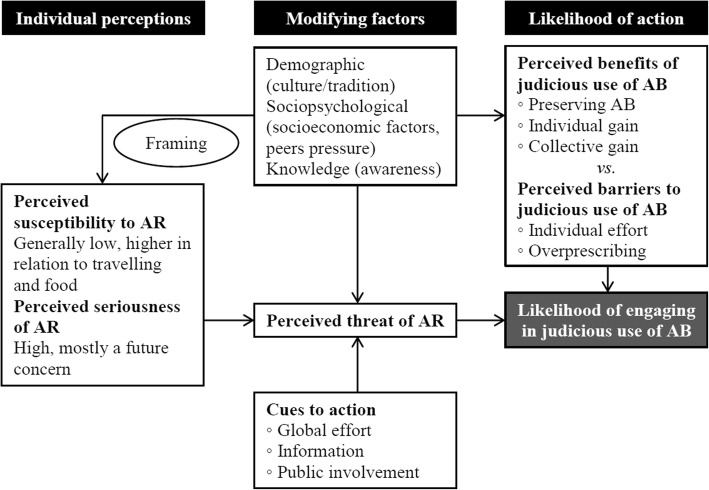
Data were collected through focus group discussions at the end of 2016. Twenty-three Swedes were recruited using an area-based approach and purposive sampling, aiming for as heterogeneous groups as possible regarding gender (13 women, 10 men), age (range 20-81, mean 38), and education level. Interview transcripts were analyzed using qualitative content analysis. The Health Belief Model was used as a theoretical framework.
Antibiotic resistance was identified by participants as a health threat with the potential for terrible consequences. The severity of the problem was perceived more strongly than the actual likelihood of being affected by it. Metaphors such as climate change were abundantly employed to describe antibiotic resistance as a slowly emerging problem. There was a tension between individual (egoistic) and collective (altruistic) reasons for engaging in judicious behavior. The individual effort needed and antibiotics overprescribing were considered major barriers to such behavior. In their discussions, participants stressed the need for empowerment, achieved through good health communication from authorities and family physicians.
Knowledge about antibiotic consumption and resistance, as well as values such as altruism and trust in the health care system, has significant influence on both perceptions of individual responsibility and on behavior. This suggests that these factors should be emphasized in health education and health promotion. To instead frame antibiotic resistance as a slowly emerging disaster, risks diminish the public perception of being susceptible to it.
高抗生素消费已被确定为抗生素耐药性增加的重要驱动因素,被认为是对全球公众健康的最大威胁之一。仅仅告知公众这一后果不足以促使行为改变。本研究探讨了瑞典人的信念和看法,旨在确定促进和阻碍合理使用抗生素的因素。本研究主要关注抗生素的医疗用途,同时考虑与抗生素耐药性相关的其他方面,如旅行和食品消费。
数据通过 2016 年底的焦点小组讨论收集。采用基于区域的方法和目的抽样,招募了 23 名瑞典人,尽可能使性别(13 名女性,10 名男性)、年龄(20-81 岁,平均 38 岁)和教育程度的群体多样化。使用定性内容分析对访谈记录进行分析。健康信念模型被用作理论框架。
参与者将抗生素耐药性视为一种健康威胁,具有可怕后果的潜在风险。对问题的严重程度的感知强于对自身受影响的实际可能性的感知。气候变化等隐喻被大量用于描述抗生素耐药性是一个缓慢出现的问题。参与明智行为的个体(利己主义)和集体(利他主义)原因之间存在紧张关系。个人所需的努力和抗生素的过度处方被认为是这种行为的主要障碍。在讨论中,参与者强调了赋权的必要性,通过权威机构和家庭医生提供良好的健康沟通来实现。
关于抗生素消费和耐药性的知识,以及利他主义和对医疗保健系统的信任等价值观,对个人责任的看法和行为都有重大影响。这表明这些因素应该在健康教育和健康促进中得到强调。相反,将抗生素耐药性描述为一个缓慢出现的灾难会降低公众对易受其影响的认识。