Thoracic Medicine Department, Hunan Cancer Hospital, Changsha, 410013, People's Republic of China.
Department of Rheumatology, Navy General Hospital, Beijing, 100048, People's Republic of China.
Arthritis Res Ther. 2018 Oct 3;20(1):219. doi: 10.1186/s13075-018-1722-9.
Rheumatoid arthritis fibroblast-like synoviocytes (RA-FLSs) actively drive joint inflammation and degradation by producing inflammatory cytokines and matrix-degrading molecules, making them key factors in the pathogenesis of RA. Cylindromatosis (CYLD) is a tumor suppressor that downregulates nuclear factor kappa-light-chain-enhancer of activated B cells (NF-κB) activation by deubiquitinating NF-κB essential modulator and tumor necrosis factor receptor-associated factors 2 and 6. In this study, we aimed to determine CYLD expression in the synovium of patients with RA, analyze its correlation with NF-κB activation and clinical disease activity, further investigate CYLD expression in RA-FLSs, and explore CYLD's roles and mechanisms in the pro-inflammatory effects, proliferation, apoptosis, and cell cycles of RA-FLSs.
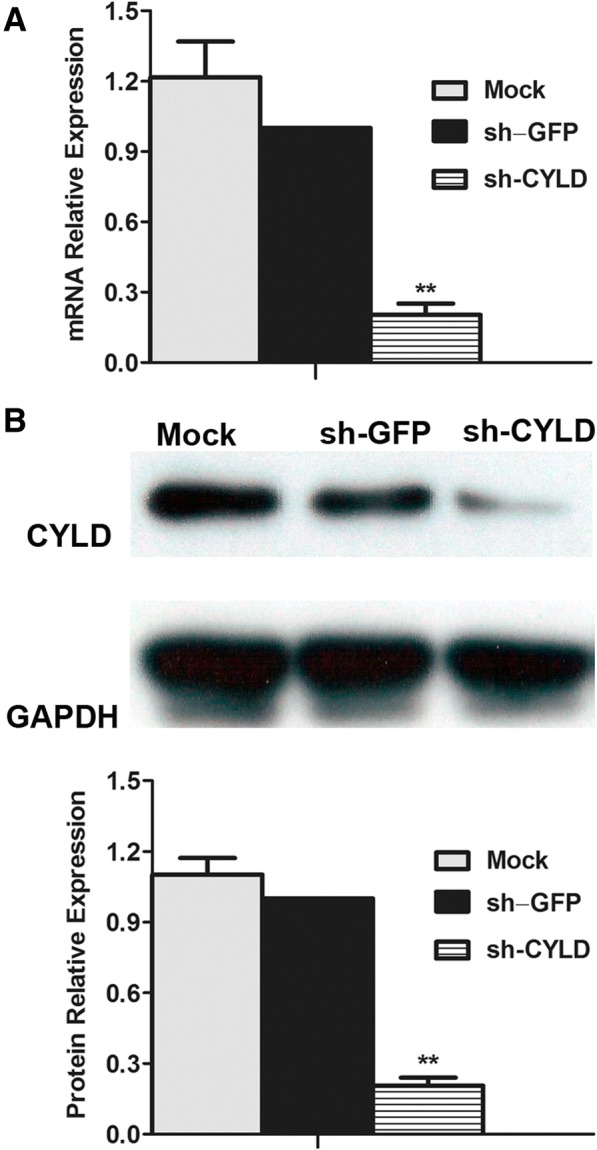
We obtained synovia from 50 patients with active RA and 20 with osteoarthritis (OA) and then cultured FLSs from the samples. We determined CYLD expression in the synovia of RA patients and in FLSs via reverse transcription polymerase chain reaction (RT-PCR). CYLD was depleted by lentiviral CYLD short hairpin ribonucleic acid. We used RT-PCR and enzyme-linked immunosorbent assay to analyze the expression of pro-inflammatory cytokines, matrix metalloproteinases (MMPs), and receptor activator of nuclear factor kappa-B ligand (RANKL). We detected cell proliferation using Cell Counting Kit-8 and examined cell apoptosis and cell cycle using flow cytometry.
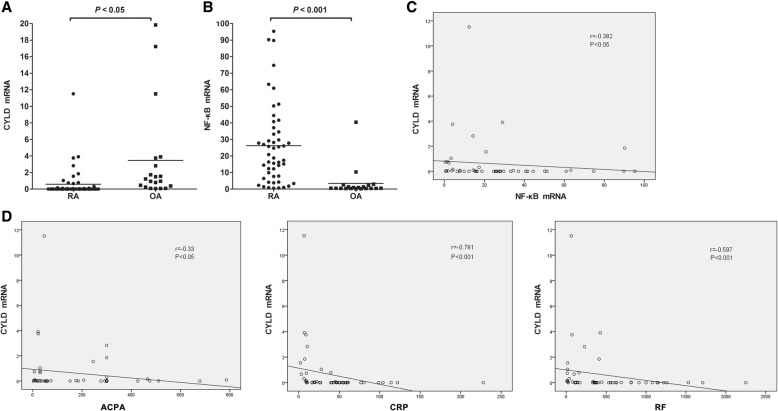
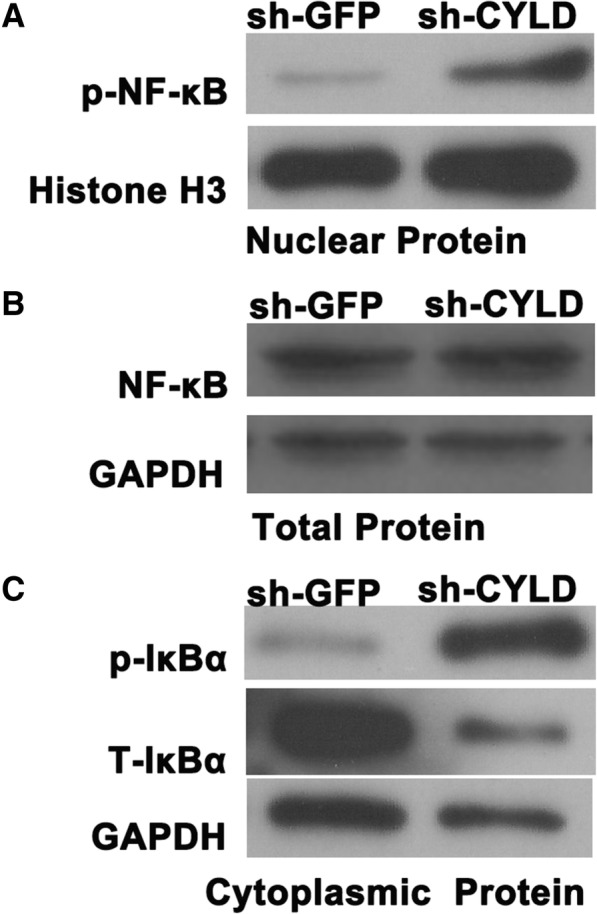
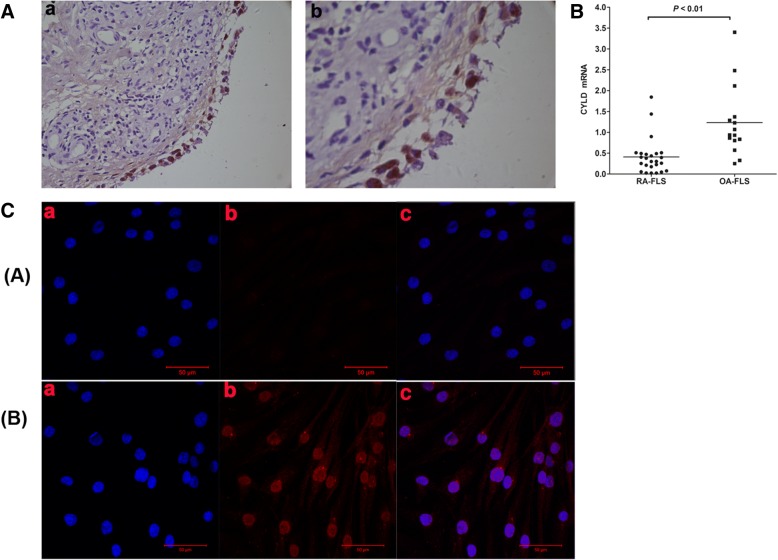
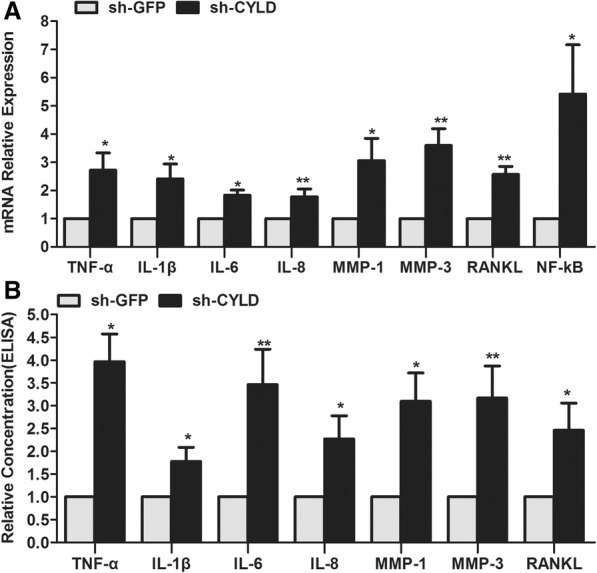
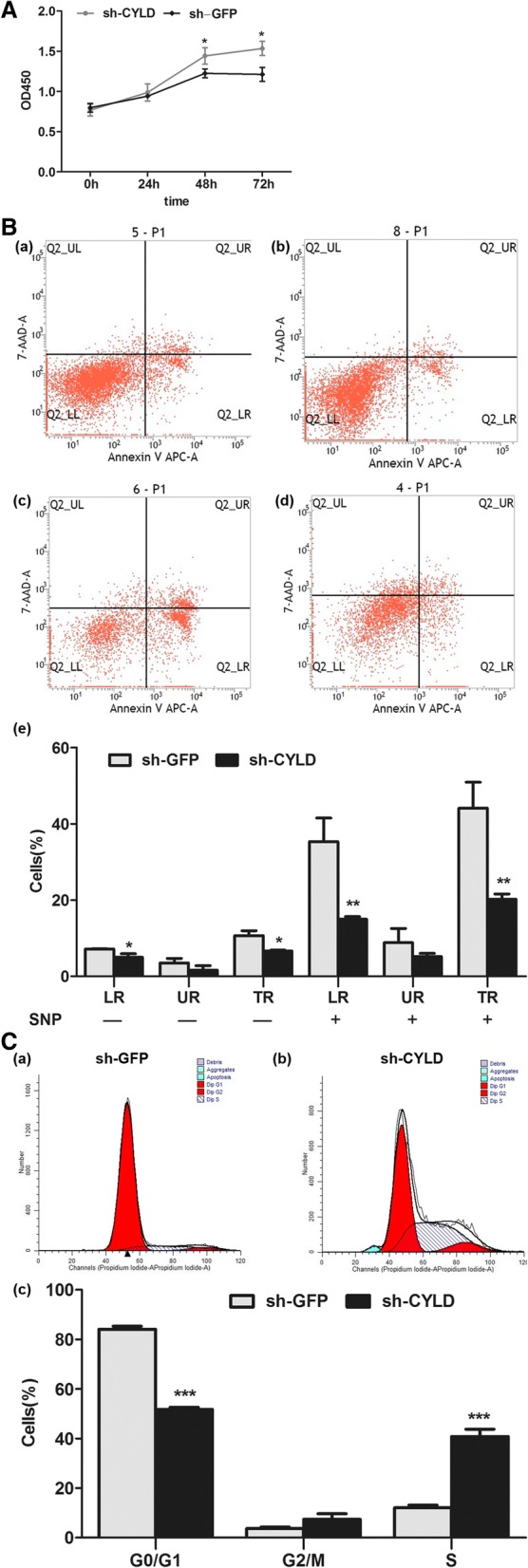
We obtained the following results: 1. In synovia from patients with RA, CYLD expression was significantly downregulated while NF-κB expression was distinctly upregulated, compared with synovia from patients with OA. Thus, there is a significant inverse correlation between CYLD and NF-κB in synovia affected by RA. 2. CYLD expression significantly decreased in RA-FLSs compared with OA-FLSs. 3. CYLD suppression enhanced the production of pro-inflammatory cytokines, MMPs, and RANKL by activating NF-κB in RA-FLSs. 4. CYLD suppression enhanced proliferation, reduced apoptosis, and increased cell division of RA-FLSs and aggravated the activity of NF-κB in RA-FLSs.
Via its regulation of NF-κB activation, CYLD may be involved in the pathogenesis of synovial inflammation in RA as well as in the pro-inflammatory effects and hyperproliferation of RA-FLSs. CYLD may therefore provide a potential target for the treatment of RA.
类风湿关节炎成纤维样滑膜细胞(RA-FLSs)通过产生炎症细胞因子和基质降解分子积极驱动关节炎症和降解,使其成为类风湿关节炎发病机制中的关键因素。Cylindromatosis(CYLD)是一种肿瘤抑制因子,通过去泛素化 NF-κB 必需调节剂和肿瘤坏死因子受体相关因子 2 和 6 下调核因子 κB 轻链增强子的激活。在这项研究中,我们旨在确定 CYLD 在 RA 患者滑膜中的表达,分析其与 NF-κB 激活和临床疾病活动的相关性,进一步研究 RA-FLSs 中的 CYLD 表达,并探讨 CYLD 在 RA-FLSs 的促炎作用、增殖、凋亡和细胞周期中的作用和机制。
我们从 50 例活动性 RA 患者和 20 例骨关节炎(OA)患者中获得滑膜,并从样本中培养 FLSs。我们通过逆转录聚合酶链反应(RT-PCR)确定 RA 患者滑膜和 FLSs 中的 CYLD 表达。通过慢病毒 CYLD 短发夹 RNA 耗尽 CYLD。我们使用 RT-PCR 和酶联免疫吸附试验分析促炎细胞因子、基质金属蛋白酶(MMPs)和核因子 κB 受体激活剂配体(RANKL)的表达。我们使用细胞计数试剂盒-8 检测细胞增殖,并通过流式细胞术检测细胞凋亡和细胞周期。
我们得到了以下结果:1. 在 RA 患者的滑膜中,与 OA 患者的滑膜相比,CYLD 的表达明显下调,而 NF-κB 的表达明显上调,因此,RA 滑膜中 CYLD 和 NF-κB 之间存在显著的负相关。2. CYLD 在 RA-FLSs 中的表达明显低于 OA-FLSs。3. CYLD 抑制通过激活 NF-κB 增强 RA-FLSs 中促炎细胞因子、MMPs 和 RANKL 的产生。4. CYLD 抑制增强 RA-FLSs 的增殖,减少凋亡,增加细胞分裂,并加重 RA-FLSs 中 NF-κB 的活性。
通过调节 NF-κB 的激活,CYLD 可能参与 RA 滑膜炎症的发病机制以及 RA-FLSs 的促炎作用和过度增殖。因此,CYLD 可能为 RA 的治疗提供一个潜在的靶点。