Zin Che Suraya, Nazar Nor Ilyani, Rahman Norny Syafinaz, Alias Nor Elina, Ahmad Wan Rohaidah, Rani Nurul Sahida, Cardosa Mary Suma, Ng Kim Swan, Ye Felicia Loh
Department of Pharmacy Practice, Kulliyah of Pharmacy, International Islamic University Malaysia, Kuantan, Malaysia,
Department of Anaesthesiology and Intensive Care, Hospital Sultanah Nur Zahirah, Kuala Terengganu, Malaysia.
J Pain Res. 2018 Sep 20;11:1959-1966. doi: 10.2147/JPR.S164774. eCollection 2018.
To examine the trends of analgesic prescribing at public tertiary hospital outpatient settings and explore the patterns of their utilization in nonsteroidal anti-inflammatory drugs (NSAIDs), tramadol, and opioid patients.
This cross-sectional study was conducted from 2010 to 2016 using the prescription databases of two tertiary hospitals in Malaysia. Prescriptions for nine NSAIDs (ketoprofen, diclofenac, celecoxib, etoricoxib, ibuprofen, indomethacin, meloxicam, mefenamic acid, and naproxen), tramadol, and five other opioids (morphine, fentanyl, oxycodone, dihydrocodeine, and buprenorphine) were included in this study. Annual number of patients and prescriptions were measured in repeat cross-sectional estimates. Descriptive statistics and linear trend analysis were performed using Stata version 13.
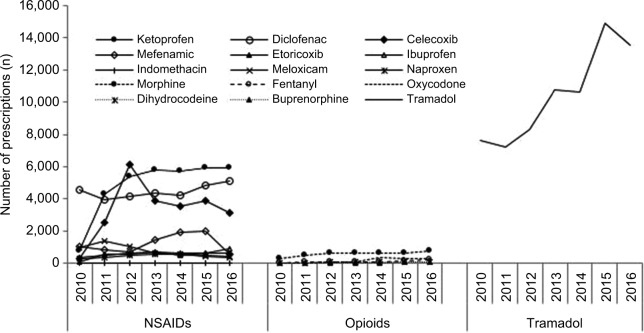
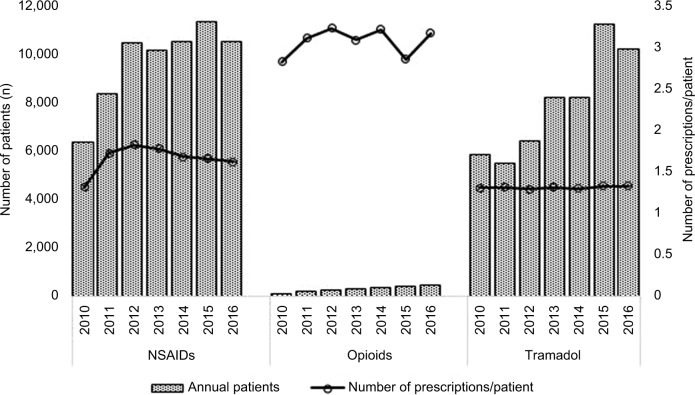
A total of 192,747 analgesic prescriptions of the nine NSAIDs, tramadol, and five other opioids were given for 97,227 patients (51.8% NSAIDs patients, 46.6% tramadol patients, and 1.7% opioid patients) from 2010 to 2016. Tramadol (37.9%, n=72,999) was the most frequently prescribed analgesic, followed by ketoprofen (17.5%, n=33,793), diclofenac (16.2%, n=31,180), celecoxib (12.2%, n=23,487), and other NSAIDs (<4.5%). All the analgesics were increased over time except meloxicam, indomethacin, and mefenamic acid. Opioids, primarily morphine (2.2%, n=4,021) and oxycodone (0.5%, n=1,049), were prescribed the least, but the rate of increase was the highest.
Tramadol was the most frequently prescribed analgesic in hospital outpatient settings in Malaysia. Opioids were prescribed the least, but noted the highest increase in utilization.
研究公立三级医院门诊镇痛药物的处方趋势,并探讨非甾体抗炎药(NSAIDs)、曲马多和阿片类药物患者的用药模式。
本横断面研究使用马来西亚两家三级医院的处方数据库,研究时间为2010年至2016年。本研究纳入了九种NSAIDs(酮洛芬、双氯芬酸、塞来昔布、依托考昔、布洛芬、吲哚美辛、美洛昔康、甲芬那酸和萘普生)、曲马多以及其他五种阿片类药物(吗啡、芬太尼、羟考酮、二氢可待因和丁丙诺啡)的处方。通过重复横断面估计来衡量每年的患者数量和处方数量。使用Stata 13版本进行描述性统计和线性趋势分析。
2010年至2016年期间,共为97227名患者开具了192747份九种NSAIDs、曲马多和其他五种阿片类药物的镇痛处方(NSAIDs患者占51.8%,曲马多患者占46.6%,阿片类药物患者占1.7%)。曲马多(37.9%,n = 72999)是最常开具的镇痛药物,其次是酮洛芬(17.5%,n = 33793)、双氯芬酸(16.2%,n = 31180)、塞来昔布(12.2%,n = 23487)和其他NSAIDs(<4.5%)。除美洛昔康、吲哚美辛和甲芬那酸外,所有镇痛药物的使用量均随时间增加。阿片类药物,主要是吗啡(2.2%,n = 4021)和羟考酮(0.5%,n = 1049),开具量最少,但增加率最高。
曲马多是马来西亚医院门诊最常开具的镇痛药物。阿片类药物开具量最少,但使用量增加率最高。