Department of Endocrinology, Nanjing First Hospital, Nanjing Medical University, Nanjing, Jiangsu, China (mainland).
Department of Endocrinology, Nanjing First Hospital, Nanjing Medical University, Nanjing, China (mainland).
Med Sci Monit. 2018 Oct 8;24:7170-7177. doi: 10.12659/MSM.910827.
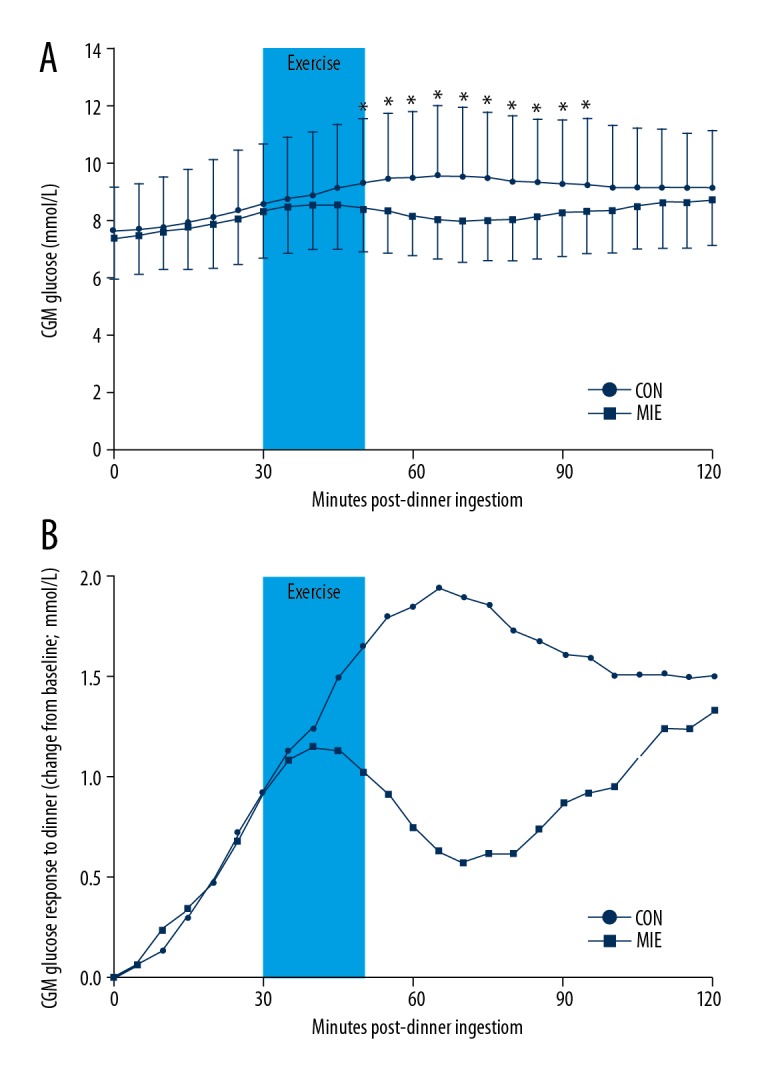
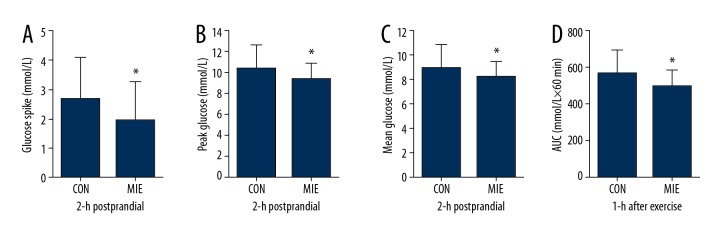
BACKGROUND Postprandial hyperglycemia and glycemic fluctuations are significant cardiovascular disease risk factors for patients with type 2 diabetes. We investigated the effects of a single session of post-dinner moderate-intensity exercise on the postprandial glycemic response compared with a non-exercise condition in a study population of Chinese patients with type 2 diabetes. MATERIAL AND METHODS This randomized crossover self-controlled pilot study involved 29 patients with type 2 diabetes who participated in post-dinner exercise days using non-exercise days as a control. The interstitial glucose level was monitored using a continuous glucose monitoring system, with a standardized diet and medication. For the non-exercise control days, patients pursued normal daily activities but refrained from unusual strenuous physical activity. On the exercise days, participants walked on a treadmill for 20 minutes after dinner, with a heart rate reserve of 40%. RESULTS Post-dinner moderate-intensity exercise reduced the 2-hour postprandial glucose spike, mean glucose level, and peak glucose level compared to the control condition. The cumulative glucose total area under the curve during 1-hour post-exercise was lower with exercise than under the control condition. The 12-hour standard deviation of blood glucose and the coefficient variation of glucose were significantly lower in the with exercise day compared to the control day, although the 12-hour mean amplitude of glycemic fluctuations did not reach statistical significance. No nocturnal hypoglycemia subsequently occurred on the exercise day. CONCLUSIONS A short session of moderate-intensity post-dinner exercise can improve postprandial hyperglycemia and glycemic excursions in Chinese patients with type 2 diabetes, with no potential hypoglycemia risk at a later period.
餐后高血糖和血糖波动是 2 型糖尿病患者发生心血管疾病的重要危险因素。我们研究了单次晚餐后中等强度运动与 2 型糖尿病中国患者非运动状态相比对餐后血糖反应的影响。
这是一项随机交叉自身对照的初步研究,共纳入 29 例 2 型糖尿病患者,他们在晚餐后进行运动,以非运动日作为对照。采用连续血糖监测系统监测间质血糖水平,同时给予标准化饮食和药物治疗。在非运动对照日,患者进行正常的日常活动,但避免剧烈的体力活动。在运动日,患者在晚餐后进行 20 分钟的跑步机运动,达到心率储备 40%。
与对照条件相比,晚餐后中等强度运动降低了 2 小时餐后血糖峰值、平均血糖水平和峰值血糖水平。与对照条件相比,运动后 1 小时内的累积血糖总曲线下面积较低。与对照日相比,运动日的 12 小时血糖标准差和血糖变异系数显著降低,尽管 12 小时血糖波动平均幅度没有达到统计学意义。运动日没有发生夜间低血糖。
短暂的晚餐后中等强度运动可以改善中国 2 型糖尿病患者的餐后高血糖和血糖波动,后期没有潜在的低血糖风险。