Department of Psychiatry and Behavioral Sciences, Memorial Sloan Kettering Cancer Center, New York, New York, USA.
Joan Karnell Cancer Center, Pennsylvania Hospital, Philadelphia, Pennsylvania, USA.
Psychooncology. 2019 Jan;28(1):39-47. doi: 10.1002/pon.4907. Epub 2018 Nov 7.
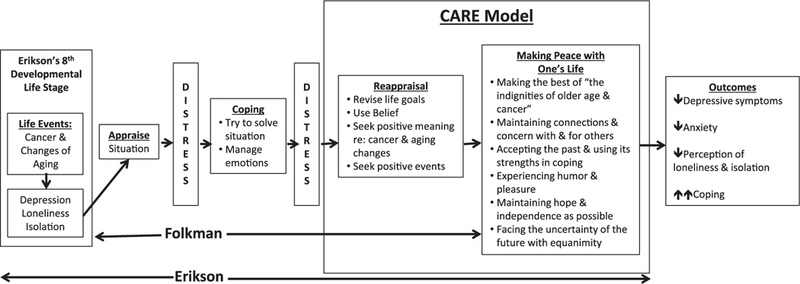
Cancer and Aging: Reflections for Elders (CARE) is a novel, telephone-delivered intervention designed to alleviate distress in older cancer patients. This pilot randomized controlled trial tested the feasibility and initial efficacy of CARE, drawing from age-appropriate developmental themes and well-established coping theory.
Eligible patients were ≥70 years old; ≥6 months post-diagnosis of lung, prostate, breast, lymphoma, or gynecological cancer; on active cancer treatment or within 6 months of ending cancer treatment; and had elevated scores on the Distress Thermometer (≥4) or Hospital Anxiety and Depression Scale (≥6). Participants completed five sessions of psychotherapy over 7 weeks with assessments at study entry, post-intervention, and 2 months post-intervention. Primary outcomes were feasibility and initial efficacy on anxiety and depression; secondary outcomes included demoralization, coping, loneliness, and spiritual well-being.
Fifty-nine participants were randomized to either the CARE arm (n = 31) or the enhanced Social Work Control arm (n = 28). The intervention was feasible and tolerable, meeting a priori criteria for rates of eligibility, acceptance, retention, assessment, and treatment fidelity. Upon completion of the intervention, participants in the CARE arm demonstrated lower mean depression scores (d = 0.58 [CI: 0.04-1.12], P = 0.01) and trended towards increased coping-planning (d = 0.30 [CI: -0.83 to 0.24], P = 0.18). Promising trends in anxiety (d = 0.41 [CI: -0.17 to 0.98], P = 0.10) emerged at 2 months post-intervention; effects for coping-planning dissipated.
These pilot data suggest the CARE intervention is feasibly delivered, potentially impacts important psychosocial variables, and is accessible for older, frail patients with cancer. Future research will evaluate this intervention on a larger scale.
癌症与衰老:老年人的反思(CARE)是一种新颖的、通过电话传递的干预措施,旨在减轻老年癌症患者的痛苦。这项试点随机对照试验测试了 CARE 的可行性和初步疗效,其借鉴了适合年龄的发展主题和成熟的应对理论。
符合条件的患者年龄≥70 岁;肺癌、前列腺癌、乳腺癌、淋巴瘤或妇科癌症诊断后≥6 个月;正在接受癌症治疗或在结束癌症治疗后 6 个月内;且在痛苦温度计(≥4)或医院焦虑和抑郁量表(≥6)上得分较高。参与者在 7 周内完成了 5 次心理治疗,在研究开始时、干预后和干预后 2 个月进行评估。主要结局是焦虑和抑郁的可行性和初步疗效;次要结局包括意志消沉、应对、孤独和精神健康。
59 名参与者被随机分配到 CARE 组(n=31)或强化社会工作对照组(n=28)。该干预措施是可行且可耐受的,符合事先规定的入选率、接受率、保留率、评估和治疗保真度标准。干预完成后,CARE 组的参与者抑郁评分平均较低(d=0.58 [CI:0.04-1.12],P=0.01),且应对计划的趋势有所增加(d=0.30 [CI:-0.83 至 0.24],P=0.18)。干预后 2 个月时,焦虑出现了有希望的趋势(d=0.41 [CI:-0.17 至 0.98],P=0.10);应对计划的效果消失。
这些初步数据表明,CARE 干预措施可行,可能会影响重要的社会心理变量,并且适合患有癌症的年老体弱患者。未来的研究将在更大规模上评估该干预措施。