Liu Yanchun, Yang Xuelian, Li Jingjing, Kou Erhu, Tian Huidong, Huang Heqing
College of Education Science, Hubei Normal University, Huangshi, China.
Wuhan Sports University, Wuhan, China.
Front Psychol. 2018 Sep 21;9:1819. doi: 10.3389/fpsyg.2018.01819. eCollection 2018.
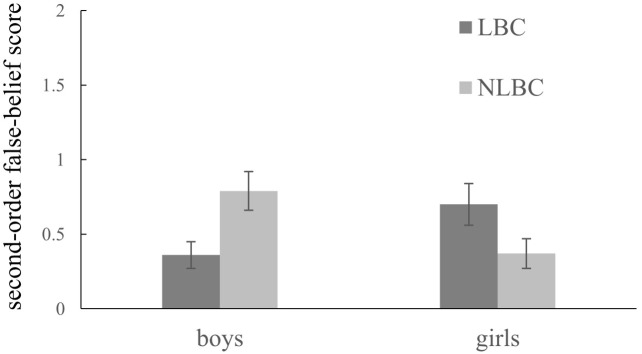
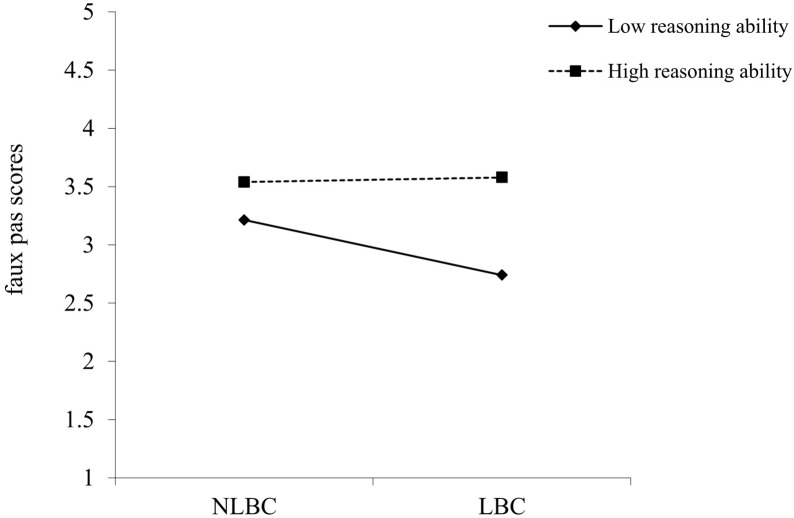
The current study aimed to investigate differences in theory of mind between left-behind children and non-left-behind children in rural China and to examine the potential protective role of general reasoning ability in left-behind children's theory of mind. Participants included 213 children aged 7.10-13.67 years (111 boys and 102 girls, = 10.51 years, = 1.33), 101 of whom were left behind in rural areas by one or both migrating parents for at least 6 months. The Strange Stories task, a second-order false belief task, and a faux pas task were used to measure children's theory of mind, and Sessions B and C in Raven's Standard Progressive Matrices were used to test children's general reasoning ability. The results showed that left-behind children scored lower on both the faux pas task and Strange Stories task. Additionally, on second-order false belief understanding, left-behind boys performed worse than non-left-behind boys, while left-behind girls scored higher than non-left behind girls. Moreover, children's general reasoning ability moderated the relationship between parental migrant status and children's faux pas understanding: For children with high levels of general reasoning ability, left-behind children performed similarly to non-left-behind children, while for children with low levels of general reasoning ability, left-behind children scored lower than non-left-behind children, indicating that general reasoning ability buffered the negative effect of being left behind on children's theory of mind development. The implications of these findings for training directed at left-behind children are discussed.
本研究旨在调查中国农村留守儿童与非留守儿童心理理论的差异,并检验一般推理能力在留守儿童心理理论中的潜在保护作用。研究参与者包括213名年龄在7.10至13.67岁之间的儿童(111名男孩和102名女孩,平均年龄 = 10.51岁,标准差 = 1.33),其中101名儿童的父母一方或双方外出打工,将他们留在农村至少6个月。采用意外故事任务、二阶错误信念任务和失礼任务来测量儿童的心理理论,并使用瑞文标准推理测验的B套和C套来测试儿童的一般推理能力。结果表明,留守儿童在失礼任务和意外故事任务上的得分较低。此外,在二阶错误信念理解方面,留守男孩的表现比非留守男孩差,而留守女孩的得分高于非留守女孩。此外,儿童的一般推理能力调节了父母外出务工状况与儿童失礼理解之间的关系:对于一般推理能力较高的儿童,留守儿童的表现与非留守儿童相似;而对于一般推理能力较低的儿童,留守儿童的得分低于非留守儿童,这表明一般推理能力缓冲了留守对儿童心理理论发展的负面影响。本文讨论了这些研究结果对留守儿童培训的启示。