Mayer Jürgen, Robert-Moreno Alexandre, Sharpe James, Swoger Jim
1Centre for Genomic Regulation (CRG), The Barcelona Institute of Science and Technology, Dr. Aiguader 88, 08003 Barcelona, Spain.
2Universitat Pompeu Fabra (UPF), Barcelona, Spain.
Light Sci Appl. 2018 Oct 3;7:70. doi: 10.1038/s41377-018-0068-z. eCollection 2018.
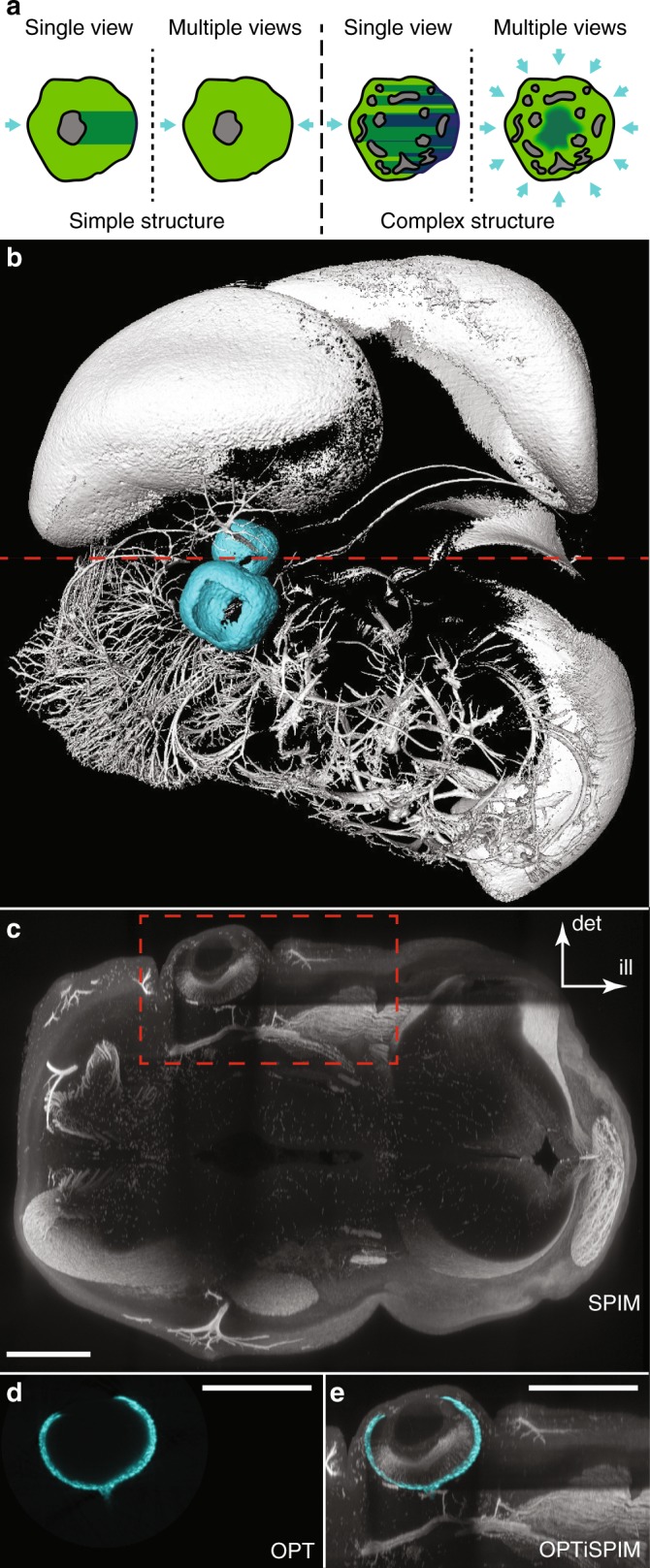
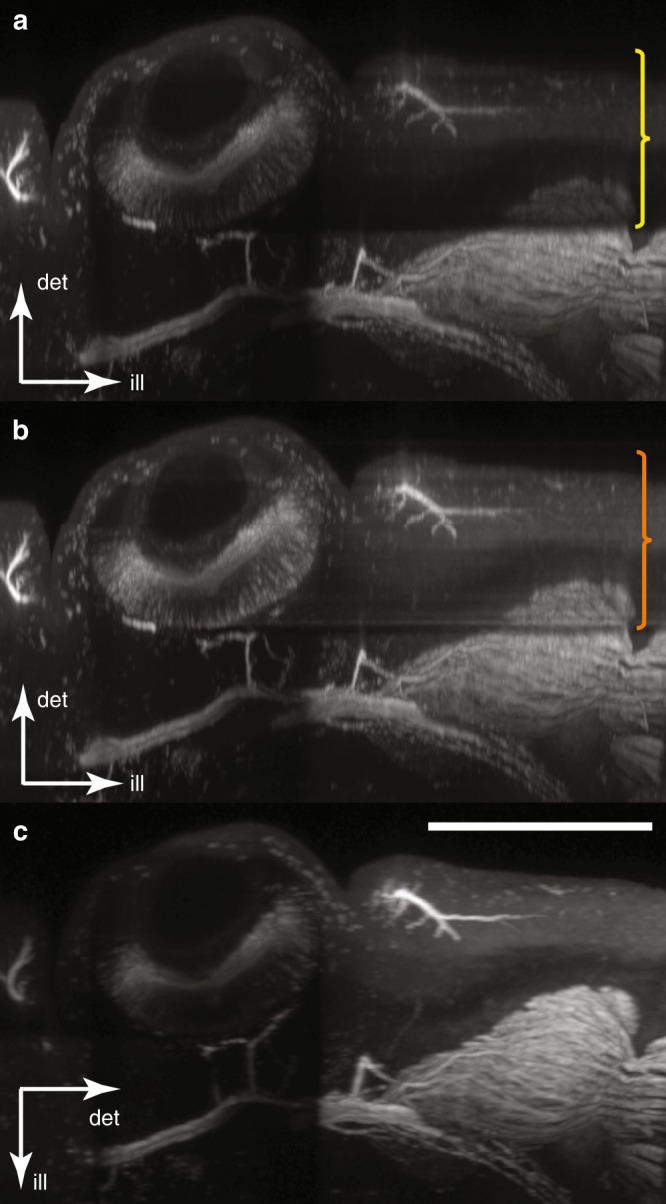
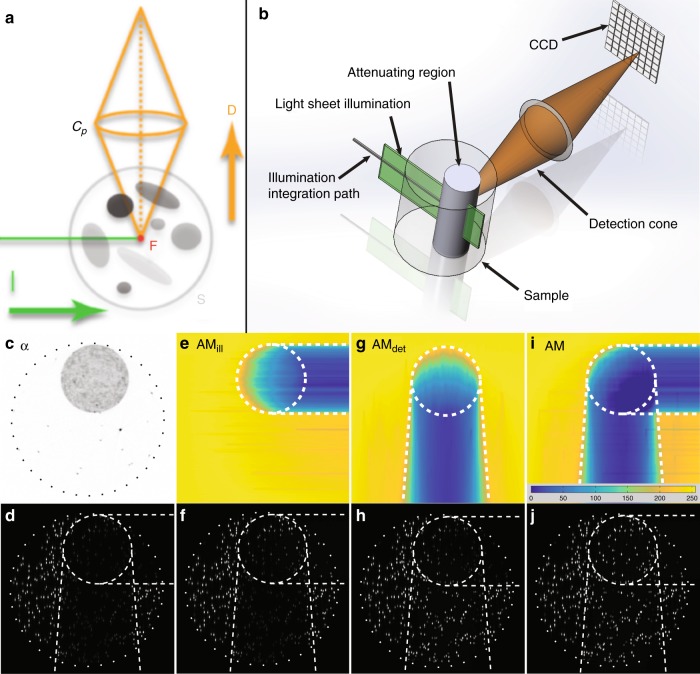
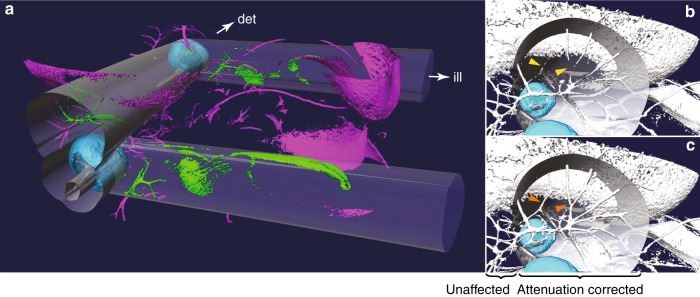
Light sheet fluorescence microscopy (LSFM) is rapidly becoming an essential technology for mesoscopic imaging of samples such as embryos and adult mouse organs. However, LSFM can suffer from optical artifacts for which there is no intrinsic solution. The attenuation of light due to absorbing material causes "shadow" artifacts along both the illumination and detection paths. Several approaches have been introduced to reduce this problem, including scanning illumination and multi-view imaging. However, neither of these approaches completely eliminates the problem. If the distribution of the absorbing material is complex, shadows cannot be avoided. We introduce a new approach that relies on multi-modal integration of two very different mesoscopic techniques. Unlike LSFM, optical projection tomography (OPT) can operate in transmission mode to create a voxel map of the 3D distribution of the sample's optical attenuation. Here, we demonstrate a hybrid instrument (OPTiSPIM) that can quantify this attenuation and use the information to correct the shadow artifacts of LSFM.
光片荧光显微镜(LSFM)正迅速成为用于对胚胎和成年小鼠器官等样本进行介观成像的一项关键技术。然而,LSFM可能会出现光学伪像,对此尚无内在的解决办法。由于吸收材料导致的光衰减会在照明路径和检测路径上产生“阴影”伪像。已经引入了几种方法来减少这个问题,包括扫描照明和多视图成像。然而,这些方法都不能完全消除该问题。如果吸收材料的分布复杂,阴影就无法避免。我们引入了一种新方法,该方法依赖于两种截然不同的介观技术的多模态整合。与LSFM不同,光学投影断层扫描(OPT)可以在透射模式下运行,以创建样本光学衰减三维分布的体素图。在此,我们展示了一种混合仪器(OPTiSPIM),它可以量化这种衰减,并利用该信息校正LSFM的阴影伪像。