Mitthamsiri Wat, Pradubpongsa Panitan, Sangasapaviliya Atik, Boonpiyathad Tadech
Division of Allergy and Clinical Immunology, Department of Medicine, Phramongkutklao Hospital, Bangkok, Thailand.
Allergy Asthma Immunol Res. 2018 Nov;10(6):662-674. doi: 10.4168/aair.2018.10.6.662.
Group 2 innate lymphoid cells (ILC2s) have been implicated in the pathogenesis of allergic disease. However, the effect of allergen-specific immunotherapy (AIT) on ILCs remains to be clarified. The aim of this study was to evaluate the levels of ILC subsets in allergic rhinitis (AR) patients in response to house dust mite (HDM)-specific immunotherapy.
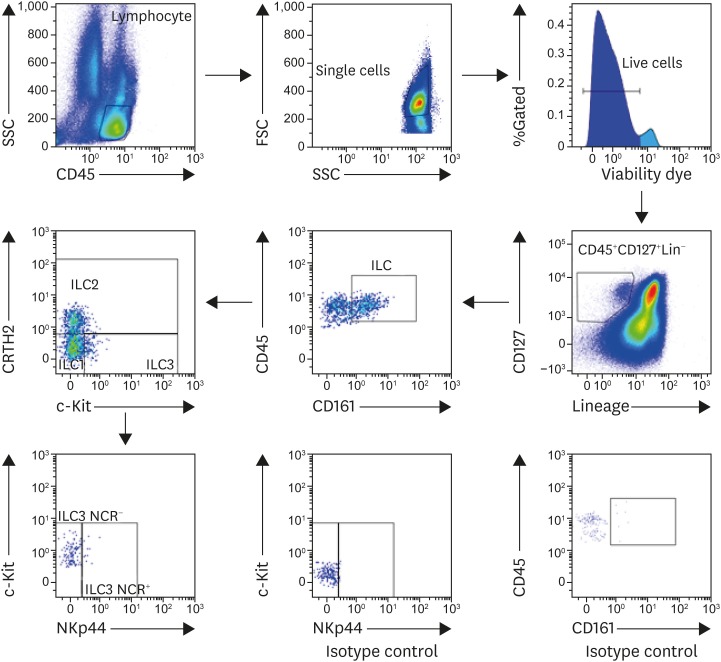
We enrolled 37 AR patients undergoing AIT (16 responders and 11 non-responders) for 2 years, 35 HDM AR patients and 28 healthy subjects. Peripheral blood mononuclear cells (PBMCs) were analyzed by flow cytometry to identify ILC subsets. Stimulation of ILC2s with recombinant allergen-specific protein was used to determine ILC2's activation (CD69 expression).
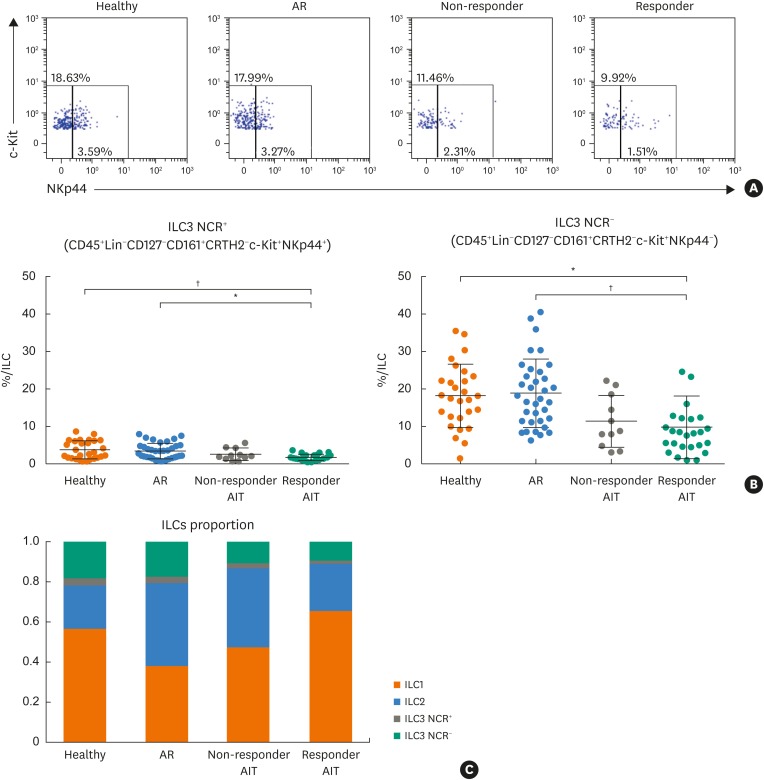
Responder AIT patients and healthy subjects had a decreased frequency of circulating ILC2s compared to non-responder AIT and AR patients. Conversely, ILC1s from responder AIT patients and healthy subjects showed increased frequency compared to non-responder AIT and AR patients. The frequency of ILC3s natural cytotoxicity receptor (NCR)⁺ and NCR⁻ in responder AIT patients was significantly lower compared to AR patients and healthy subjects. The ILC1: ILC2 proportion in responder AIT patients was similar to that of healthy subjects. PBMCs from patients who were responders to AIT had a significantly lower expression of the activation marker CD69 on ILC2s in response to allergen re-stimulation compared to AR patients, but no difference compared to non-responder AIT patients and healthy subjects.
We propose that AIT might affect ILC responses. The activation of ILC2s was reduced in AR patients treated with AIT. Our results indicate that a relative ILC1/ILC2 skewed response is a possible key to successful AIT.
2型固有淋巴细胞(ILC2s)与过敏性疾病的发病机制有关。然而,变应原特异性免疫疗法(AIT)对固有淋巴细胞的影响仍有待阐明。本研究的目的是评估过敏性鼻炎(AR)患者在接受屋尘螨(HDM)特异性免疫疗法后固有淋巴细胞亚群的水平。
我们招募了37名接受AIT治疗2年的AR患者(16名有反应者和11名无反应者)、35名HDM AR患者和28名健康受试者。通过流式细胞术分析外周血单个核细胞(PBMC)以鉴定固有淋巴细胞亚群。用重组变应原特异性蛋白刺激ILC2s以确定ILC2的活化(CD69表达)。
与无反应的AIT患者和AR患者相比,有反应的AIT患者和健康受试者循环ILC2s的频率降低。相反,与无反应的AIT患者和AR患者相比,有反应的AIT患者和健康受试者的ILC1s频率增加。与AR患者和健康受试者相比,有反应的AIT患者中ILC3s自然细胞毒性受体(NCR)⁺和NCR⁻的频率显著降低。有反应的AIT患者中ILC1:ILC2的比例与健康受试者相似。与AR患者相比,对AIT有反应的患者的PBMC在变应原再刺激后ILC2s上活化标志物CD69的表达显著降低,但与无反应的AIT患者和健康受试者相比无差异。
我们认为AIT可能会影响固有淋巴细胞反应。接受AIT治疗的AR患者中ILC2s的活化减少。我们的结果表明,相对的ILC1/ILC2偏倚反应可能是AIT成功的关键。