1Department of Agricultural Structure and Bioenvironmental Engineering,College of Water Resources and Civil Engineering,China Agricultural University,Beijing 100083,China.
3Department of Agricultural and Biological Engineering,Mississippi State University,Mississippi,MS 39762, USA.
Animal. 2019 Jun;13(6):1245-1251. doi: 10.1017/S1751731118002537. Epub 2018 Oct 12.
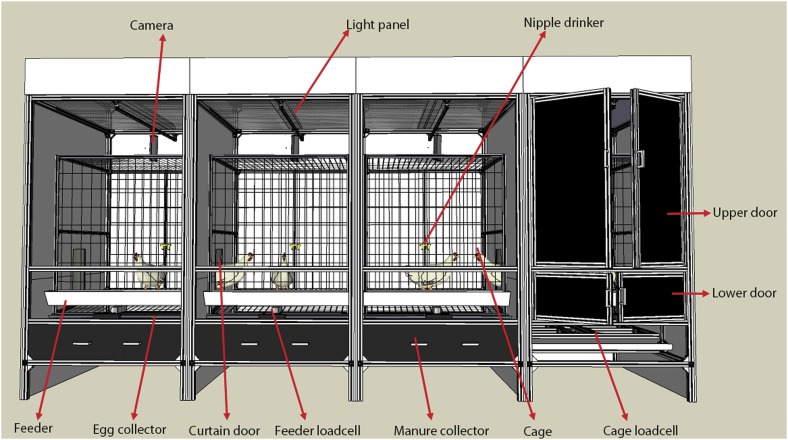
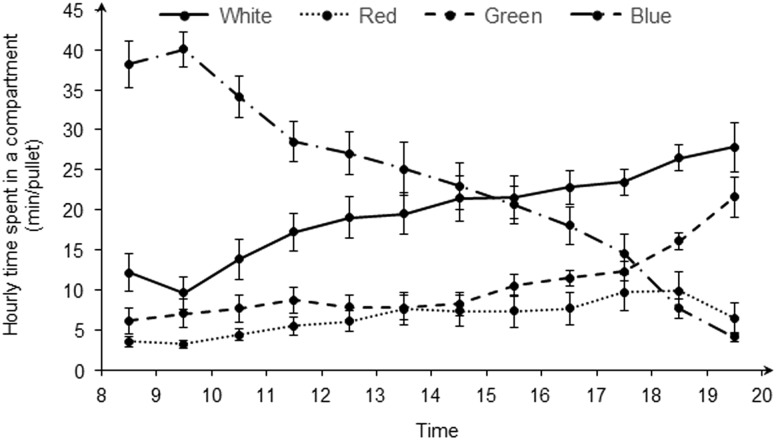
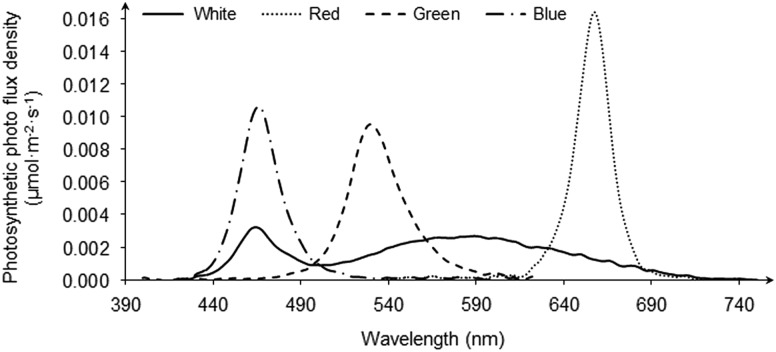
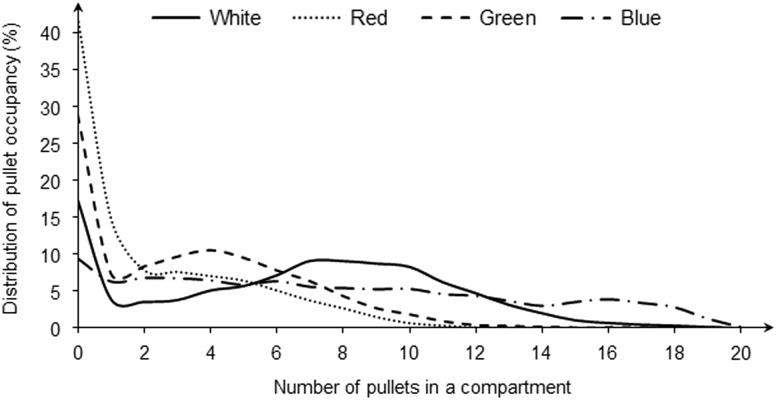
Light colors may affect poultry behaviors, well-being and performance. However, preferences of layer pullets for light colors are not fully understood. This study was conducted to investigate the pullet preferences for four light-emitting diode colors, including white, red, green and blue, in a lighting preference test system. The system contained four identical compartments each provided with a respective light color. The pullets were able to move freely between the adjacent compartments. A total of three groups of 20 Chinese domestic Jingfen layer pullets (54 to 82 days of age) were used for the test. Pullet behaviors were continuously recorded and summarized for each light color/compartment into daily time spent (DTS), daily percentage of time spent (DPTS), daily times of visit (DTV), duration per visit, daily feed intake (DFI), daily feeding time (DFT), feeding rate (FR), distribution of pullet occupancy and hourly time spent. The results showed that the DTS (h/pullet·per day) were 3.9±0.4 under white, 1.4±0.3 under red, 2.2±0.3 under green and 4.5±0.4 under blue light, respectively. The DTS corresponded to 11.7% to 37.6% DPTS in 12-h lighting periods. The DTV (times/pullet·per day) were 84±5 under white, 48±10 under red, 88±10 under green and 94±8 under blue light. Each visit lasted 1.5 to 3.2 min. The DFI (g/pullet·per day) were 27.6±1.7 under white, 7.1±1.6 under red, 15.1±1.1 under green and 23.1±2.0 under blue light. The DFT was 0.18 to 0.65 h/pullet·per day and the FR was 0.57 to 0.75 g/min. For most of the time during the lighting periods, six to 10 birds stayed under white, and one to five birds stayed under red, green and blue light. Pullets preferred to stay under blue light when the light was on and under white light 4 h before the light off. Overall, pullets preferred blue light the most and red light the least. These findings substantiate the preferences of layer pullets for light colors, providing insights for use in the management of light-emitting diode colors to meet pullet needs.
浅色可能会影响家禽的行为、福利和性能。然而,母鸡对浅色的偏好还不完全清楚。本研究旨在通过光照偏好测试系统,调查母鸡对四种发光二极管颜色(白色、红色、绿色和蓝色)的偏好。该系统包含四个相同的隔室,每个隔室提供一种相应的光色。母鸡可以在相邻的隔室之间自由移动。共有三组 20 只中国本地京粉蛋鸡(54-82 日龄)用于测试。连续记录母鸡在每种光色/隔室的行为,并总结为每日停留时间(DTS)、每日停留时间百分比(DPTS)、每日访问次数(DTV)、每次访问持续时间、每日采食量(DFI)、每日采食时间(DFT)、采食率(FR)、母鸡占用分布和每小时停留时间。结果表明,白色光下的 DTS(h/只·天)为 3.9±0.4,红色光下为 1.4±0.3,绿色光下为 2.2±0.3,蓝色光下为 4.5±0.4。在 12 小时光照周期中,DTS 对应 DPTS 的 11.7%至 37.6%。白色光下的 DTV(次/只·天)为 84±5,红色光下为 48±10,绿色光下为 88±10,蓝色光下为 94±8。每次访问持续 1.5 至 3.2 分钟。白色光下的 DFI(g/只·天)为 27.6±1.7,红色光下为 7.1±1.6,绿色光下为 15.1±1.1,蓝色光下为 23.1±2.0。DFT 为 0.18 至 0.65 h/只·天,FR 为 0.57 至 0.75 g/min。在光照期间的大部分时间里,6 到 10 只鸡停留在白色光下,1 到 5 只鸡停留在红色、绿色和蓝色光下。母鸡在光照时更喜欢停留在蓝色光下,在光照关闭前 4 小时更喜欢停留在白色光下。总的来说,母鸡最喜欢蓝色光,最不喜欢红色光。这些发现证实了母鸡对光色的偏好,为满足母鸡的需求,在管理发光二极管颜色方面提供了参考。