Faculty of Chemistry, Biotechnology and Food Science, Norwegian University of Life Sciences, Ås, 1432, Norway.
Architecture et Fonction des Macromolécules Biologiques, CNRS, Aix-Marseille Université, Marseille, F-13288, France.
ISME J. 2019 Mar;13(3):603-617. doi: 10.1038/s41396-018-0290-y. Epub 2018 Oct 12.
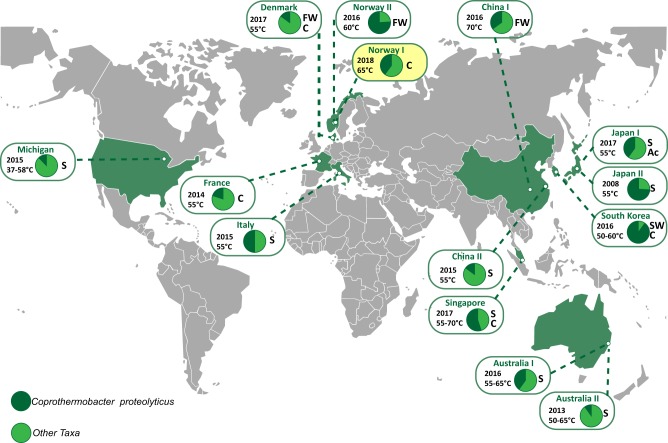
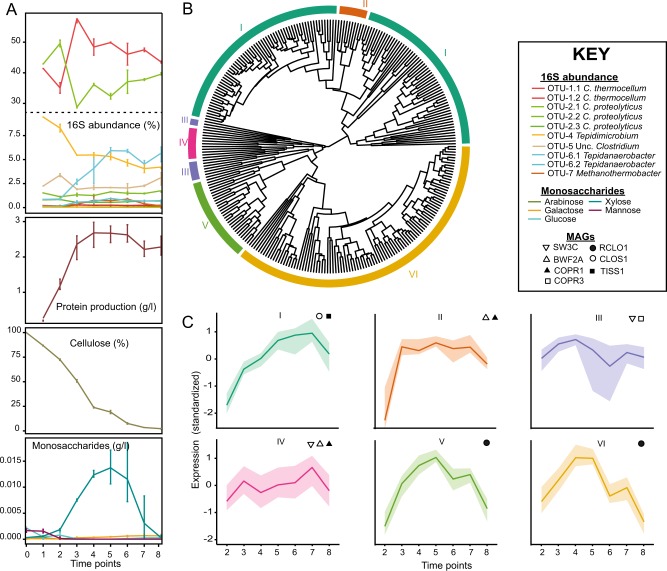
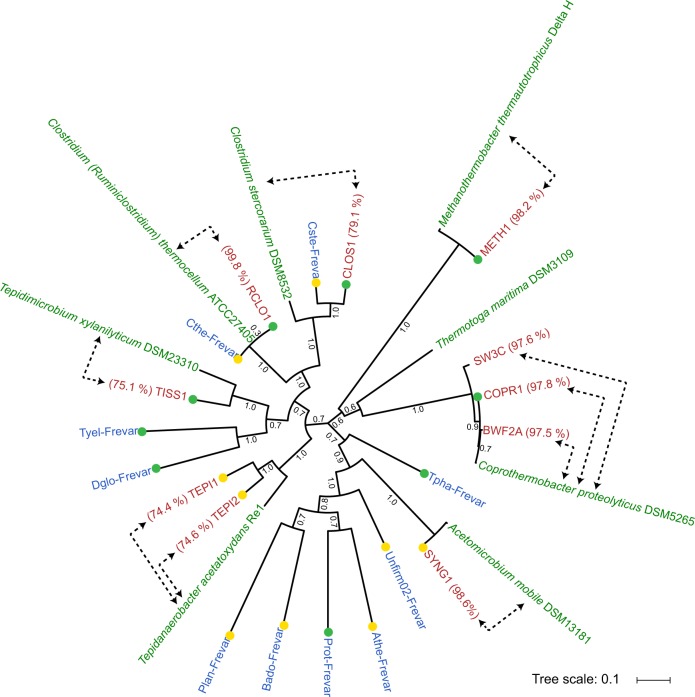
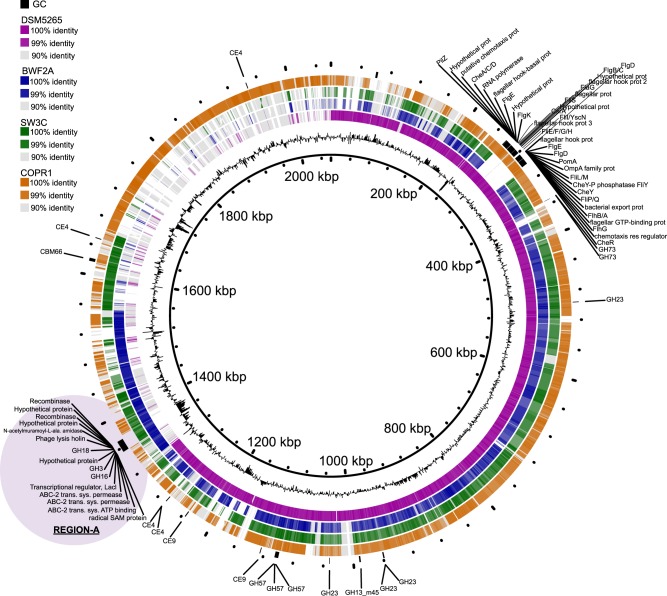
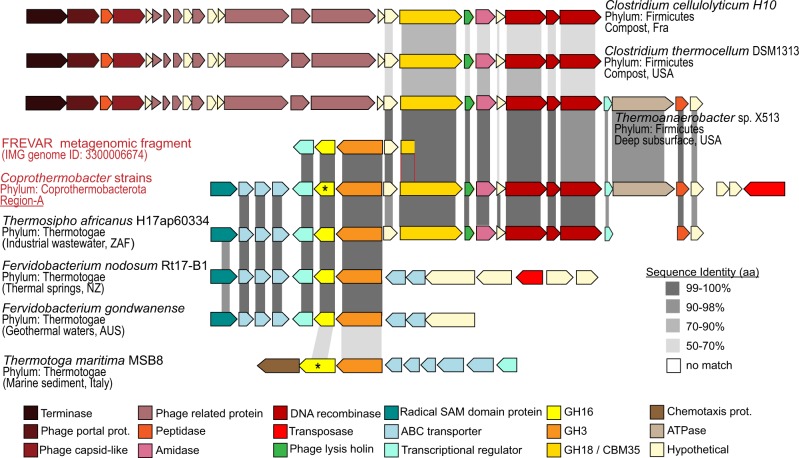
Microbial communities that degrade lignocellulosic biomass are typified by high levels of species- and strain-level complexity, as well as synergistic interactions between both cellulolytic and non-cellulolytic microorganisms. Coprothermobacter proteolyticus frequently dominates thermophilic, lignocellulose-degrading communities with wide geographical distribution, which is in contrast to reports that it ferments proteinaceous substrates and is incapable of polysaccharide hydrolysis. Here we deconvolute a highly efficient cellulose-degrading consortium (SEM1b) that is co-dominated by Clostridium (Ruminiclostridium) thermocellum and multiple heterogenic strains affiliated to C. proteolyticus. Metagenomic analysis of SEM1b recovered metagenome-assembled genomes (MAGs) for each constituent population, whereas in parallel two novel strains of C. proteolyticus were successfully isolated and sequenced. Annotation of all C. proteolyticus genotypes (two strains and one MAG) revealed their genetic acquisition of carbohydrate-active enzymes (CAZymes), presumably derived from horizontal gene transfer (HGT) events involving polysaccharide-degrading Firmicutes or Thermotogae-affiliated populations that are historically co-located. HGT material included a saccharolytic operon, from which a CAZyme was biochemically characterized and demonstrated hydrolysis of multiple hemicellulose polysaccharides. Finally, temporal genome-resolved metatranscriptomic analysis of SEM1b revealed expression of C. proteolyticus CAZymes at different SEM1b life stages as well as co-expression of CAZymes from multiple SEM1b populations, inferring deeper microbial interactions that are dedicated toward community degradation of cellulose and hemicellulose. We show that C. proteolyticus, a ubiquitous population, consists of closely related strains that have adapted via HGT to presumably degrade both oligo- and longer polysaccharides present in decaying plants and microbial cell walls, thus explaining its dominance in thermophilic anaerobic digesters on a global scale.
能够降解木质纤维素生物质的微生物群落的特点是具有高水平的物种和菌株复杂性,以及纤维素分解菌和非纤维素分解菌之间的协同相互作用。Coprothermobacter proteolyticus 广泛分布于嗜热、木质纤维素降解群落中,通常占据主导地位,这与它发酵蛋白类底物且不能水解多糖的报道形成了鲜明对比。在这里,我们对一个高效的纤维素降解共生体(SEM1b)进行了剖析,该共生体由 Clostridium (Ruminiclostridium) thermocellum 和多个属于 C. proteolyticus 的异质菌株共同主导。对 SEM1b 的宏基因组分析回收了每个组成种群的宏基因组组装基因组(MAG),同时平行成功分离并测序了两个新的 C. proteolyticus 菌株。对所有 C. proteolyticus 基因型(两个菌株和一个 MAG)的注释揭示了它们遗传获得了碳水化合物活性酶(CAZymes),这些酶可能源自涉及多糖降解的 Firmicutes 或 Thermotogae 相关种群的水平基因转移(HGT)事件,这些种群在历史上是共存的。HGT 物质包括一个糖化酶操纵子,从中生化表征了一种 CAZyme,并证明了它能够水解多种半纤维素多糖。最后,对 SEM1b 的时间分辨的宏转录组分析揭示了 C. proteolyticus 在 SEM1b 不同生命阶段的 CAZyme 表达,以及来自多个 SEM1b 种群的 CAZyme 的共表达,推断出更深层次的微生物相互作用,这些相互作用专门用于社区降解纤维素和半纤维素。我们表明,C. proteolyticus 是一种普遍存在的种群,由密切相关的菌株组成,这些菌株通过 HGT 适应了可能降解植物和微生物细胞壁中存在的寡糖和较长多糖的能力,从而解释了它在全球范围内在嗜热厌氧消化器中占据主导地位的原因。