Mulligan Megan K, Zhao Wenyuan, Dickerson Morgan, Arends Danny, Prins Pjotr, Cavigelli Sonia A, Terenina Elena, Mormede Pierre, Lu Lu, Jones Byron C
Department of Genetics, Genomics, and Informatics, The University of Tennessee Health Science Center, Memphis, TN, United States.
Albrecht Daniel Thaer-Institut für Agrar- und Gartenbauwissenschaften, Humboldt-Universität zu Berlin, Berlin, Germany.
Front Genet. 2018 Sep 25;9:370. doi: 10.3389/fgene.2018.00370. eCollection 2018.
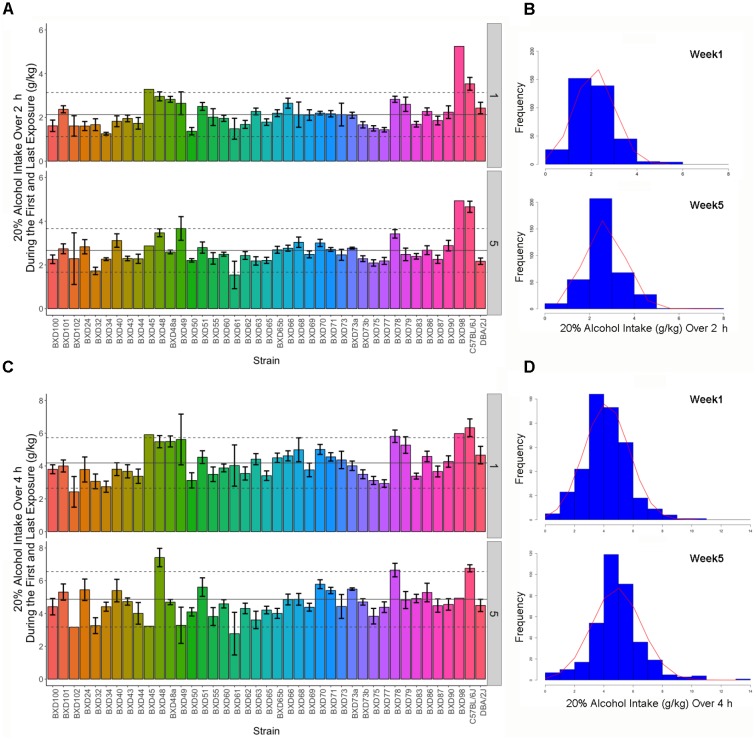
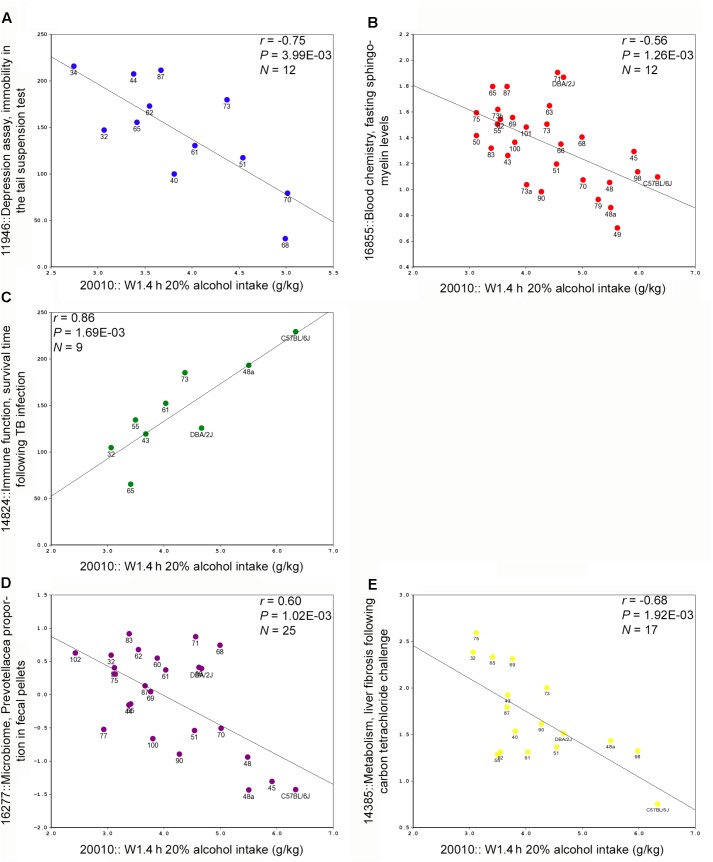
We profiled individual differences in alcohol consumption upon initial exposure and during 5 weeks of voluntary alcohol intake in female mice from 39 BXD recombinant inbred strains and parents using the drinking in the dark (DID) method. In this paradigm, a single bottle of 20% (v/v) alcohol was presented as the sole liquid source for 2 or 4 h starting 3 h into the dark cycle. For 3 consecutive days mice had access to alcohol for 2 h followed by a 4th day of 4 h access and 3 intervening days where alcohol was not offered. We followed this regime for 5 weeks. For most strains, 2 or 4 h alcohol intake increased over the 5-week period, with some strains demonstrating greatly increased intake. There was considerable and heritable genetic variation in alcohol consumption upon initial early and sustained weekly exposure. Two different mapping algorithms were used to identify QTLs associated with alcohol intake and only QTLs detected by both methods were considered further. Multiple suggestive QTLs for alcohol intake on chromosomes (Chrs) 2, 6, and 12 were identified for the first 4 h exposure. Suggestive QTLs for sustained intake during later weeks were identified on Chrs 4 and 8. Thirty high priority candidate genes, including , and were nominated for early and sustained alcohol intake QTLs. In addition, a suggestive QTL on Chr 15 was detected for change in 2 h alcohol intake over the duration of the study and was identified as a strong candidate gene. Bioinformatic analyses revealed that early and sustained alcohol intake is likely driven by genes and pathways involved in signaling, and/or immune and metabolic function, while a combination of epigenetic factors related to alcohol experience and genetic factors likely drives progressive alcohol intake.
我们使用黑暗中饮水(DID)方法,对来自39个BXD重组近交系及其亲本的雌性小鼠在初次接触酒精以及自愿摄入酒精5周期间的酒精消费个体差异进行了分析。在该实验范式中,从黑暗周期开始3小时起,提供一瓶20%(v/v)酒精作为唯一液体来源,持续2或4小时。连续3天,小鼠有2小时的酒精摄入时间,随后第4天有4小时的酒精摄入时间,中间3天不提供酒精。我们遵循此方案进行了5周。对于大多数品系,在5周内2或4小时的酒精摄入量有所增加,一些品系的摄入量显著增加。在初次早期和每周持续接触酒精时,酒精消费存在相当大的可遗传基因变异。使用两种不同的定位算法来识别与酒精摄入相关的数量性状基因座(QTL),只有两种方法都检测到的QTL才会被进一步考虑。在初次4小时接触酒精时,在染色体(Chr)2、6和12上鉴定出多个与酒精摄入相关的暗示性QTL。在随后几周持续摄入酒精的暗示性QTL在Chr 4和8上被鉴定出来。包括[具体基因名称未给出]等30个高优先级候选基因被提名为早期和持续酒精摄入QTL。此外,在Chr 15上检测到一个暗示性QTL,与研究期间2小时酒精摄入量的变化有关,[具体基因名称未给出]被确定为一个强有力的候选基因。生物信息学分析表明,早期和持续酒精摄入可能由参与信号传导、和/或免疫及代谢功能的基因和途径驱动,而与酒精经历相关的表观遗传因素和遗传因素的组合可能驱动酒精摄入量的逐步增加。