Mapanao Ana Katrina, Santi Melissa, Faraci Paolo, Cappello Valentina, Cassano Domenico, Voliani Valerio
Center for Nanotechnology Innovation, NEST, Istituto Italiano di Tecnologia, Piazza San Silvestro, 12, 56126 Pisa, Italy.
NEST-Scuola Normale Superiore, Piazza San Silvestro, 12, 56126 Pisa, Italy.
ACS Omega. 2018 Sep 30;3(9):11796-11801. doi: 10.1021/acsomega.8b01719. Epub 2018 Sep 24.
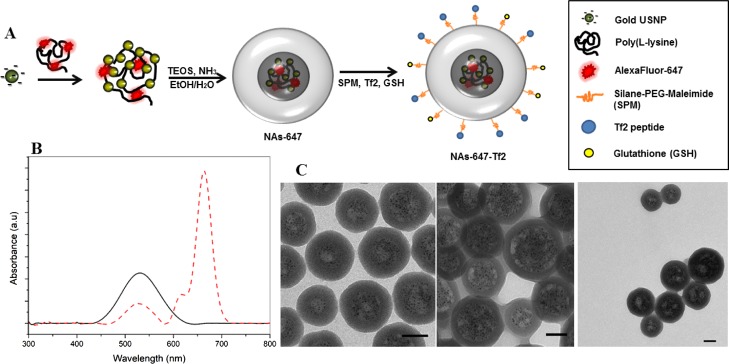
Several nanomaterials rely on the passive accumulation in the neoplasm target because of enhanced permeability and retention effect. On the other hand, directing nanomaterials to the target by employing the targeting agents may lead to a pivotal improvement in the efficacy of the treatment for a number of cancers. However, targeting moieties often lose their functionality upon injection in the bloodstream, leaving questions on their efficiency. Here, we assessed using a significant in vitro 3D model of pancreatic carcinoma the targeting efficiency of passion fruit-like nanoarchitectures (NAs) incorporated with a peptide that can recognize transferrin directly in the medium, thereby modulating protein solvation. NAs are biodegradable ultrasmall-in-nano platforms that combine the most appealing behaviors of noble metal nanomaterials with organism excretion of the building blocks by the renal pathway. Although the confocal images did not illustrate the significant differences in the targeting efficiency of the peptide-modified NAs, an improved internalization was quantitatively observed by inductively coupled plasma-mass spectrometry analysis. Our findings demonstrate that the peptide conjugation of NAs might be considered to enhance their theranostic potentials for this type of neoplasm.
由于增强的渗透和滞留效应,几种纳米材料依赖于在肿瘤靶点的被动积累。另一方面,通过使用靶向剂将纳米材料导向靶点可能会显著提高多种癌症的治疗效果。然而,靶向部分在注入血液后往往会失去其功能,这对其效率提出了疑问。在这里,我们使用一种重要的胰腺癌体外3D模型评估了百香果样纳米结构(NAs)与一种能在培养基中直接识别转铁蛋白的肽结合后的靶向效率,从而调节蛋白质溶剂化。NAs是可生物降解的超小纳米平台,它将贵金属纳米材料最吸引人的特性与通过肾脏途径排出构建块的生物体排泄相结合。尽管共聚焦图像没有显示肽修饰的NAs在靶向效率上的显著差异,但通过电感耦合等离子体质谱分析定量观察到内化有所改善。我们的研究结果表明,NAs的肽偶联可能被认为可以增强其对这类肿瘤的诊疗潜力。