Centre for Population Health Research on Electromagnetic Energy (PRESEE), School of Public Health and Preventive Medicine, Monash University, Melbourne, VIC 3004, Australia.
Department of Epidemiology and Preventive Medicine, School of Public Health and Preventive Medicine, Monash University, 553 St Kilda Road, Melbourne, VIC 3004, Australia.
Int J Environ Res Public Health. 2018 Oct 12;15(10):2234. doi: 10.3390/ijerph15102234.
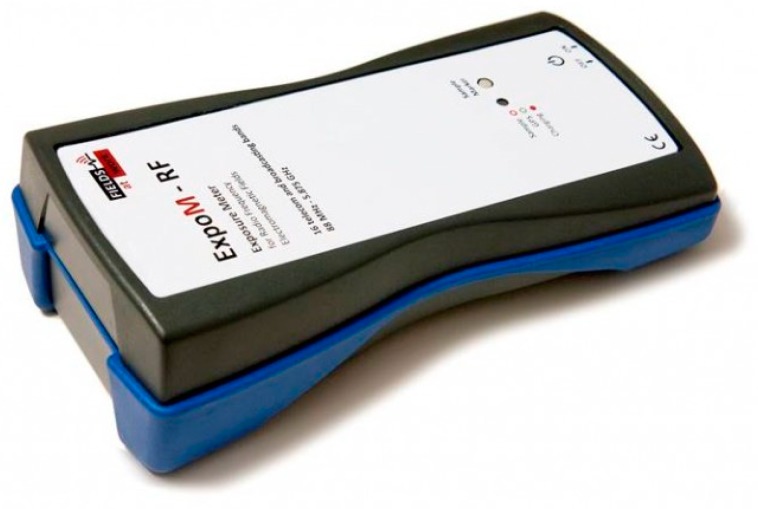
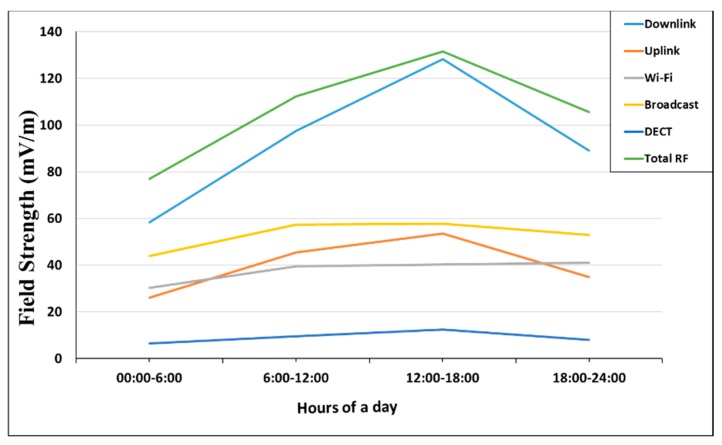
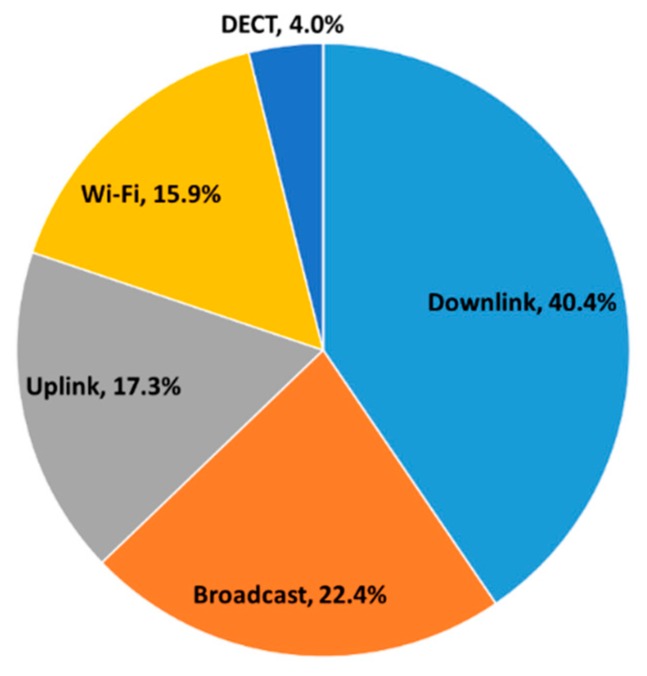
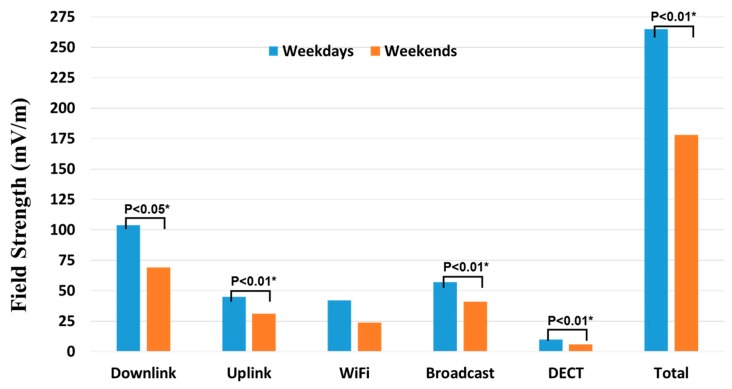
The measurement of personal exposure to radiofrequency electromagnetic fields (RF-EMFs) is important for epidemiological studies. RF-EMF exposure can be measured using personal exposimeters that register RF-EMFs over a wide range of frequency bands. This study aimed to measure and describe personal RF-EMF exposure levels from a wide range of frequency bands. Measurements were recorded from 63 participants over an average of 27.4 (±4.5) hours. RF-EMF exposure levels were computed for each frequency band, as well as from downlink (RF from mobile phone base station), uplink (RF from mobile phone handsets), broadcast, and Wi-Fi. Participants had a mean (±SD) age of 36.9 ± 12.5 years; 66.7% were women; and almost all (98.2%) from urban areas. A Wi-Fi router at home was reported by 61 participants (96.8%), with 38 (61.2%) having a Wi-Fi enabled smart TV. Overall, 26 (41.3%) participants had noticed the existence of a mobile phone base station in their neighborhood. On average, participants estimated the distance between the base station and their usual residence to be about 500 m. The median personal RF-EMF exposure was 208 mV/m. Downlink contributed 40.4% of the total RF-EMF exposure, followed by broadcast (22.4%), uplink (17.3%), and Wi-Fi (15.9%). RF-EMF exposure levels on weekdays were higher than weekends ( < 0.05). Downlink and broadcast are the main contributors to total RF-EMF personal exposure. Personal RF-EMF exposure levels vary according to day of the week and time of day.
个人暴露于射频电磁场(RF-EMF)的测量对于流行病学研究很重要。RF-EMF 暴露可以使用个人暴露计来测量,这些暴露计可以在广泛的频率范围内记录 RF-EMF。本研究旨在测量和描述来自广泛频率范围的个人 RF-EMF 暴露水平。对 63 名参与者进行了平均 27.4(±4.5)小时的测量。为每个频率波段以及下行链路(来自移动电话基站的 RF)、上行链路(来自移动电话手机的 RF)、广播和 Wi-Fi 计算了 RF-EMF 暴露水平。参与者的平均年龄(±SD)为 36.9 ± 12.5 岁;66.7%为女性;几乎所有人(98.2%)都来自城市地区。61 名参与者(96.8%)报告家中有 Wi-Fi 路由器,其中 38 名(61.2%)有 Wi-Fi 智能电视。总体而言,26 名(41.3%)参与者注意到他们所在社区有移动电话基站。参与者平均估计基站与他们通常居住的地方的距离约为 500 米。个人 RF-EMF 暴露的中位数为 208 mV/m。下行链路占总 RF-EMF 暴露的 40.4%,其次是广播(22.4%)、上行链路(17.3%)和 Wi-Fi(15.9%)。工作日的 RF-EMF 暴露水平高于周末(<0.05)。下行链路和广播是总 RF-EMF 个人暴露的主要贡献者。个人 RF-EMF 暴露水平根据一周中的不同天数和一天中的不同时间而有所不同。