Center for Brain Repair, Department of Biomedical Sciences, Florida State University College of Medicine, Tallahassee, Florida, United States of America.
Pediatric Psychopharmacology, Department of Psychiatry, Massachusetts General Hospital, Harvard Medical School, Boston, Massachusetts, United States of America.
PLoS Biol. 2018 Oct 16;16(10):e2006497. doi: 10.1371/journal.pbio.2006497. eCollection 2018 Oct.
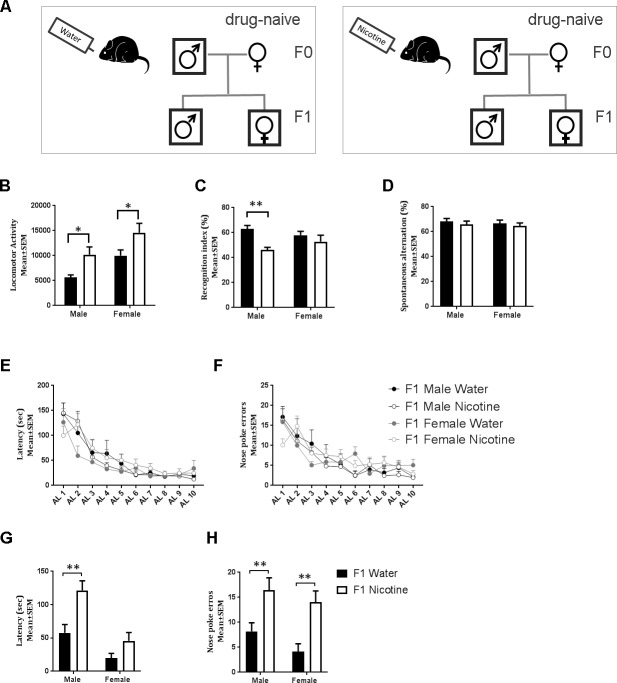
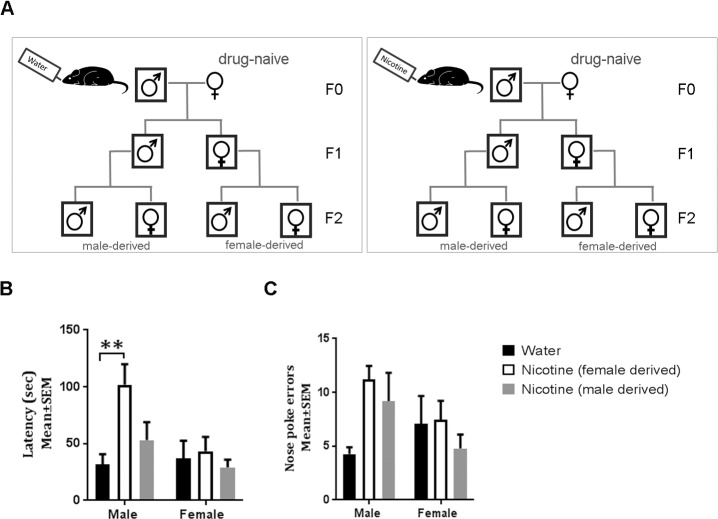
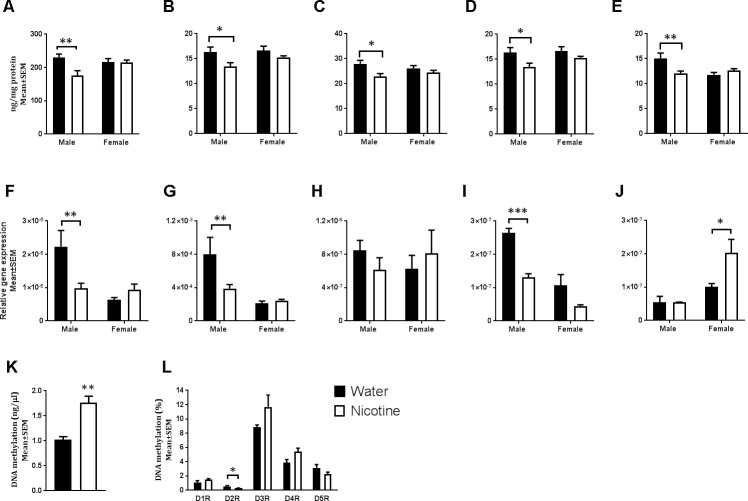
Use of tobacco products is injurious to health in men and women. However, tobacco use by pregnant women receives greater scrutiny because it can also compromise the health of future generations. More men smoke cigarettes than women. Yet the impact of nicotine use by men upon their descendants has not been as widely scrutinized. We exposed male C57BL/6 mice to nicotine (200 μg/mL in drinking water) for 12 wk and bred the mice with drug-naïve females to produce the F1 generation. Male and female F1 mice were bred with drug-naïve partners to produce the F2 generation. We analyzed spontaneous locomotor activity, working memory, attention, and reversal learning in male and female F1 and F2 mice. Both male and female F1 mice derived from the nicotine-exposed males showed significant increases in spontaneous locomotor activity and significant deficits in reversal learning. The male F1 mice also showed significant deficits in attention, brain monoamine content, and dopamine receptor mRNA expression. Examination of the F2 generation showed that male F2 mice derived from paternally nicotine-exposed female F1 mice had significant deficits in reversal learning. Analysis of epigenetic changes in the spermatozoa of the nicotine-exposed male founders (F0) showed significant changes in global DNA methylation and DNA methylation at promoter regions of the dopamine D2 receptor gene. Our findings show that nicotine exposure of male mice produces behavioral changes in multiple generations of descendants. Nicotine-induced changes in spermatozoal DNA methylation are a plausible mechanism for the transgenerational transmission of the phenotypes. These findings underscore the need to enlarge the current focus of research and public policy targeting nicotine exposure of pregnant mothers by a more equitable focus on nicotine exposure of the mother and the father.
使用烟草制品对男性和女性的健康都是有害的。然而,由于孕妇吸烟会危及后代的健康,因此对其关注度更高。与女性相比,更多的男性吸烟。然而,男性吸烟对其后代的影响并没有受到广泛关注。我们将雄性 C57BL/6 小鼠暴露于尼古丁(饮用水中 200μg/ml)中 12 周,并让这些雄性小鼠与未接触药物的雌性小鼠交配,产生 F1 代。雄性和雌性 F1 代小鼠与未接触药物的雌雄小鼠交配,产生 F2 代。我们分析了雄性和雌性 F1 和 F2 代小鼠的自发运动活动、工作记忆、注意力和反转学习。来自暴露于尼古丁的雄性的雄性和雌性 F1 代小鼠的自发运动活动显著增加,并且反转学习能力显著受损。雄性 F1 代小鼠的注意力、大脑单胺含量和多巴胺受体 mRNA 表达也显著降低。对 F2 代的研究表明,来自父系尼古丁暴露的雌性 F1 代的雄性 F2 代小鼠的反转学习能力显著受损。对暴露于尼古丁的雄性父系精子的表观遗传变化的分析表明,整体 DNA 甲基化和多巴胺 D2 受体基因启动子区域的 DNA 甲基化发生了显著变化。我们的研究结果表明,雄性小鼠暴露于尼古丁会导致多代后代的行为发生变化。精子 DNA 甲基化的尼古丁诱导变化是表型跨代传递的一种可能机制。这些发现强调了需要扩大当前研究和公共政策的重点,将目标从母亲暴露于尼古丁转移到更公平地关注母亲和父亲暴露于尼古丁。