Prado José Carlos Mann, Monezi Telma Alves, Amorim Aline Teixeira, Lino Vanesca, Paladino Andressa, Boccardo Enrique
Departamento de Microbiologia, Instituto de Ciencias Biomedicas, Universidade de Sao Paulo, Sao Paulo, SP, BR.
Clinics (Sao Paulo). 2018 Oct 11;73(suppl 1):e558s. doi: 10.6061/clinics/2018/e558s.
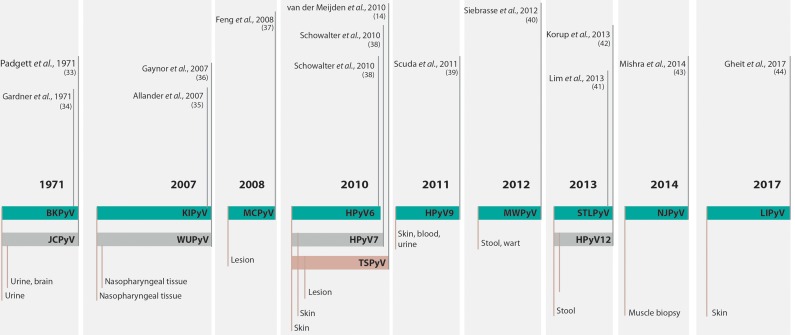
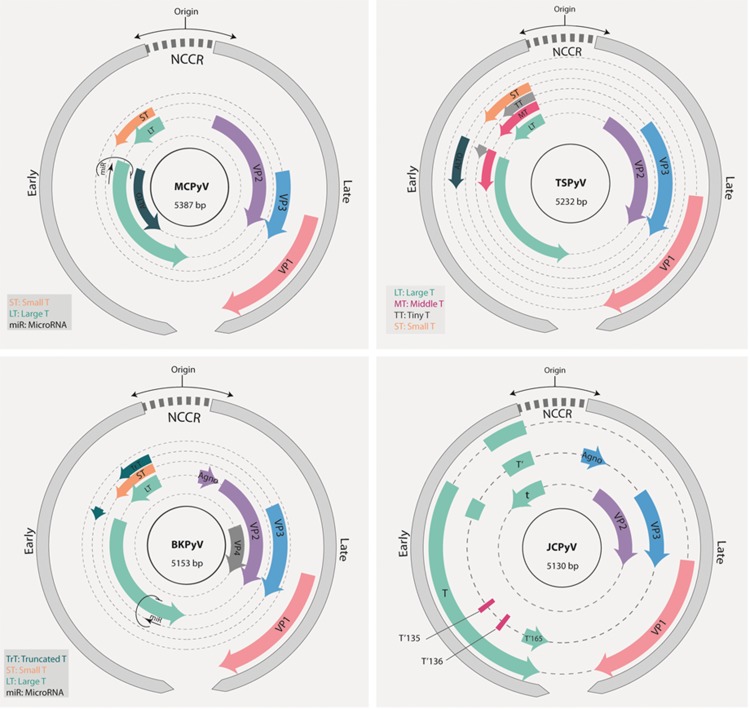
The name of the family Polyomaviridae, derives from the early observation that cells infected with murine polyomavirus induced multiple (poly) tumors (omas) in immunocompromised mice. Subsequent studies showed that many members of this family exhibit the capacity of mediating cell transformation and tumorigenesis in different experimental models. The transformation process mediated by these viruses is driven by viral pleiotropic regulatory proteins called T (tumor) antigens. Similar to other viral oncoproteins T antigens target cellular regulatory factors to favor cell proliferation, immune evasion and downregulation of apoptosis. The first two human polyomaviruses were isolated over 45 years ago. However, recent advances in the DNA sequencing technologies led to the rapid identification of additional twelve new polyomaviruses in different human samples. Many of these viruses establish chronic infections and have been associated with conditions in immunosuppressed individuals, particularly in organ transplant recipients. This has been associated to viral reactivation due to the immunosuppressant therapy applied to these patients. Four polyomaviruses namely, Merkel cell polyomavirus (MCPyV), Trichodysplasia spinulosa polyomavirus (TSPyV), John Cunningham Polyomavirus (JCPyV) and BK polyomavirus (BKPyV) have been associated with the development of specific malignant tumors. However, present evidence only supports the role of MCPyV as a carcinogen to humans. In the present review we present a summarized discussion on the current knowledge concerning the role of MCPyV, TSPyV, JCPyV and BKPyV in human cancers.
多瘤病毒科的名称源于早期的观察结果,即感染鼠多瘤病毒的细胞在免疫功能低下的小鼠中会诱发多发性(多)肿瘤(瘤)。随后的研究表明,该科的许多成员在不同的实验模型中都表现出介导细胞转化和肿瘤发生的能力。这些病毒介导的转化过程由称为T(肿瘤)抗原的病毒多效性调节蛋白驱动。与其他病毒癌蛋白类似,T抗原靶向细胞调节因子以促进细胞增殖、免疫逃逸和凋亡下调。45多年前分离出了首批两种人类多瘤病毒。然而,DNA测序技术的最新进展导致在不同的人类样本中迅速鉴定出另外12种新的多瘤病毒。这些病毒中的许多会建立慢性感染,并与免疫抑制个体的疾病有关,尤其是器官移植受者。这与应用于这些患者的免疫抑制疗法导致的病毒重新激活有关。四种多瘤病毒,即默克尔细胞多瘤病毒(MCPyV)、棘状毛发发育异常多瘤病毒(TSPyV)、约翰·坎宁安多瘤病毒(JCPyV)和BK多瘤病毒(BKPyV)与特定恶性肿瘤的发生有关。然而,目前的证据仅支持MCPyV作为人类致癌物的作用。在本综述中,我们对目前关于MCPyV、TSPyV、JCPyV和BKPyV在人类癌症中的作用的知识进行了总结性讨论。