1Université Clermont Auvergne,INRA,VetAgro Sup,UMR Herbivores,63122 Saint-Genès-Champanelle,France.
2UMR AGIR,INRA,Université de Toulouse,INPT,31324 Castanet-Tolosan,France.
Animal. 2019 Aug;13(8):1773-1784. doi: 10.1017/S1751731118002586. Epub 2018 Oct 18.
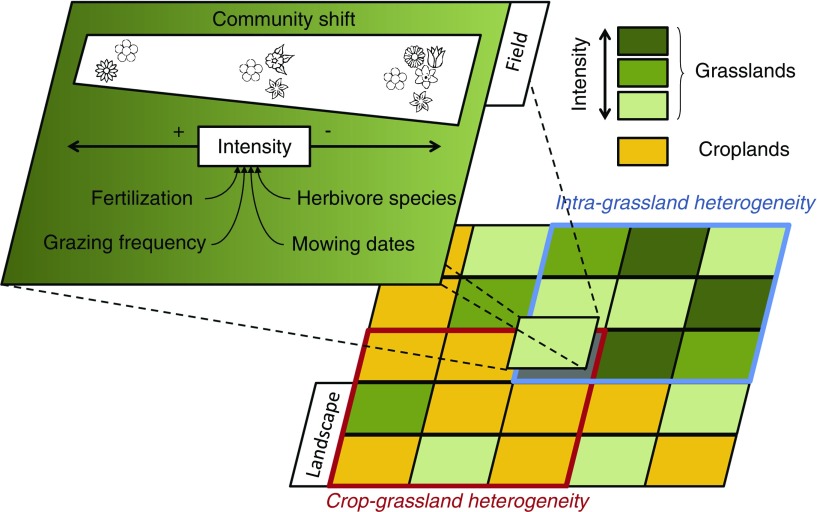
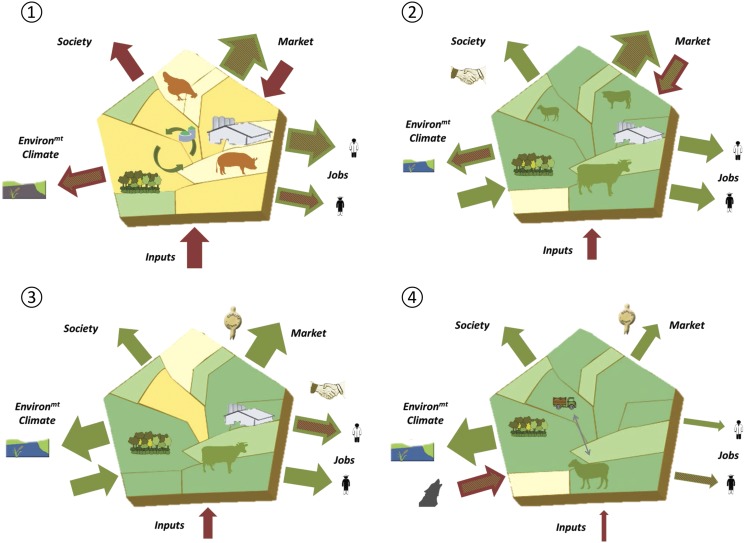
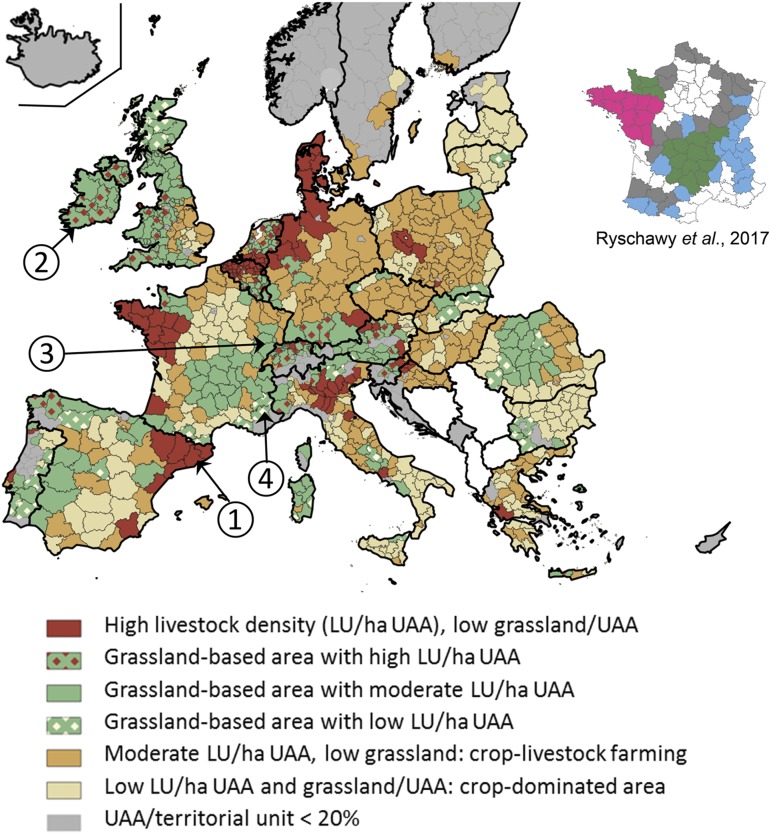
Livestock is a major driver in most rural landscapes and economics, but it also polarises debate over its environmental impacts, animal welfare and human health. Conversely, the various services that livestock farming systems provide to society are often overlooked and have rarely been quantified. The aim of analysing bundles of services is to chart the coexistence and interactions between the various services and impacts provided by livestock farming, and to identify sets of ecosystem services (ES) that appear together repeatedly across sites and through time. We review three types of approaches that analyse associations among impacts and services from local to global scales: (i) detecting ES associations at system or landscape scale, (ii) identifying and mapping bundles of ES and impacts and (iii) exploring potential drivers using prospective scenarios. At a local scale, farming practices interact with landscape heterogeneity in a multi-scale process to shape grassland biodiversity and ES. Production and various ES provided by grasslands to farmers, such as soil fertility, biological regulations and erosion control, benefit to some extent from the functional diversity of grassland species, and length of pasture phase in the crop rotation. Mapping ES from the landscape up to the EU-wide scale reveals a frequent trade-off between livestock production on one side and regulating and cultural services on the other. Maps allow the identification of target areas with higher ecological value or greater sensitivity to risks. Using two key factors (livestock density and the proportion of permanent grassland within utilised agricultural area), we identified six types of European livestock production areas characterised by contrasted bundles of services and impacts. Livestock management also appeared to be a key driver of bundles of services in prospective scenarios. These scenarios simulate a breakaway from current production, legislation (e.g. the use of food waste to fatten pigs) and consumption trends (e.g. halving animal protein consumption across Europe). Overall, strategies that combine a reduction of inputs, of the use of crops from arable land to feed livestock, of food waste and of meat consumption deliver a more sustainable food future. Livestock as part of this sustainable future requires further enhancement, quantification and communication of the services provided by livestock farming to society, which calls for the following: (i) a better targeting of public support, (ii) more precise quantification of bundles of services and (iii) better information to consumers and assessment of their willingness to pay for these services.
家畜是大多数农村景观和经济的主要驱动力,但它也使人们对其环境影响、动物福利和人类健康产生了两极分化的争论。相反,家畜养殖系统向社会提供的各种服务往往被忽视,而且很少被量化。分析服务包的目的是描绘家畜养殖提供的各种服务和影响之间的共存和相互作用,并确定在不同地点和时间内反复出现的生态系统服务(ES)集。我们回顾了从本地到全球尺度分析影响和服务之间关联的三种类型的方法:(i)在系统或景观尺度上检测 ES 关联,(ii)识别和绘制 ES 和影响的捆绑包,(iii)使用前瞻性情景探索潜在驱动因素。在本地尺度上,农业实践与景观异质性在多尺度过程中相互作用,从而塑造了草原生物多样性和 ES。草原为农民提供的生产和各种 ES,如土壤肥力、生物调节和侵蚀控制,在一定程度上受益于草原物种的功能多样性和作物轮作中牧场阶段的长度。从景观到欧盟范围内的 ES 映射揭示了家畜生产与调节和文化服务之间的频繁权衡。地图允许识别具有更高生态价值或对风险更敏感的目标区域。使用两个关键因素(家畜密度和农业利用区永久草地的比例),我们确定了六种具有不同服务和影响捆绑包的欧洲家畜生产类型。家畜管理似乎也是前瞻性情景中服务捆绑包的关键驱动因素。这些情景模拟了与当前生产、立法(例如利用食物垃圾育肥猪)和消费趋势(例如在整个欧洲将动物蛋白消耗减半)的背离。总体而言,结合减少投入、减少从耕地到喂养家畜的作物使用、减少食物浪费和减少肉类消费的战略可以为更可持续的粮食未来提供帮助。家畜作为可持续未来的一部分,需要进一步加强对社会提供的家畜养殖服务的增强、量化和传播,这需要:(i)更好地定位公共支持,(ii)更精确地量化服务捆绑包,(iii)更好地向消费者提供信息并评估他们对这些服务的支付意愿。