a Department of Cardiology , The Second Affiliated Hospital and Yuying Children's Hospital of Wenzhou Medical University , Wenzhou , PR China.
b Department of Neurology , The Second Affiliated Hospital and Yuying Children's Hospital of Wenzhou Medical University , Wenzhou , PR China.
Drug Deliv. 2018 Nov;25(1):1617-1633. doi: 10.1080/10717544.2018.1486471.
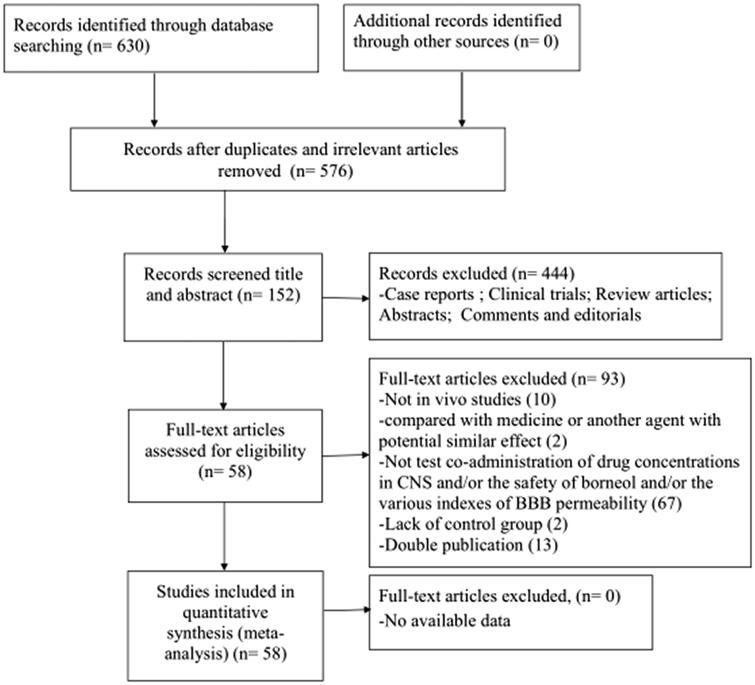
To achieve sufficient blood-brain barrier (BBB), penetration is one of the biggest challenges in the development of diagnostic and therapeutic for central nervous system (CNS) disorders. Here, we conducted a systematic review and meta-analysis to assess the preclinical evidence and possible mechanisms of borneol for improving co-administration of CNS drug delivery in animal models. The electronic literature search was conducted in six databases. Fifty-eight studies with 63 comparisons involved 1137 animals were included. Among 47 studies reporting the assessments of CNS drug concentration, 45 studies showed the significant effects of borneol for improving CNS drug delivery (p<.05), whereas 2 studies showed no difference (p>.05). Nineteen comparisons showed borneol up-regulated BBB permeability (p<.05) using brain EB content (n = 8), Rh 123 content (n = 4), brain imaging agent content (n = 2), brain water content (n = 1) and observing ultrastructure of BBB (n = 4), whereas three studies showed no difference or unclear results. Seven studies reported the safety, in which one study showed borneol was reversible changes in the BBB penetration; six studies showed borneol did not increase co-administration of blood drugs concentration of peripheral tissues (p > .05). Effects of borneol are closely associated with inhibition of efflux protein function, releasement of tight junction protein, increasement of vasodilatory neurotransmitters, and inhibition of active transport by ion channels. In conclusion, borneol is a promising candidate for CNS drug delivery, mainly through mediating a multi-targeted BBB permeability.
为了实现足够的血脑屏障(BBB)通透性,这是开发中枢神经系统(CNS)疾病诊断和治疗方法的最大挑战之一。在这里,我们进行了系统评价和荟萃分析,以评估冰片改善动物模型中 CNS 药物传递的联合给药的临床前证据和可能机制。电子文献检索在六个数据库中进行。纳入了 58 项研究,涉及 63 个比较,共 1137 只动物。在 47 项报告 CNS 药物浓度评估的研究中,45 项研究表明冰片对改善 CNS 药物传递有显著效果(p<.05),而 2 项研究表明无差异(p>.05)。19 项比较表明,冰片通过脑 EB 含量(n = 8)、Rh123 含量(n = 4)、脑成像剂含量(n = 2)、脑水含量(n = 1)和观察 BBB 的超微结构(n = 4)上调 BBB 通透性(p<.05),而 3 项研究表明无差异或结果不明确。有 7 项研究报告了安全性,其中 1 项研究表明冰片对 BBB 通透性的改变是可逆的;6 项研究表明冰片不会增加外周组织血液药物浓度的联合给药(p>.05)。冰片的作用与抑制外排蛋白功能、释放紧密连接蛋白、增加血管舒张神经递质以及抑制离子通道的主动转运密切相关。总之,冰片是一种很有前途的 CNS 药物递送候选物,主要通过介导多靶点 BBB 通透性。