Nadi Ali, Shiravi Amir Abbas, Mohammadi Zahra, Aslani Amin, Zeinalian Mehrdad
School of Nutrition and Food Sciences, Isfahan University of Medical sciences, Isfahan, Iran.
Department of Genetics and Molecular biology, School of Medicine, Isfahan University of Medical sciences, Isfahan, Iran.
J Herb Med. 2023 Mar;38:100635. doi: 10.1016/j.hermed.2023.100635. Epub 2023 Jan 26.
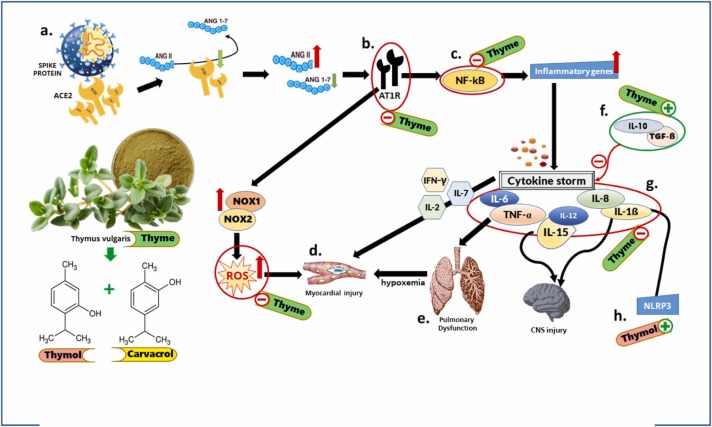
A worldwide pandemic infection by severe acute respiratory syndrome coronavirus 2 (SARS-CoV-2) is the cause of a deadly disease called COVID-19. Interaction of the virus and the Angiotensin converting-enzyme 2 (ACE2) receptor leads to an inflammatory-induced tissue damage. (TvL) is a plant with a long history in traditional medicine that has antimicrobial, antiseptic, and antiviral properties. Thymol and Carvacrol are two important biological components in Thyme that have anti-inflammatory, antioxidant, and immunomodulatory properties. This study is a molecular review on the potential effects of TvL and its active compounds on SARS-COV2 infection.
This is a narrative review in which using PubMed, Scopus, ISI, Cochrane, ScienceDirect, Google scholar, and Arxiv preprint databases, the molecular mechanisms of therapeutic and protective effects of TvL and its active compounds have been discussed regarding the molecular pathogenesis in COVID-19.
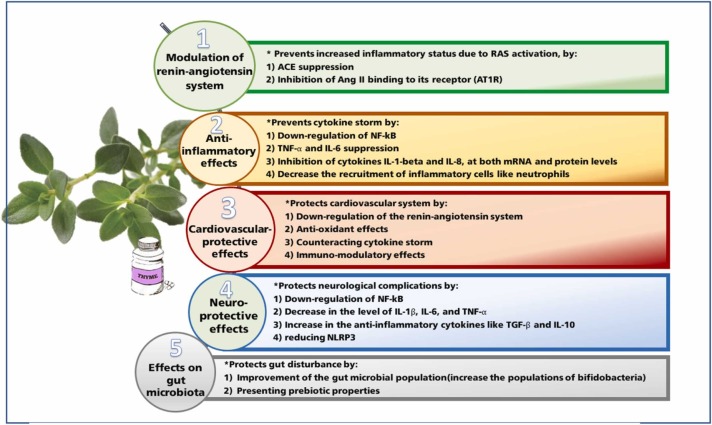
Thyme could suppress TNF-alpha, IL-6, and other inflammatory cytokines. It also enhances the anti-inflammatory cytokines like TGF-beta and IL-10. Thyme extract acts also as an inhibitor of cytokines IL-1-beta and IL-8, at both mRNA and protein levels. Thymol may also control the progression of neuro-inflammation toward neurological disease by reducing some factors. Thyme and its active ingredients, especially Thymol and Carvacrol, have also positive effects on the renin-angiotensin system (RAS) and intestinal microbiota.
Accordingly, TvL and its bioactive components may prevent COVID-19 complications and has a potential protective role against the deleterious consequences of the disease.
严重急性呼吸综合征冠状病毒2(SARS-CoV-2)在全球范围内引发的大流行感染是一种名为COVID-19的致命疾病的病因。病毒与血管紧张素转换酶2(ACE2)受体的相互作用会导致炎症诱导的组织损伤。百里香(TvL)是一种在传统医学中有悠久历史的植物,具有抗菌、防腐和抗病毒特性。百里香酚和香芹酚是百里香中的两种重要生物成分,具有抗炎、抗氧化和免疫调节特性。本研究是对TvL及其活性化合物对SARS-CoV-2感染潜在影响的分子综述。
这是一篇叙述性综述,通过使用PubMed、Scopus、ISI、Cochrane、ScienceDirect、谷歌学术和Arxiv预印本数据库,讨论了TvL及其活性化合物在COVID-19分子发病机制方面的治疗和保护作用的分子机制。
百里香可以抑制肿瘤坏死因子-α、白细胞介素-6和其他炎性细胞因子。它还能增强抗炎细胞因子,如转化生长因子-β和白细胞介素-10。百里香提取物在mRNA和蛋白质水平上也作为细胞因子白细胞介素-1-β和白细胞介素-8的抑制剂。百里香酚还可能通过减少一些因素来控制神经炎症向神经疾病的进展。百里香及其活性成分,尤其是百里香酚和香芹酚,对肾素-血管紧张素系统(RAS)和肠道微生物群也有积极影响。
因此,TvL及其生物活性成分可能预防COVID-19并发症,并对该疾病的有害后果具有潜在的保护作用。