Department of Environmental Health, Boston University School of Public Health, Boston, MA, USA.
Department of Environmental Medicine and Public Health, Icahn School of Medicine at Mount Sinai, New York, NY, USA.
J Expo Sci Environ Epidemiol. 2019 Sep;29(5):674-687. doi: 10.1038/s41370-018-0081-6. Epub 2018 Oct 18.
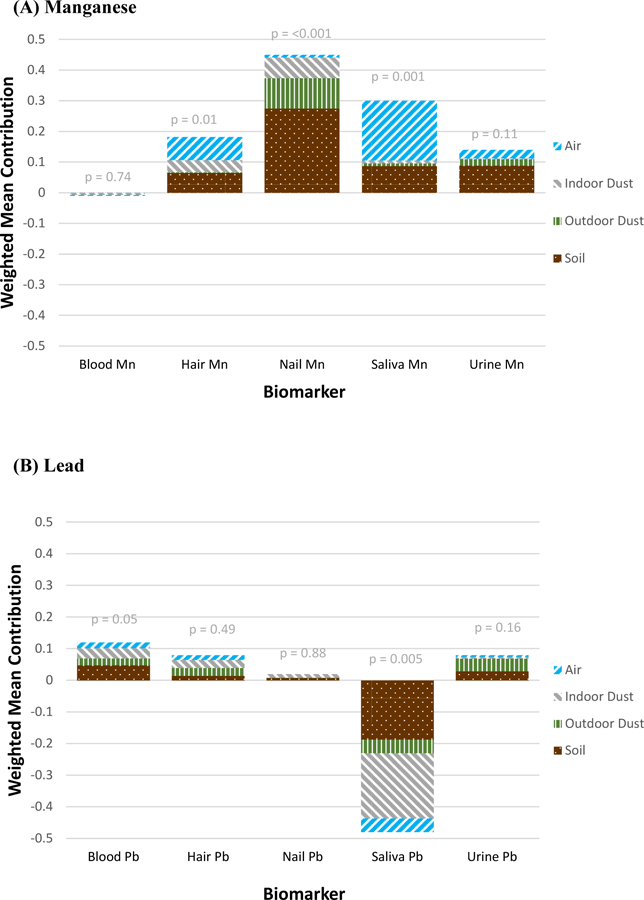
Residential proximity to ferroalloy production has been associated with increased manganese exposure, which can adversely affect health, particularly among children. Little is known, however, about which environmental samples contribute most to internal levels of manganese and other ferroalloy metals. We aimed to characterize sources of exposure to metals and evaluate the ability of internal biomarkers to reflect exposures from environmental media. In 717 Italian adolescents residing near ferromanganese industry, we examined associations between manganese, lead, chromium, and copper in environmental samples (airborne particles, surface soil, indoor/outdoor house dust) and biological samples (blood, hair, nails, saliva, urine). In multivariable regression analyses adjusted for child age and sex, a 10% increase in soil Mn was associated with increases of 3.0% (95% CI: 1.1%, 4.9%) in nail Mn and 1.6% (95% CI: -0.2%, 3.4%) in saliva Mn. Weighted-quantile-sum (WQS) regression estimated that higher soil and outdoor dust Mn accounted for most of the effect on nail Mn (WQS weights: 0.61 and 0.22, respectively, out of a total of 1.0). Higher air and soil Mn accounted for most of the effect on saliva Mn (WQS weights: 0.65 and 0.29, respectively). These findings can help inform biomarker selection in future epidemiologic studies and guide intervention strategies in exposed populations.
居民居住地与铁合金生产之间的接近程度与锰暴露的增加有关,这可能对健康造成不利影响,尤其是在儿童中。然而,人们对哪些环境样本对锰和其他铁合金金属的内部水平影响最大知之甚少。我们旨在描述金属暴露的来源,并评估内部生物标志物反映环境介质暴露的能力。在意大利 717 名居住在铁锰工业区附近的青少年中,我们研究了环境样本(空气传播颗粒、地表土壤、室内/室外房屋灰尘)和生物样本(血液、头发、指甲、唾液、尿液)中锰、铅、铬和铜之间的关联。在调整了儿童年龄和性别的多变量回归分析中,土壤 Mn 增加 10%,与指甲 Mn 增加 3.0%(95%CI:1.1%,4.9%)和唾液 Mn 增加 1.6%(95%CI:-0.2%,3.4%)相关。加权分位数总和(WQS)回归估计,较高的土壤和室外灰尘 Mn 对指甲 Mn 的影响最大(WQS 权重分别为 0.61 和 0.22,总计 1.0)。较高的空气和土壤 Mn 对唾液 Mn 的影响最大(WQS 权重分别为 0.65 和 0.29)。这些发现可以帮助为未来的流行病学研究选择生物标志物提供信息,并为暴露人群的干预策略提供指导。