Whittaker Dominic G, Colman Michael A, Ni Haibo, Hancox Jules C, Zhang Henggui
School of Biomedical Sciences, Faculty of Biological Sciences, University of Leeds, Leeds, United Kingdom.
Biological Physics Group, School of Physics and Astronomy, The University of Manchester, Manchester, United Kingdom.
Front Physiol. 2018 Oct 4;9:1402. doi: 10.3389/fphys.2018.01402. eCollection 2018.
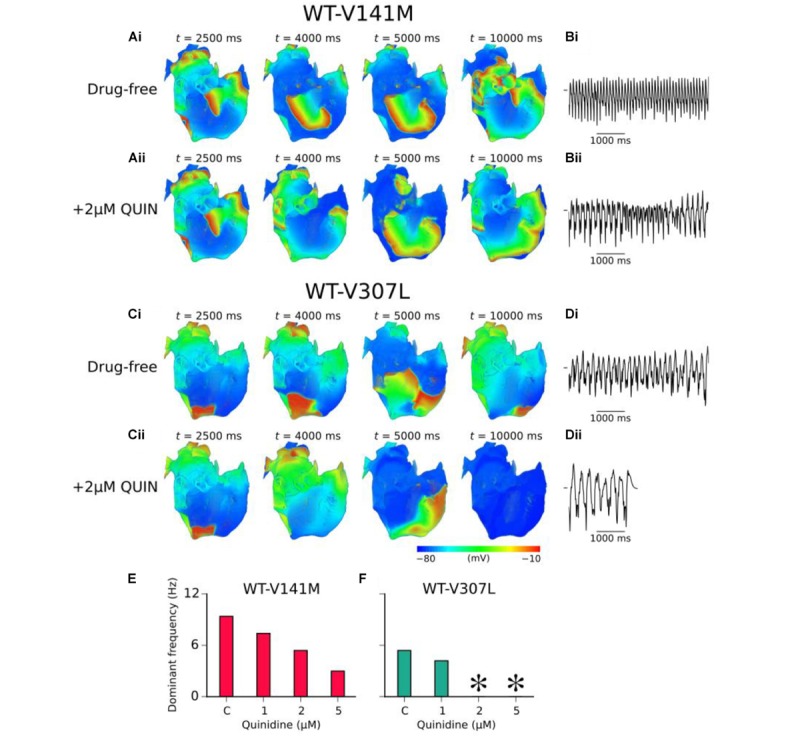
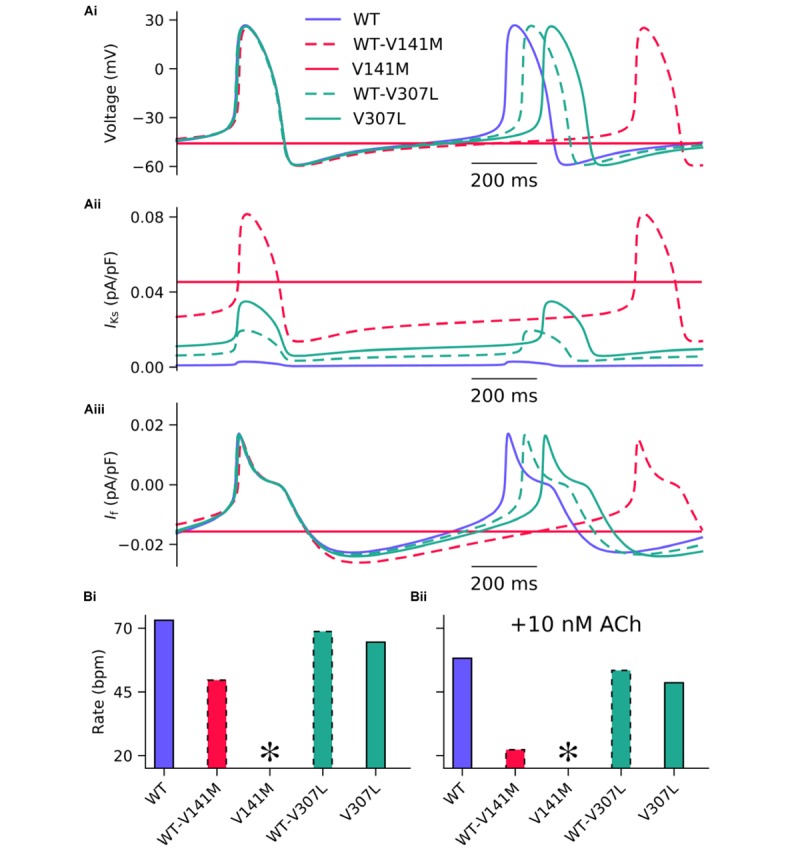
Atrial fibrillation (AF) and sinus bradycardia have been reported in patients with short QT syndrome variant 2 (SQT2), which is underlain by gain-of-function mutations in encoding the α subunit of channels carrying slow delayed rectifier potassium current, . However, the mechanism(s) underlying the increased atrial arrhythmogenesis and impaired cardiac pacemaking activity arising from increased remain unclear. Possible pharmacological interventions of AF in the SQT2 condition also remain to be elucidated. Using computational modelling, we assessed the functional impact of SQT2 mutations on human sinoatrial node (SAN) pacemaking, atrial repolarisation and arrhythmogenesis, and efficacy of the anti-arrhythmic drug quinidine. Markov chain formulations of describing two mutations - V141M and V307L - were developed from voltage-clamp experimental data and then incorporated into contemporary action potential (AP) models of human atrial and SAN cells, the former of which were integrated into idealised and anatomically detailed tissue models. Both mutations shortened atrial AP duration (APD) through distinct 'gain-of-function' mechanisms, whereas SAN pacemaking rate was slowed markedly only by the V141M mutation. Differences in APD restitution steepness influenced re-entry dynamics in tissue - the V141M mutation promoted stationary and stable spiral waves whereas the V307L mutation promoted non-stationary and unstable re-entrant waves. Both mutations shortened tissue excitation wavelength through reduced effective refractory period but not conduction velocity, which served to increase the lifespan of re-entrant excitation in a 3D anatomical human atria model, as well as the dominant frequency (DF), which was higher for the V141M mutation. Quinidine was effective at terminating arrhythmic excitation waves associated with the V307L but not V141M mutation, and reduced the DF in a dose-dependent manner under both mutation conditions. This study provides mechanistic insights into different AF/bradycardia phenotypes in SQT2 and the efficacy of quinidine pharmacotherapy.
短QT综合征2型(SQT2)患者中曾有房颤(AF)和窦性心动过缓的报道,该综合征由编码携带缓慢延迟整流钾电流(IKs)通道α亚基的功能获得性突变所致。然而,IKs增加导致心房心律失常发生增加和心脏起搏活动受损的机制仍不清楚。SQT2情况下房颤可能的药物干预措施也有待阐明。我们通过计算建模评估了SQT2突变对人窦房结(SAN)起搏、心房复极和心律失常发生的功能影响,以及抗心律失常药物奎尼丁的疗效。从电压钳实验数据开发了描述两种突变——V141M和V307L——的IKs马尔可夫链公式,然后将其纳入人心房和SAN细胞的当代动作电位(AP)模型,前者被整合到理想化和解剖学详细的组织模型中。两种突变均通过不同的IKs“功能获得”机制缩短了心房AP时长(APD),而仅V141M突变显著减慢了SAN起搏率。APD恢复斜率的差异影响了组织中的折返动力学——V141M突变促进了静止和稳定的螺旋波,而V307L突变促进了非静止和不稳定的折返波。两种突变均通过缩短有效不应期而非传导速度来缩短组织兴奋波长,这有助于增加三维解剖学人心房模型中折返兴奋的寿命以及主导频率(DF),V141M突变的DF更高。奎尼丁可有效终止与V307L突变相关的心律失常兴奋波,但对V141M突变无效,并且在两种突变情况下均以剂量依赖性方式降低了DF。本研究为SQT2中不同的房颤/心动过缓表型以及奎尼丁药物治疗的疗效提供了机制性见解。