Wu Shengru, Liu Yanli, Duan Yongle, Wang Fangyuan, Guo Fangshen, Yan Fang, Yang Xiaojun, Yang Xin
1College of Animal Science and Technology, Northwest A&F University, Yangling, Shaanxi China.
2College of animal science and Technology, Hebei Agricultural University, Baoding, Hebei China.
J Anim Sci Biotechnol. 2018 Oct 8;9:74. doi: 10.1186/s40104-018-0286-5. eCollection 2018.
Limited research has focused on the effect of on the intestinal toxicity of deoxynivalenol (DON). The present study was conducted to investigate the role of JM113 in protecting against the intestinal toxicity caused by DON.
A total of 144 one-day-old healthy Arbor Acres broilers were randomly distributed into 3 treatments, including the CON (basal diet), the DON (extra 10 mg/kg deoxynivalenol), and the DL (extra 1 × 10 CFU/ kg JM113 based on DON group) treatments. The growth performance, organ indexes, intestinal morphology, pancreatic digestive enzymes, intestinal secreted immunoglobulin A (sIgA), jejunal transcriptome, and intestinal microbiota were evaluated.
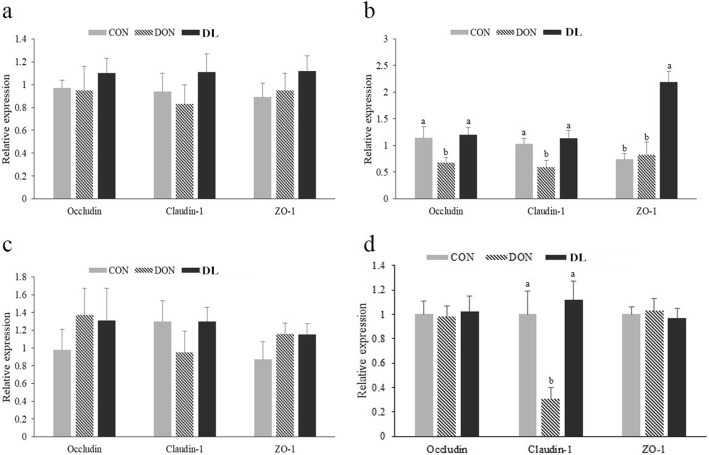
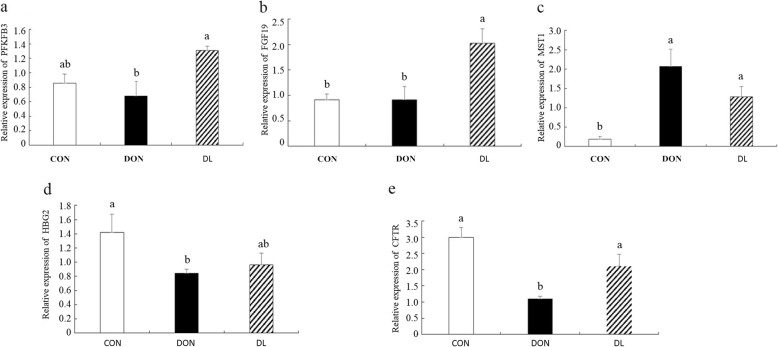
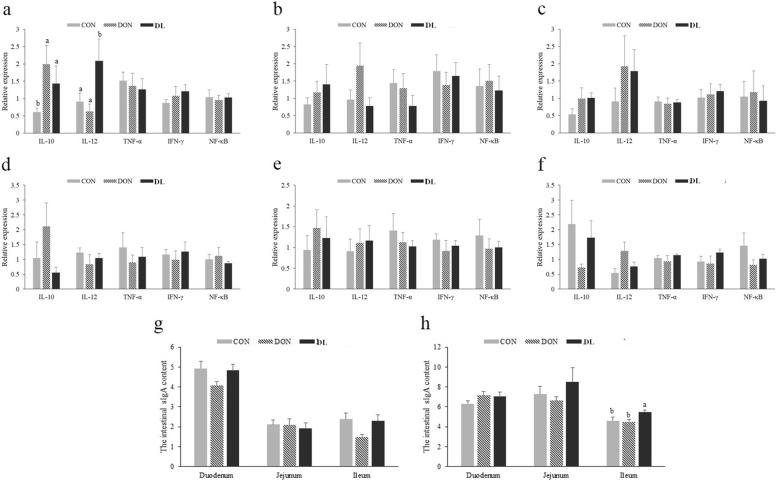
Compared with the CON and DL groups, the DON supplementation altered intestinal morphology, especially in duodenum and jejunum, where villi were shorter and crypts were deeper ( < 0.05). Meanwhile, the significantly decreased mRNA expression of jejunal claudin-1 and occludin ( < 0.05), ileal and jejunal of 21-day-old broilers ( < 0.05), as well as duodenal and ileal of 42-day-old broilers were identified in the DON group. Moreover, supplementation with JM113 could increase duodenal expression of and of 21-day-old broilers, ileal sIgA of 42-day-old broilers, and the bursa of Fabricius index of 21-day-old broilers. Further jejunal transcriptome proved that the genes related to the intestinal absorption and metabolism were significantly reduced in the DON group but a significant increase when supplemented with extra JM113. Furthermore, the bacteria related to nutrient utilization, including the Proteobacteria, , < 0.05, and ( < 0.1) were all decreased in the DON group. By contrast, supplementation with JM113 increased the relative abundance of beneficial bacterium, including the Bacteroidetes, , , , and ( < 0.05). Specifically, the increased abundance of bacteria in the DL group could be proved by the significantly increased caecal content of propionic acid, n-Butyric acid, and total short-chain fatty acid.
JM113 enhanced the digestion, absorption, and metabolic functions of the gut when challenged with DON by reducing the injury to intestinal barriers and by increasing the abundance of beneficial bacterium.
关于[具体物质]对脱氧雪腐镰刀菌烯醇(DON)肠道毒性影响的研究有限。本研究旨在探讨[具体物质]JM113在预防DON引起的肠道毒性中的作用。
将144只1日龄健康爱拔益加肉鸡随机分为3组,包括对照组(基础日粮)、DON组(额外添加10 mg/kg脱氧雪腐镰刀菌烯醇)和DL组(在DON组基础上额外添加1×10⁶CFU/kg[具体物质]JM113)。评估生长性能、器官指数、肠道形态、胰腺消化酶、肠道分泌型免疫球蛋白A(sIgA)、空肠转录组和肠道微生物群。
与对照组和DL组相比,添加DON改变了肠道形态,尤其是十二指肠和空肠,绒毛变短,隐窝加深(P<0.05)。同时,在DON组中,21日龄肉鸡空肠紧密连接蛋白-1和闭合蛋白的mRNA表达显著降低(P<0.05),回肠[具体基因1]和空肠[具体基因2]降低(P<0.05),42日龄肉鸡十二指肠[具体基因3]和回肠[具体基因4]也降低。此外,添加[具体物质]JM113可增加21日龄肉鸡十二指肠[具体基因5]和[具体基因6]的表达、42日龄肉鸡回肠sIgA以及21日龄肉鸡法氏囊指数。进一步的空肠转录组分析表明,与肠道吸收和代谢相关的基因在DON组中显著减少,但额外添加[具体物质]JM113后显著增加。此外,与营养利用相关的细菌,包括变形菌门、[具体菌属1](P<0.05)、[具体菌属2](P<0.05)和[具体菌属3](P<0.1)在DON组中均减少。相比之下,添加[具体物质]JM113增加了有益菌的相对丰度,包括拟杆菌门、[具体菌属4]、[具体菌属5]、[具体菌属6]和[具体菌属7](P<0.05)。具体而言,DL组中细菌丰度的增加可通过盲肠内容物中丙酸、正丁酸和总短链脂肪酸的显著增加得到证明。
当受到DON攻击时,JM113通过减少对肠道屏障的损伤和增加有益菌的丰度,增强了肠道的消化、吸收和代谢功能。