Jamal Mohamed, Lewandowski Sara L, Lawton Matthew L, Huang George T-J, Ikonomou Laertis
Center for Regenerative Medicine, Boston University and Boston Medical Center, Boston, MA, USA.
Department of Bioscience Research, College of Dentistry, University of Tennessee Health Science Center, Memphis, TN, USA.
Stem Cell Res. 2018 Dec;33:100-109. doi: 10.1016/j.scr.2018.10.015. Epub 2018 Oct 10.
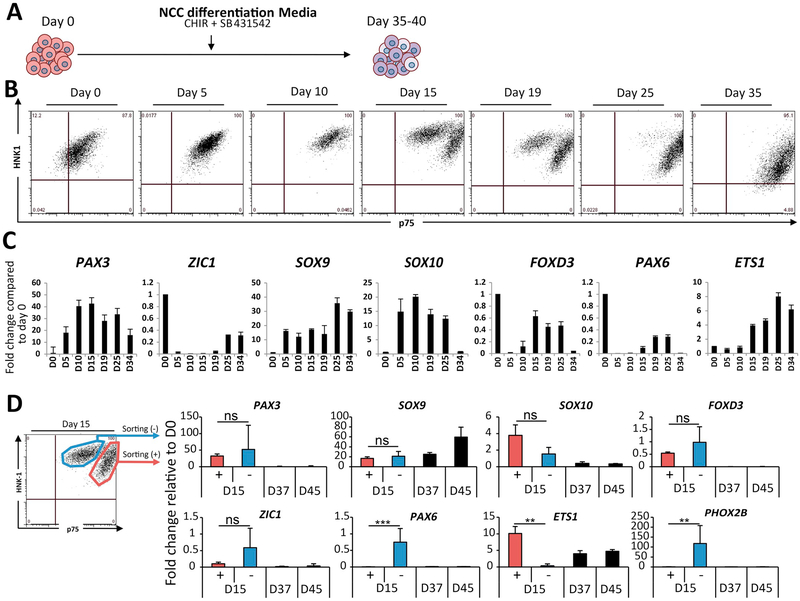
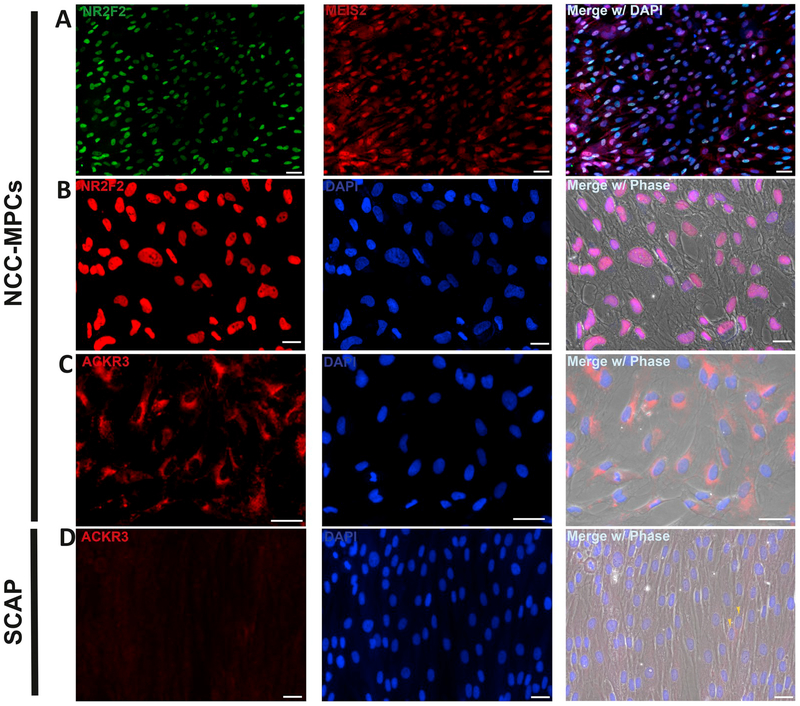
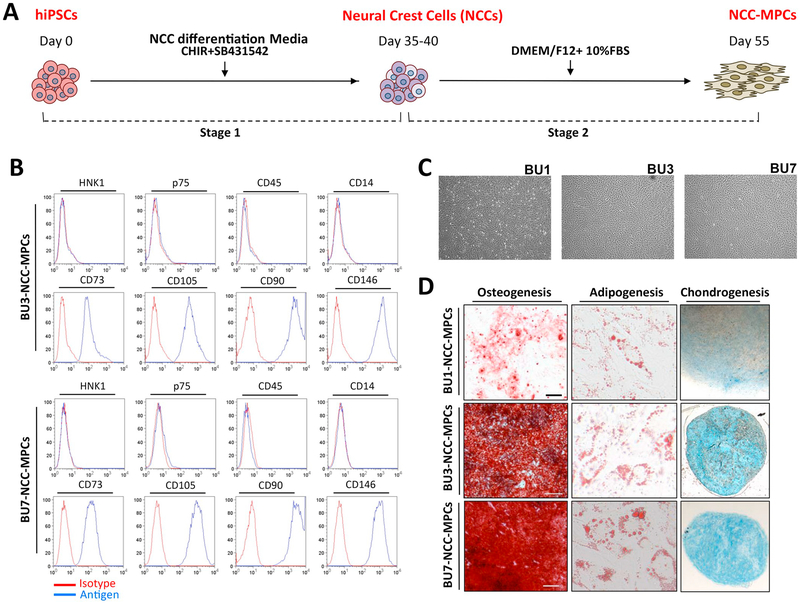
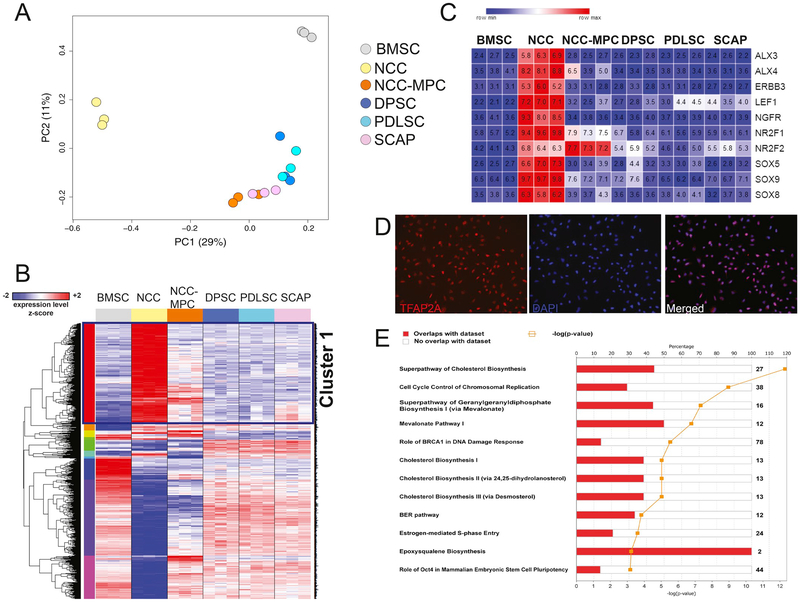
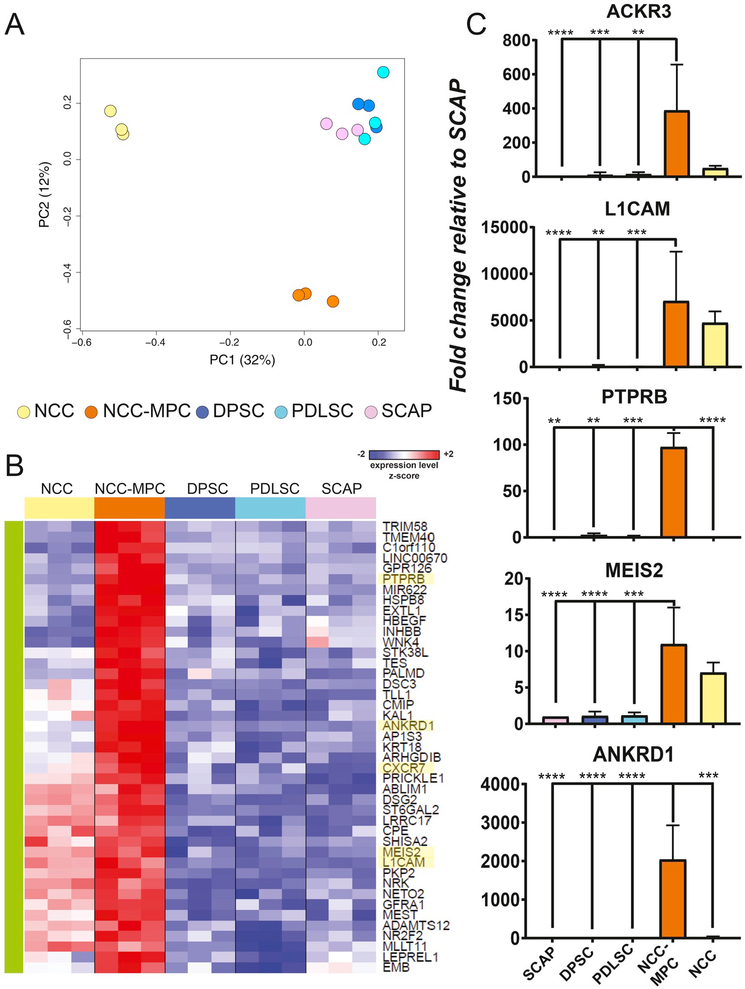
The introduction and widespread adoption of induced pluripotent stem cell (iPSC) technology has opened new avenues for craniofacial regenerative medicine. Neural crest cells (NCCs) are the precursor population to many craniofacial structures, including dental and periodontal structures, and iPSC-derived NCCs may, in the near future, offer an unlimited supply of patient-specific cells for craniofacial repair interventions. Here, we used an established protocol involving simultaneous Wnt signaling activation and TGF-β signaling inhibition to differentiate three human iPSC lines to cranial NCCs. We then derived a mesenchymal progenitor cell (NCC-MPCs) population with chondrogenic and osteogenic potential from cranial NCCs and investigated their similarity to widely studied human postnatal dental or periodontal stem/progenitor cells. NCC-MPCs were quite distinct from both their precursor cells (NCCs) and bone-marrow mesenchymal stromal cells, a stromal population of mesodermal origin. Despite their similarity with dental stem/progenitor cells, NCC-MPCs were clearly differentiated by a core set of 43 genes, including ACKR3 (CXCR7), whose expression (both at transcript and protein level) appear to be specific to NCC-MPCs. Altogether, our data demonstrate the feasibility of craniofacial mesenchymal progenitor derivation from human iPSCs through a neural crest-intermediate and set the foundation for future studies regarding their full differentiation repertoire and their in vivo existence.
诱导多能干细胞(iPSC)技术的引入和广泛应用为颅面再生医学开辟了新途径。神经嵴细胞(NCCs)是许多颅面结构的前体细胞群体,包括牙齿和牙周结构,并且在不久的将来,iPSC衍生的NCCs可能为颅面修复干预提供无限量的患者特异性细胞。在此,我们使用了一种既定方案,该方案涉及同时激活Wnt信号和抑制TGF-β信号,将三个人类iPSC系分化为颅神经嵴细胞。然后,我们从颅神经嵴细胞中获得了具有软骨生成和成骨潜力的间充质祖细胞(NCC-MPCs)群体,并研究了它们与广泛研究的人类出生后牙齿或牙周干/祖细胞的相似性。NCC-MPCs与其前体细胞(NCCs)和骨髓间充质基质细胞(一种中胚层来源的基质群体)都有很大不同。尽管NCC-MPCs与牙齿干/祖细胞相似,但它们通过一组43个核心基因明显区分开来,包括ACKR3(CXCR7),其表达(在转录和蛋白质水平)似乎是NCC-MPCs特有的。总之,我们的数据证明了通过神经嵴中间体从人类iPSC中获得颅面间充质祖细胞的可行性,并为未来关于其完全分化潜能及其体内存在的研究奠定了基础。