Meng Jialin, Fan Xinyao, Zhang Meng, Hao Zongyao, Liang Chaozhao
Department of Urology, The First Affiliated Hospital of Anhui Medical University, No. 218th, Jixi Road, Hefei, 230022, Anhui, China.
Institute of Urology, Anhui Medical University, No. 218th, Jixi Road, Hefei, 230022, Anhui, China.
BMC Med Genet. 2018 Oct 19;19(1):189. doi: 10.1186/s12881-018-0704-8.
Currently, several studies have demonstrated that PRKAA1 polymorphisms conduce to the development of cancer. PRKAA1 gene encodes the AMP-activated protein kinase summit-α1, and plays an important role in cell metabolism. Thus, we performed a systematic review and meta-analysis of all enrolled eligible case-control studies to obtain a precise correlation between PRKAA1 polymorphism and cancer susceptibility.
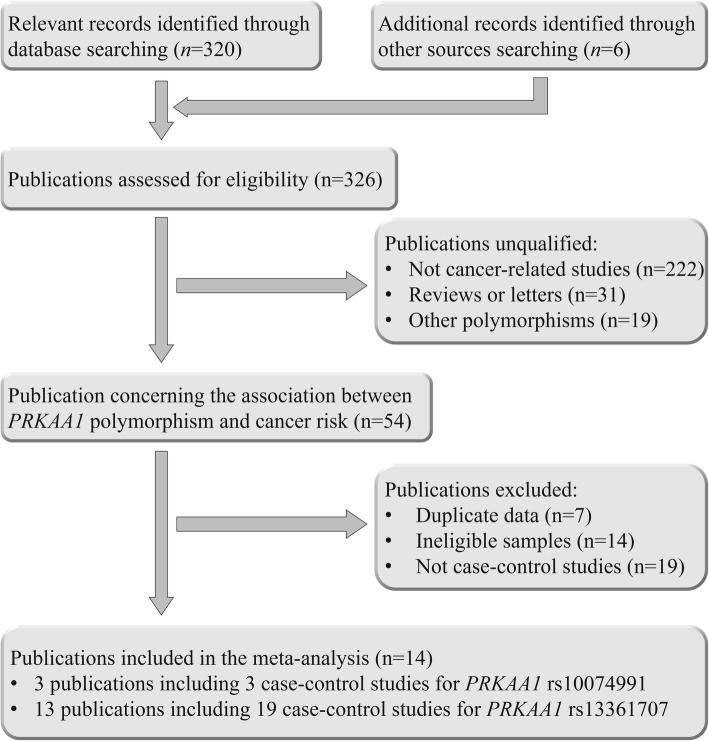
Extensive retrieve was performed in Web of Science, Google Scholar, PubMed, EMbase, CNKI and Wanfang databases up to August 26, 2018. Odds ratios (ORs) and 95% CIs were performed to evaluate the overall strength of the associations in five models, as well as in subgroup analyses, stratified by ethnicity, cancer type or source of control. Q-test, Egger's test and Begg's funnel plot were applied to evaluate the heterogeneity and publication bias. In-silico analysis was performed to demonstrate the relationship of PRKAA1 expression correlated with cancer tissues and survival time.
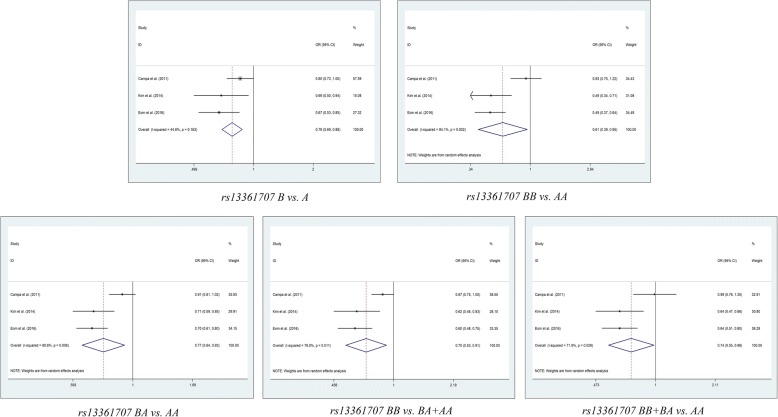
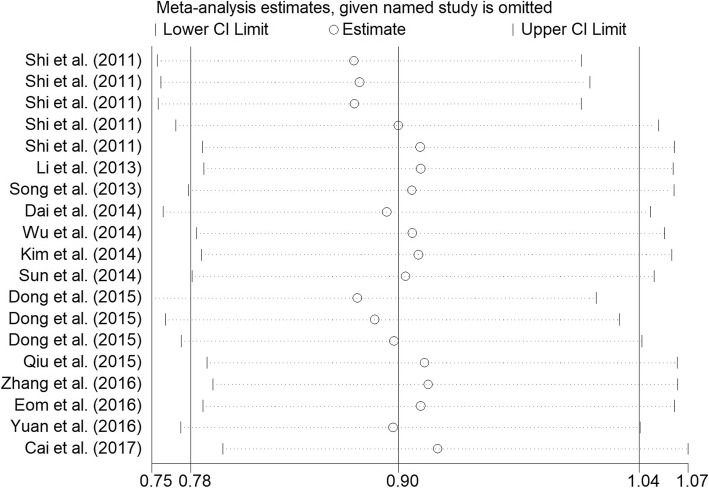
Twenty-two case-control studies from 14 publications were enrolled, with 17,068 cases and 20,871 controls for rs13361707, and 2514 cases and 3193 controls for rs10074991. Overall, we identified that the PRKAA1 rs13361707 polymorphism is not significantly associated with cancer susceptibility under all five genetic models. For rs10074991, we revealed a significant decrease risk in allelic comparison model (B vs. A: OR = 0.774, 95% CI = 0.642-0.931, P = 3.37610), heterozygote comparison model (BA vs. AA: OR = 0.779 95%CI = 0.691-0.877, P = 9.8610;), and dominant genetic model (BB + BA vs. AA: OR = 0.697 95%CI = 0.533-0.912, P = 4.211*10;). Evidence from TCGA database and GTEx projects indicated that the expression of PRKAA1 in gastric cancer tissue is higher, compared to normal stomach tissue, as well as it in breast cancer and esophageal squamous cell carcinoma. However, the Kaplan-Meier estimate showed that there is no significant difference of OS and RFS between the low and high PRKAA1 TPM groups in gastric cancer, breast cancer, and esophageal carcinoma.
To sum up, PRKAA1 rs13361707 polymorphism is not participant with the increased risk of cancer, while the A allele of PRKAA1 rs10074991 revealed a significant decrease risk.
目前,多项研究表明PRKAA1基因多态性与癌症的发生发展有关。PRKAA1基因编码AMP激活的蛋白激酶α1亚基,在细胞代谢中起重要作用。因此,我们对所有纳入的合格病例对照研究进行了系统评价和荟萃分析,以明确PRKAA1基因多态性与癌症易感性之间的精确关联。
截至2018年8月26日,在Web of Science、谷歌学术、PubMed、EMbase、中国知网和万方数据库中进行了广泛检索。采用比值比(OR)和95%可信区间(CI)在五种模型中评估关联的总体强度,并在亚组分析中按种族、癌症类型或对照来源进行分层。应用Q检验、Egger检验和Begg漏斗图评估异质性和发表偏倚。进行了电子分析以证明PRKAA1表达与癌组织和生存时间的关系。
纳入了14篇文献中的22项病例对照研究,rs13361707有17068例病例和20871例对照,rs10074991有2514例病例和3193例对照。总体而言,我们发现PRKAA1 rs13361707多态性在所有五种遗传模型下均与癌症易感性无显著关联。对于rs10074991,我们发现在等位基因比较模型(B vs. A:OR = 0.774,95%CI = 0.642 - 0.931,P = 3.376×10)、杂合子比较模型(BA vs. AA:OR = 0.779,95%CI = 0.691 - 0.877,P = 9.86×10)和显性遗传模型(BB + BA vs. AA:OR = 0.697,95%CI = 0.533 - 0.912,P = 4.211×1)中风险显著降低。来自TCGA数据库和GTEx项目的证据表明,与正常胃组织以及乳腺癌和食管鳞状细胞癌相比,PRKAA1在胃癌组织中的表达更高。然而,Kaplan-Meier估计显示,在胃癌、乳腺癌和食管癌中,PRKAA1低TPM组和高TPM组之间的总生存期(OS)和无复发生存期(RFS)无显著差异。
综上所述,PRKAA1 rs13361707多态性与癌症风险增加无关,而PRKAA1 rs10074991的A等位基因显示风险显著降低。