Pfister Stephan, Boulay Anne-Marie, Berger Markus, Hadjikakou Michalis, Motoshita Masaharu, Hess Tim, Ridoutt Brad, Weinzettel Jan, Scherer Laura, Döll Petra, Manzardo Alessandro, Núñez Montserrat, Verones Francesca, Humbert Sebastien, Buxmann Kurt, Harding Kevin, Benini Lorenzo, Oki Taikan, Finkbeiner Matthias, Henderson Andrew
Institute of Environmental Engineering, Chair of Ecological System Design, ETH Zurich, 8039 Zurich, Switzerland.
CIRAIG, Sherbrooke University, Sherbrooke (QC), Canada.
Ecol Indic. 2017 Jan;72:352-359. doi: 10.1016/j.ecolind.2016.07.051.
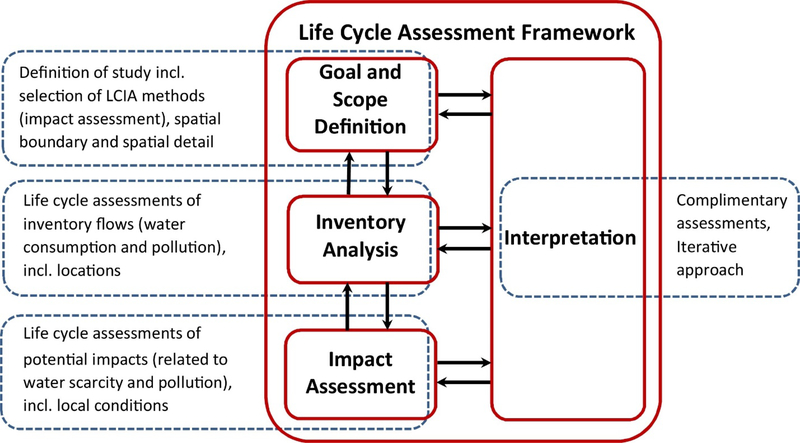
Water footprinting has emerged as an important approach to assess water use related effects from consumption of goods and services. Assessment methods are proposed by two different communities, the Water Footprint Network (WFN) and the Life Cycle Assessment (LCA) community. The proposed methods are broadly similar and encompass both the computation of water use and its impacts, but differ in communication of a water footprint result. In this paper, we explain the role and goal of LCA and ISO-compatible water footprinting and resolve the six issues raised by Hoekstra (2016) in "A critique on the water-scarcity weighted water footprint in LCA". By clarifying the concerns, we identify both the overlapping goals in the WFN and LCA water footprint assessments and discrepancies between them. The main differing perspective between the WFN and LCA-based approach seems to relate to the fact that LCA aims to account for environmental impacts, while the WFN aims to account for water productivity of global fresh water as a limited resource. We conclude that there is potential to use synergies in research for the two approaches and highlight the need for proper declaration of the methods applied.
水足迹已成为评估商品和服务消费所产生的与用水相关影响的一种重要方法。水足迹网络(WFN)和生命周期评估(LCA)这两个不同的团体提出了评估方法。所提出的方法大致相似,都包括用水量及其影响的计算,但在水足迹结果的表述上有所不同。在本文中,我们解释了LCA和与ISO兼容的水足迹的作用和目标,并解决了Hoekstra(2016年)在《对LCA中水稀缺加权水足迹的批判》中提出的六个问题。通过澄清这些问题,我们确定了WFN和LCA水足迹评估中的重叠目标以及它们之间的差异。WFN方法与基于LCA的方法之间的主要不同观点似乎在于,LCA旨在考虑环境影响,而WFN旨在将全球淡水作为一种有限资源来考虑水生产力。我们得出结论,两种方法在研究中存在协同作用的潜力,并强调了正确声明所应用方法的必要性。