Shigekawa Yoshinobu, Hayami Shinya, Ueno Masaki, Miyamoto Atsushi, Suzaki Norihiko, Kawai Manabu, Hirono Seiko, Okada Ken-Ichi, Hamamoto Ryuji, Yamaue Hiroki
Second Department of Surgery, School of Medicine, Wakayama Medical University, Wakayama, Japan.
Division of Molecular Modification and Cancer Biology, National Cancer Center Research Institute, Tokyo, Japan.
Oncotarget. 2018 Sep 28;9(76):34320-34335. doi: 10.18632/oncotarget.26144.
BACKGROUND & AIMS: Hepatocellular carcinoma (HCC) has high potential for recurrence, even in curative operative cases. Although several molecular-targeting drugs have been applied to recurrent HCC, their effectiveness has been limited. This study therefore aims to develop novel cancer drugs through protein methylation.
We investigated the role of KDM5B/JARID1B, a member of JmjC histone demethylase, in HCC. Expression profiles of KDM5B were examined by immunohistochemical analysis in 105 HCC clinical tissue samples. To examine functional effects of KDM5B using HCC cell lines, we performed loss-of-function analysis treated with KDM5B-specific small interfering RNAs (siKDM5B).
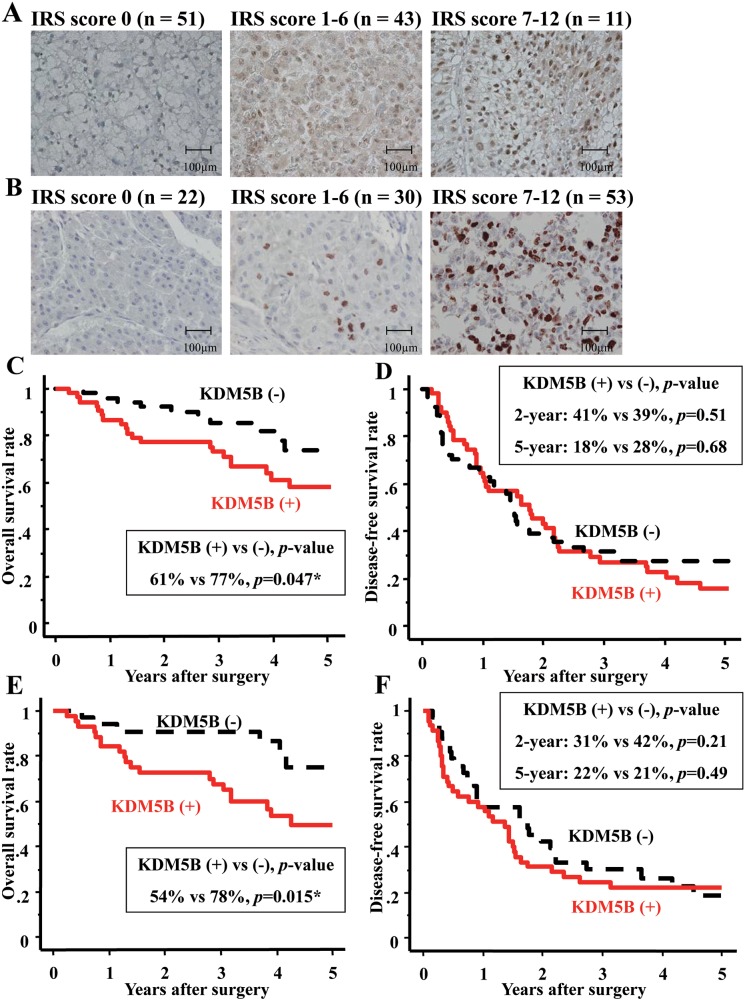
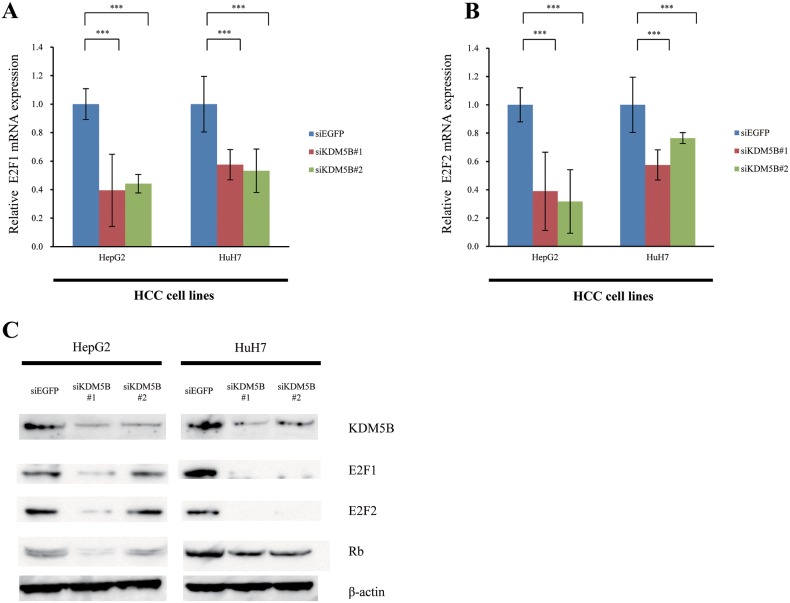
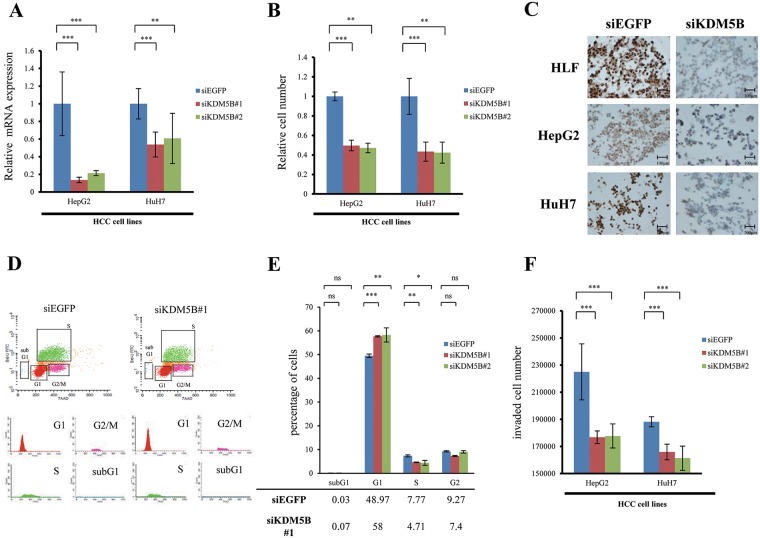
All HCC cases were divided into KDM5B-positive expression group (n=54) and negative expression group (n=51). In five-year overall survival, KDM5B-positive group had poorer prognosis than KDM5B-negative (61% vs 77%, =0.047). KDM5B-positive group had much poorer prognosis than that of the negative group, especially in HCC derived from persistent infection of hepatitis B virus (HBV) or hepatitis C virus (HCV) (54% vs 78%, =0.015). Multivariate analysis indicated that KDM5B was the strongest risk factor for poor prognosis, especially in HCC derived from HBV/HCV. Inhibition of KDM5B could significantly suppress HCC cell proliferation through no promotion from G1 to S phase. Real-time PCR and Western blotting demonstrated that E2F1/E2F2 were downstream genes of KDM5B.
Overexpression of KDM5B results in poor prognosis in HCC that especially derived from HBV/HCV. KDM5B appears to be an ideal target for the development of anti-cancer drugs.
肝细胞癌(HCC)即便在接受根治性手术的病例中也具有较高的复发可能性。尽管多种分子靶向药物已应用于复发性HCC,但它们的疗效有限。因此,本研究旨在通过蛋白质甲基化开发新型抗癌药物。
我们研究了JmjC组蛋白去甲基化酶成员KDM5B/JARID1B在HCC中的作用。通过免疫组织化学分析检测了105例HCC临床组织样本中KDM5B的表达谱。为了使用HCC细胞系检测KDM5B的功能效应,我们用KDM5B特异性小干扰RNA(siKDM5B)进行了功能缺失分析。
所有HCC病例分为KDM5B阳性表达组(n = 54)和阴性表达组(n = 51)。在五年总生存率方面,KDM5B阳性组的预后比KDM5B阴性组差(61%对77%,P = 0.047)。KDM5B阳性组的预后比阴性组差得多,尤其是在源自乙型肝炎病毒(HBV)或丙型肝炎病毒(HCV)持续感染的HCC中(54%对78%,P = 0.015)。多变量分析表明,KDM5B是预后不良的最强危险因素,尤其是在源自HBV/HCV的HCC中。抑制KDM5B可通过不促进从G1期到S期而显著抑制HCC细胞增殖。实时PCR和蛋白质印迹表明E2F1/E2F2是KDM5B的下游基因。
KDM5B的过表达导致HCC预后不良,尤其是源自HBV/HCV的HCC。KDM5B似乎是开发抗癌药物的理想靶点。