Patel Nirav P, Sanyal Mallika, Sharma Naveen, Patel Dinesh S, Shrivastav Pranav S, Patel Bhavin N
Bioanalytical Laboratory, Cliantha Research India Ltd., Bodakdev, Ahmedabad 380054, Gujarat, India.
Kadi Sarva Viswavidyalaya, Sector-15, Ghandhinagar 382715, Gujarat, India.
J Pharm Anal. 2018 Oct;8(5):341-347. doi: 10.1016/j.jpha.2018.06.002. Epub 2018 Jun 18.
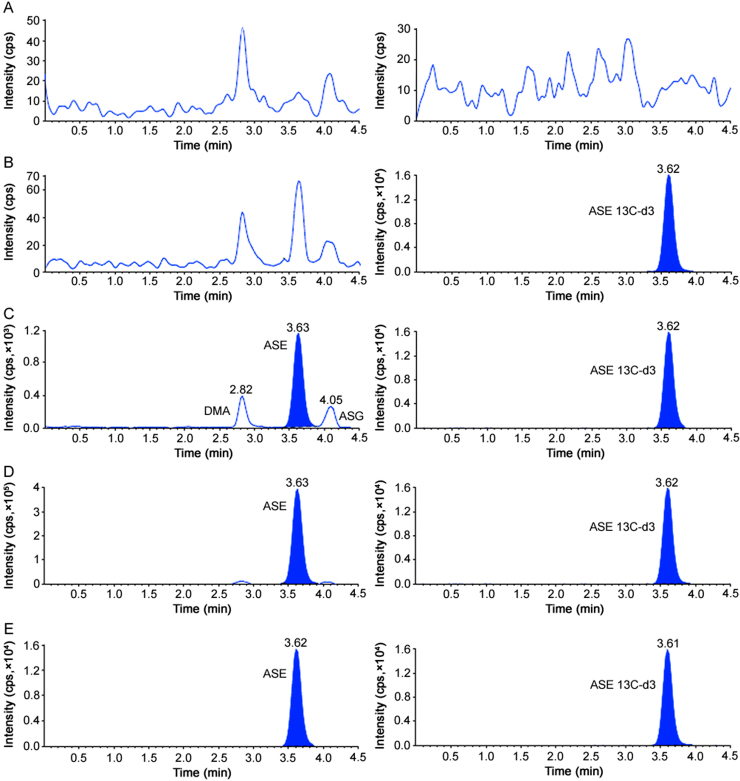
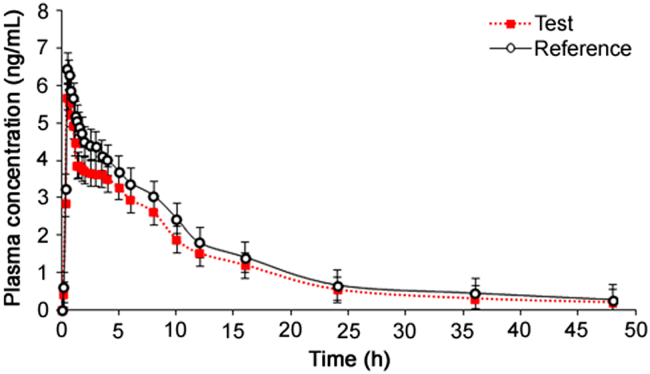
A highly selective and sensitive liquid chromatography-tandem mass spectrometry (LC-MS/MS) assay has been described for the determination of asenapine (ASE) in presence of its inactive metabolites -desmethyl asenapine (DMA) and asenapine--glucuronide (ASG). ASE, and ASE 13C-d3, used as internal standard (IS), were extracted from 300 µL human plasma by a simple and precise liquid-liquid extraction procedure using methyl -butyl ether. Baseline separation of ASE from its inactive metabolites was achieved on Chromolith Performance RP (100 mm × 4.6 mm) column using acetonitrile-5.0 mM ammonium acetate-10% formic acid (90:10:0.1, v/v/v) within 4.5 min. Quantitation of ASE was done on a triple quadrupole mass spectrometer equipped with electrospray ionization in the positive mode. The protonated precursor to product ion transitions monitored for ASE and ASE 13C-d3 were 286.1 → 166.0 and 290.0 → 166.1, respectively. The limit of detection (LOD) and limit of quantitation (LOQ) of the method were 0.0025 ng/mL and 0.050 ng/mL respectively in a linear concentration range of 0.050-20.0 ng/mL for ASE. The intra-batch and inter-batch precision (% CV) and mean relative recovery across quality control levels were ≤ 5.8% and 87.3%, respectively. Matrix effect, evaluated as IS-normalized matrix factor, ranged from 1.03 to 1.05. The stability of ASE under different storage conditions was ascertained in presence of the metabolites. The developed method is much simpler, matrix free, rapid and economical compared to the existing methods. The method was successfully used for a bioequivalence study of asenapine in healthy Indian subjects for the first time.
已描述了一种高选择性和高灵敏度的液相色谱-串联质谱(LC-MS/MS)分析法,用于在其无活性代谢物——去甲基阿塞那平(DMA)和阿塞那平-葡糖醛酸苷(ASG)存在的情况下测定阿塞那平(ASE)。使用甲基叔丁基醚,通过简单且精确的液-液萃取程序从300μL人血浆中萃取ASE和用作内标(IS)的ASE 13C-d3。在Chromolith Performance RP(100mm×4.6mm)色谱柱上,使用乙腈-5.0mM醋酸铵-10%甲酸(90:10:0.1,v/v/v),在4.5分钟内实现了ASE与其无活性代谢物的基线分离。在配备正模式电喷雾电离的三重四极杆质谱仪上对ASE进行定量。监测的ASE和ASE 13C-d3的质子化前体到产物离子的跃迁分别为286.1→166.0和290.0→166.1。该方法在ASE的线性浓度范围0.050 - 20.0ng/mL内,检测限(LOD)和定量限(LOQ)分别为0.0025ng/mL和0.050ng/mL。批内和批间精密度(%CV)以及跨质量控制水平的平均相对回收率分别≤5.8%和87.3%。以IS归一化基质因子评估的基质效应范围为1.03至1.05。在代谢物存在的情况下确定了ASE在不同储存条件下的稳定性。与现有方法相比,所开发的方法更简单、无基质、快速且经济。该方法首次成功用于健康印度受试者中阿塞那平的生物等效性研究。