Thompson Michael J, Chwiałkowska Karolina, Rubbi Liudmilla, Lusis Aldons J, Davis Richard C, Srivastava Anuj, Korstanje Ron, Churchill Gary A, Horvath Steve, Pellegrini Matteo
Molecular, Cell and Developmental Biology, University of California Los Angeles, Los Angeles, CA 90095, USA.
Centre for Bioinformatics and Data Analysis, Medical University of Bialystok, Bialystok, Poland.
Aging (Albany NY). 2018 Oct 21;10(10):2832-2854. doi: 10.18632/aging.101590.
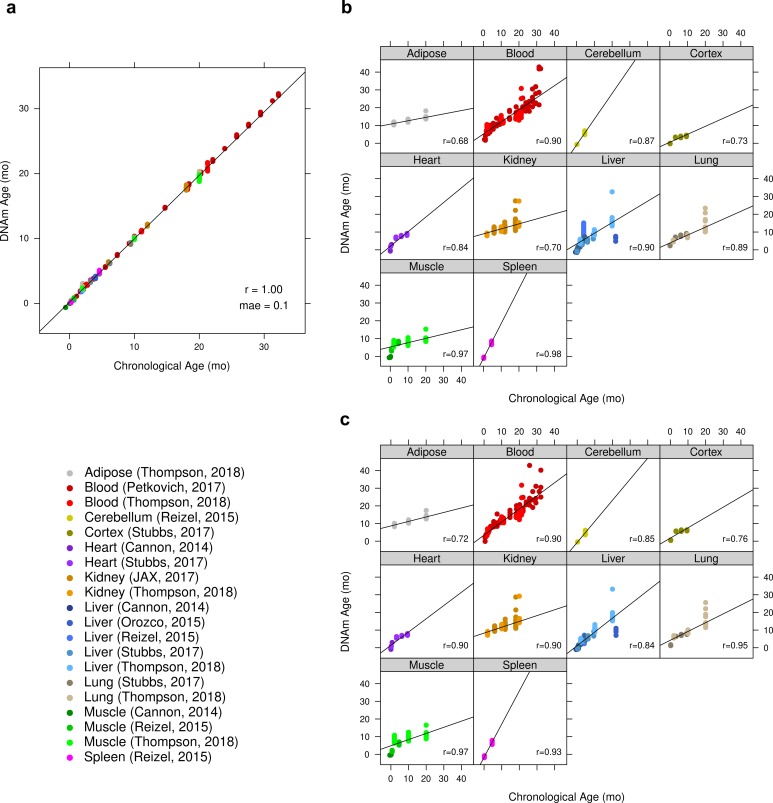
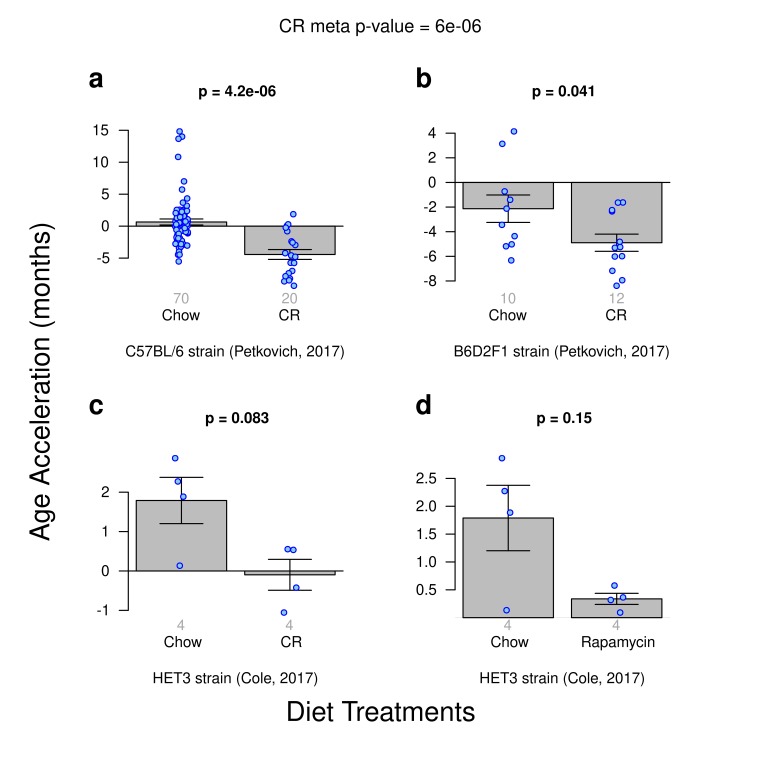
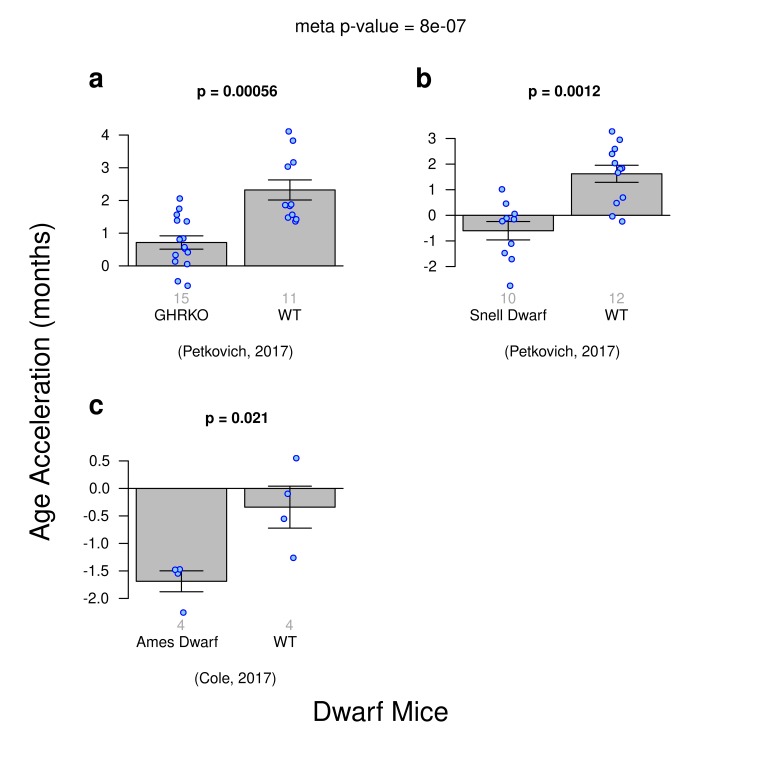
Human DNA-methylation data have been used to develop highly accurate biomarkers of aging ("epigenetic clocks"). Recent studies demonstrate that similar epigenetic clocks for mice () can be slowed by gold standard anti-aging interventions such as calorie restriction and growth hormone receptor knock-outs. Using DNA methylation data from previous publications with data collected in house for a total 1189 samples spanning 193,651 CpG sites, we developed 4 novel epigenetic clocks by choosing different regression models (elastic net- versus ridge regression) and by considering different sets of CpGs (all CpGs vs highly conserved CpGs). We demonstrate that accurate age estimators can be built on the basis of highly conserved CpGs. However, the most accurate clock results from applying elastic net regression to all CpGs. While the anti-aging effect of calorie restriction could be detected with all types of epigenetic clocks, only ridge regression based clocks replicated the finding of slow epigenetic aging effects in dwarf mice. Overall, this study demonstrates that there are trade-offs when it comes to epigenetic clocks in mice. Highly accurate clocks might not be optimal for detecting the beneficial effects of anti-aging interventions.
人类DNA甲基化数据已被用于开发高度准确的衰老生物标志物(“表观遗传时钟”)。最近的研究表明,类似的小鼠表观遗传时钟可以通过热量限制和生长激素受体基因敲除等金标准抗衰老干预措施来减缓。利用先前出版物中的DNA甲基化数据以及我们内部收集的数据,总共1189个样本涵盖193,651个CpG位点,我们通过选择不同的回归模型(弹性网络回归与岭回归)以及考虑不同的CpG集合(所有CpG与高度保守的CpG)开发了4种新型表观遗传时钟。我们证明,可以基于高度保守的CpG构建准确的年龄估计器。然而,最准确的时钟是通过对所有CpG应用弹性网络回归得到的。虽然所有类型的表观遗传时钟都能检测到热量限制的抗衰老作用,但只有基于岭回归的时钟重复了侏儒小鼠表观遗传衰老效应减缓的发现。总体而言,这项研究表明,在小鼠表观遗传时钟方面存在权衡。高度准确的时钟可能并非检测抗衰老干预有益效果的最佳选择。