Åstrand Laboratory of Work Physiology, The Swedish School of Sport and Health Sciences, Stockholm, Sweden.
Research Department, HPI Health Profile Institute, Danderyd, Sweden.
Scand J Med Sci Sports. 2019 Feb;29(2):232-239. doi: 10.1111/sms.13328. Epub 2018 Nov 15.
Long-term trend analyses of cardiorespiratory fitness (VO max) in the general population are limited.
To describe trends in VO max from 1995 to 2017 in the Swedish working force and to study developments across categories of sex, age, education, and geographic regions.
A total of 354 277 participants (44% women, 18-74 years) who participated in a nationwide occupational health service screening between 1995 and 2017 were included. Changes in standardized mean values of absolute (L/min) and relative (mL/min/kg) VO max, and the proportion with low (<32) relative VO max are reported. VO max was estimated using a submaximal cycle test.
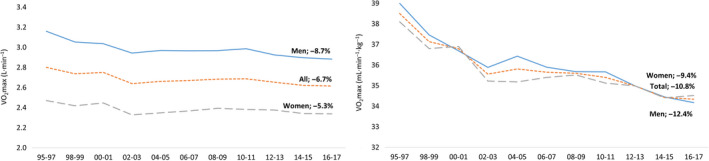
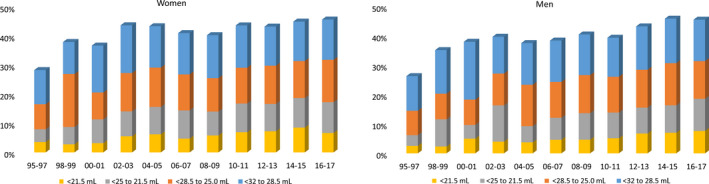
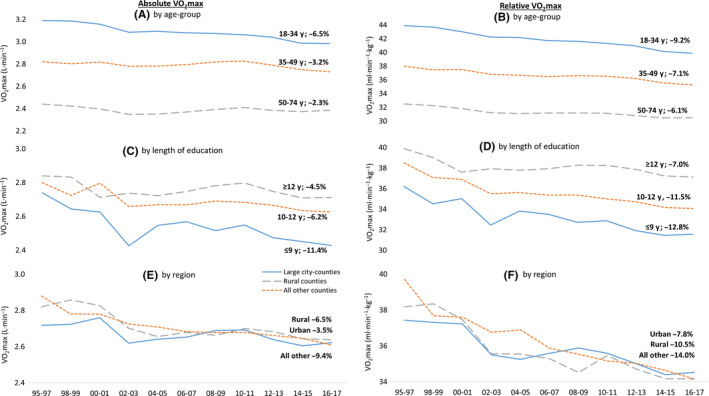
Absolute VO max decreased by -6.7% (-0.19 L/min) in the total population. Relative VO max decreased by -10.8% (-4.2 mL/min/kg) with approximately one-third explained by a simultaneous increase in body mass. Decreases in absolute fitness were more pronounced in men vs women (8.7% vs 5.3%), in younger vs older (6.5% vs 2.3%), in short (11.4%) vs long (4.5%) education, and in rural vs urban regions (6.5% vs 3.5%), all P < 0.001. The proportions with low VO max increased from 27% to 46% (P < 0.001).
Between 1995 and 2017, there was a steady and pronounced decline in mean cardiorespiratory fitness in Swedish adults. Male gender, young age, short education, and living in a rural area were predictive of greater reductions. The proportion with low cardiorespiratory fitness almost doubled. Given the strong associations between cardiorespiratory fitness and multiple morbidities and mortality, preventing further decreases is a clear public health priority, especially for vulnerable groups.
有关普通人群心肺功能(VO max)的长期趋势分析有限。
描述瑞典劳动力中从 1995 年到 2017 年 VO max 的趋势,并研究性别、年龄、教育程度和地理区域等类别的发展情况。
共纳入 354277 名(44%为女性,年龄 18-74 岁)在 1995 年至 2017 年期间参加全国性职业健康服务筛查的参与者。报告了绝对(L/min)和相对(mL/min/kg)VO max 的标准化平均值的变化,以及相对 VO max 较低(<32)的比例。VO max 使用亚最大循环测试进行估计。
总人口的绝对 VO max 下降了-6.7%(-0.19 L/min)。相对 VO max 下降了-10.8%(-4.2 mL/min/kg),约三分之一归因于体重的同时增加。与女性相比,男性(8.7%比 5.3%)、年轻(6.5%比 2.3%)、短(11.4%)与长(4.5%)教育程度和农村(6.5%比 3.5%)地区的绝对体能下降更为明显,所有 P 值均<0.001。VO max 低的比例从 27%增加到 46%(P<0.001)。
1995 年至 2017 年间,瑞典成年人的平均心肺功能呈稳步显著下降趋势。男性性别、年轻、教育程度短和居住在农村地区是预测更大降幅的因素。VO max 低的比例几乎翻了一番。鉴于心肺功能与多种疾病和死亡率之间存在很强的关联,防止进一步下降是明确的公共卫生优先事项,特别是对于弱势群体。