Department of Pediatrics, University of Rochester School of Medicine and Dentistry, Rochester, NY, USA.
Statistics and Epidemiology Unit, RTI International, Research Triangle Park, NC, USA.
J Perinatol. 2019 Feb;39(2):193-202. doi: 10.1038/s41372-018-0259-8. Epub 2018 Oct 23.
To compare neurodevelopmental outcomes in linear growth-restricted (LGR) infants born <29 weeks with and without weight gain out of proportion to linear growth.
We compared 2-year neurodevelopmental outcomes between infants with and without LGR and between LGR infants with and without weight gain out of proportion to linear growth. The outcomes were Bayley-III cognitive, motor, and language scores, cerebral palsy, Gross Motor Function Classification System (GMFCS) level ≥ 2, and neurodevelopmental impairment.
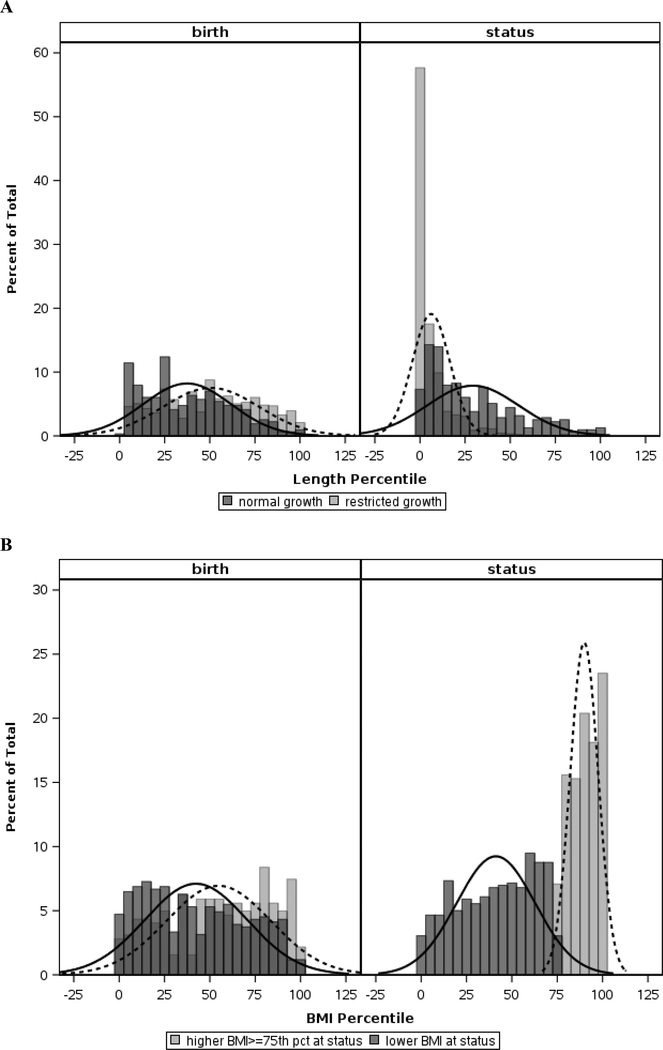
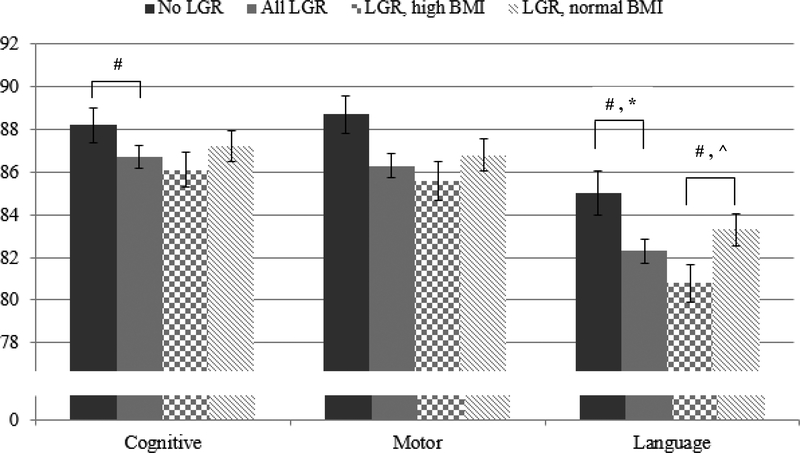
In total, 1227 infants were analyzed. LGR infants were smaller and less mature at birth, had higher BMI, and had lower Bayley-III language scores (82.3 vs. 85.0, p < 0.05). Among infants with LGR, infants with high BMI had lower language scores compared with those with low-to-normal BMI (80.8 vs. 83.3, p < 0.05), and were more likely to have GMFCS level ≥2 and neurodevelopmental impairment.
Among infants with LGR, weight gain out of proportion to linear growth was associated with poorer neurodevelopmental outcomes.
比较<29 周出生的线性生长受限(LGR)婴儿中,与线性生长不成比例的体重增加和无体重增加的神经发育结局。
我们比较了有和无 LGR 以及有和无与线性生长不成比例的体重增加的 LGR 婴儿的 2 年神经发育结局。结局是贝利 III 认知、运动和语言评分、脑瘫、粗大运动功能分类系统(GMFCS)水平≥2 和神经发育障碍。
共分析了 1227 名婴儿。LGR 婴儿出生时更小、更不成熟,体重指数更高,且贝利 III 语言评分更低(82.3 比 85.0,p<0.05)。在 LGR 婴儿中,高体重指数的婴儿语言评分低于低至正常体重指数的婴儿(80.8 比 83.3,p<0.05),且更有可能出现 GMFCS 水平≥2 和神经发育障碍。
在 LGR 婴儿中,与线性生长不成比例的体重增加与较差的神经发育结局相关。