Pesapane Filippo, Codari Marina, Sardanelli Francesco
Postgraduate School in Radiodiagnostics, Università degli Studi di Milano, Via Festa del Perdono 7, 20122, Milan, Italy.
Unit of Radiology, IRCCS Policlinico San Donato, Via Morandi 30, 20097 San Donato Milanese, Milan, Italy.
Eur Radiol Exp. 2018 Oct 24;2(1):35. doi: 10.1186/s41747-018-0061-6.
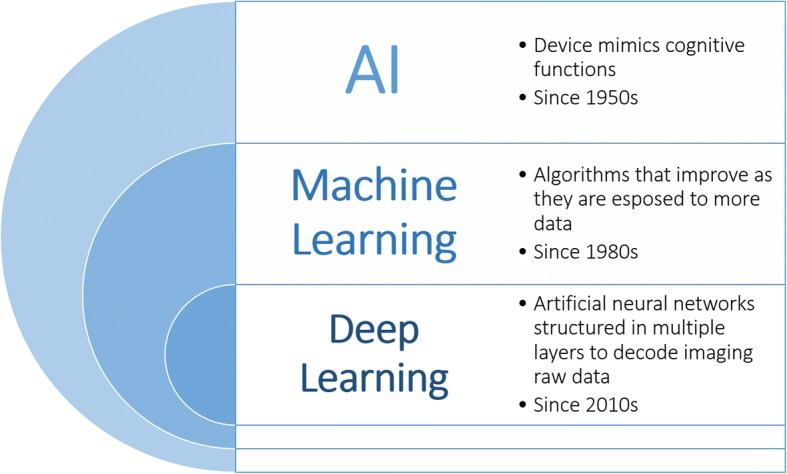
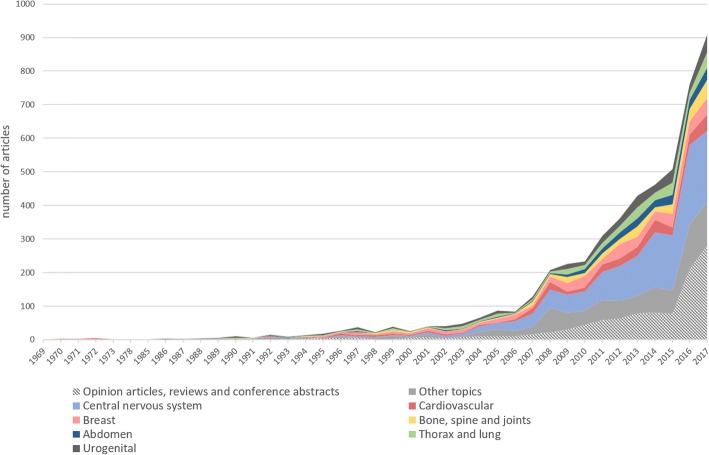
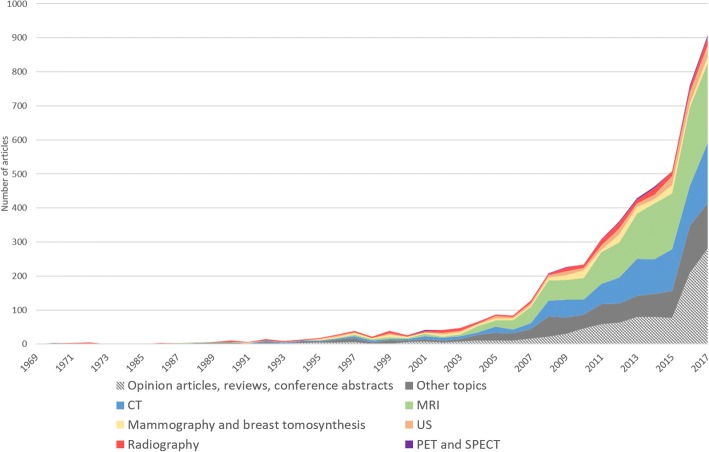
One of the most promising areas of health innovation is the application of artificial intelligence (AI), primarily in medical imaging. This article provides basic definitions of terms such as "machine/deep learning" and analyses the integration of AI into radiology. Publications on AI have drastically increased from about 100-150 per year in 2007-2008 to 700-800 per year in 2016-2017. Magnetic resonance imaging and computed tomography collectively account for more than 50% of current articles. Neuroradiology appears in about one-third of the papers, followed by musculoskeletal, cardiovascular, breast, urogenital, lung/thorax, and abdomen, each representing 6-9% of articles. With an irreversible increase in the amount of data and the possibility to use AI to identify findings either detectable or not by the human eye, radiology is now moving from a subjective perceptual skill to a more objective science. Radiologists, who were on the forefront of the digital era in medicine, can guide the introduction of AI into healthcare. Yet, they will not be replaced because radiology includes communication of diagnosis, consideration of patient's values and preferences, medical judgment, quality assurance, education, policy-making, and interventional procedures. The higher efficiency provided by AI will allow radiologists to perform more value-added tasks, becoming more visible to patients and playing a vital role in multidisciplinary clinical teams.
健康创新最具前景的领域之一是人工智能(AI)的应用,主要用于医学成像。本文提供了“机器学习/深度学习”等术语的基本定义,并分析了人工智能在放射学中的整合情况。关于人工智能的出版物数量已从2007 - 2008年的每年约100 - 150篇急剧增加到2016 - 2017年的每年700 - 800篇。磁共振成像和计算机断层扫描共同占当前文章的50%以上。神经放射学约占论文的三分之一,其次是肌肉骨骼、心血管、乳腺、泌尿生殖、肺/胸部和腹部,各占文章的6 - 9%。随着数据量的不可逆增加以及使用人工智能识别肉眼可检测或不可检测的发现的可能性,放射学现在正从一种主观感知技能转向一门更客观的科学。处于医学数字时代前沿的放射科医生可以指导将人工智能引入医疗保健领域。然而,他们不会被取代,因为放射学包括诊断沟通、考虑患者的价值观和偏好、医学判断、质量保证、教育、政策制定以及介入程序。人工智能提供的更高效率将使放射科医生能够执行更多增值任务,在患者眼中变得更加显眼,并在多学科临床团队中发挥至关重要的作用。