Communicable Disease Control Directorate, Department of Health, Shenton Park, Western Australia.
School of Medicine, University of Notre Dame, Fremantle, Western Australia.
BMC Pregnancy Childbirth. 2018 Oct 24;18(1):416. doi: 10.1186/s12884-018-2051-3.
Influenza and pertussis vaccines have been recommended in Australia for women during each pregnancy since 2010 and 2015, respectively. Estimating vaccination coverage and identifying factors affecting uptake are important for improving antenatal immunisation services.
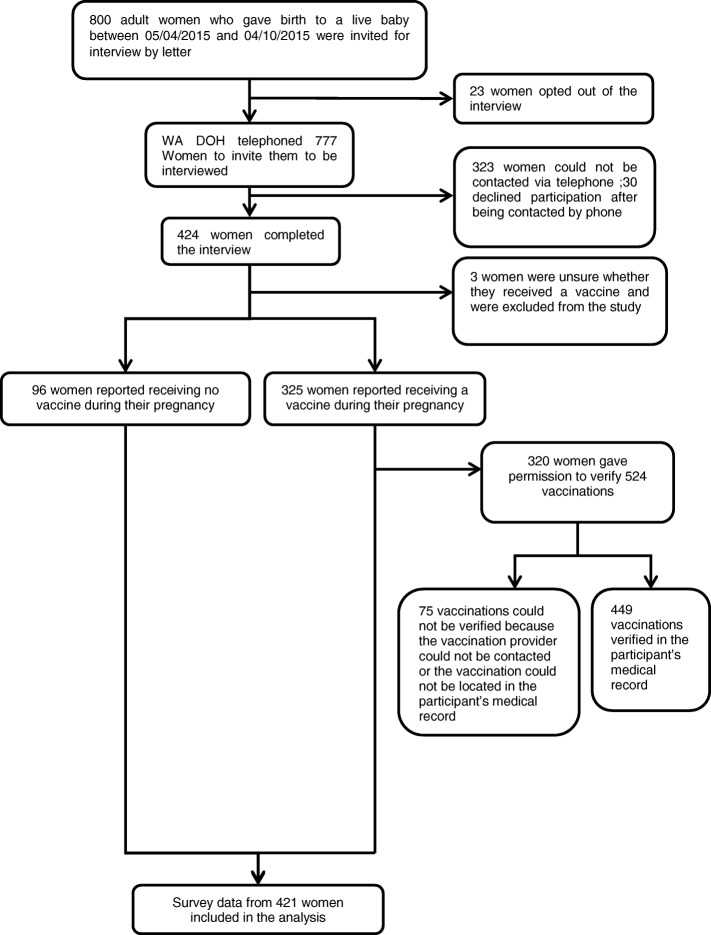
A random sample of 800 Western Australian women ≥18 years of age who gave birth between 4th April and 4th October 2015 were selected. Of the 454 (57%) who were contactable by telephone, 424 (93%) completed a survey. Data were weighted by maternal age and area of residence to ensure representativeness. The proportion immunised against influenza and pertussis was the main outcome measure; multivariate logistic regression was used to identify factors significantly associated with antenatal vaccination. Results from the 2015 study were compared to similar surveys conducted in 2012-2014.
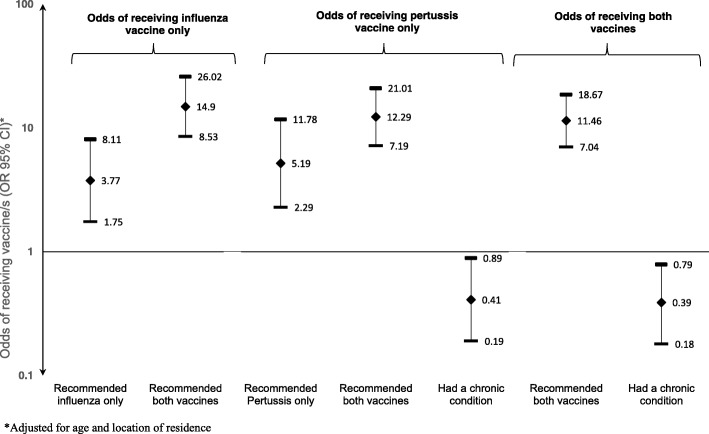
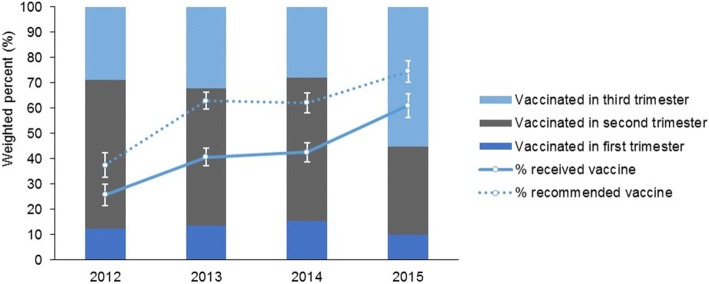
In 2015, 71% (95% CI 66-75) of women received pertussis-containing vaccine and 61% (95% CI 56-66) received influenza vaccine during pregnancy; antenatal influenza vaccine coverage was 18% higher than in 2014 (43%; 95% CI: 34-46). Pertussis and influenza vaccine were co-administered for 68% of the women who received both vaccines. The majority of influenza vaccinations in 2015 were administered during the third trimester of pregnancy, instead of the second trimester, as was observed in prior years. Women whose care provider recommended both antenatal vaccinations had significantly higher odds of being vaccinated against both influenza and pertussis (OR 33.3, 95% CI: 15.15-73.38). Of unvaccinated mothers, 53.6% (95% CI: 45.9-61.3) and 78.3% (95% CI: 70.4-85.3) reported that they would have been vaccinated against influenza and pertussis, respectively, if their antenatal care provider had recommended it.
Pertussis vaccination coverage was high in the first year of an antenatal immunisation program in Western Australia. Despite a substantial increase in influenza vaccination uptake between 2014 and 2015, coverage remained below that for pertussis. Our data suggest influenza and pertussis vaccination rates of 83% and 94%, respectively, are achievable if providers were to recommend them to all pregnant women.
自 2010 年和 2015 年以来,澳大利亚分别建议女性在每次怀孕期间接种流感疫苗和百日咳疫苗。评估疫苗接种覆盖率并确定影响接种率的因素对于改善产前免疫服务非常重要。
从 2015 年 4 月 4 日至 10 月 4 日期间在西澳大利亚分娩的 800 名年龄在 18 岁及以上的妇女中随机抽取了 800 名。在可通过电话联系的 454 名(57%)中,有 424 名(93%)完成了调查。通过母亲年龄和居住地区进行加权,以确保代表性。主要结局指标为针对流感和百日咳的免疫率;使用多变量逻辑回归确定与产前接种显著相关的因素。将 2015 年的研究结果与 2012-2014 年进行的类似调查进行了比较。
2015 年,71%(95%CI 66-75)的妇女接受了含百日咳疫苗,61%(95%CI 56-66)的妇女在怀孕期间接受了流感疫苗;产前流感疫苗覆盖率比 2014 年高 18%(43%;95%CI:34-46)。同时接受这两种疫苗的妇女中有 68%同时接种了百日咳和流感疫苗。与前几年相比,2015 年的大多数流感疫苗接种是在妊娠晚期,而不是妊娠中期进行的。如果其产前护理提供者同时推荐这两种疫苗,那么接受流感和百日咳疫苗的妇女接种疫苗的可能性要高得多(OR 33.3,95%CI:15.15-73.38)。在未接种疫苗的母亲中,分别有 53.6%(95%CI:45.9-61.3)和 78.3%(95%CI:70.4-85.3)报告说,如果他们的产前护理提供者建议接种疫苗,他们将分别接种流感疫苗和百日咳疫苗。
在西澳大利亚的产前免疫计划的第一年,百日咳疫苗的接种率很高。尽管 2014 年至 2015 年间流感疫苗的接种率大幅上升,但仍低于百日咳疫苗。如果提供者向所有孕妇推荐接种疫苗,我们的数据表明,分别达到 83%和 94%的流感和百日咳疫苗接种率是可行的。