Department of Integrative Structural and Computational Biology, The Scripps Research Institute, La Jolla, CA, 92037, USA.
Department of Biochemistry and Cellular Biology, Geisel School of Medicine at Dartmouth, Hanover, NH, 03755, USA.
Sci Rep. 2018 Oct 24;8(1):15701. doi: 10.1038/s41598-018-34171-7.
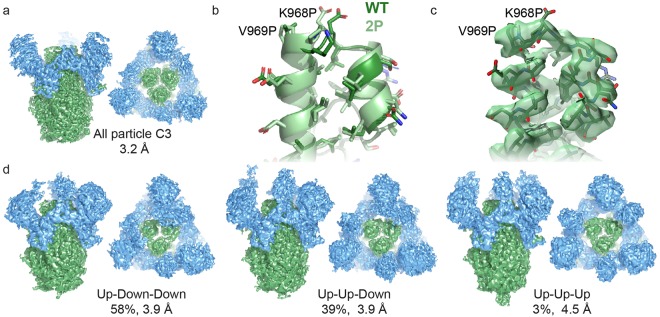
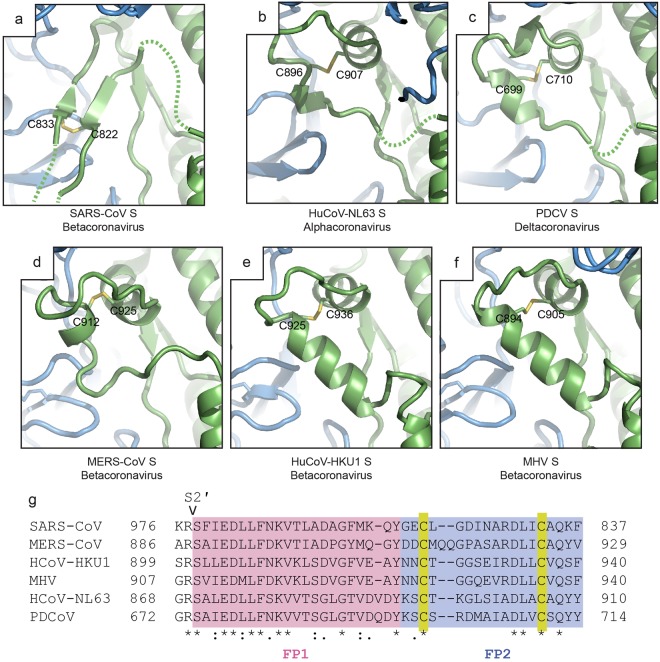
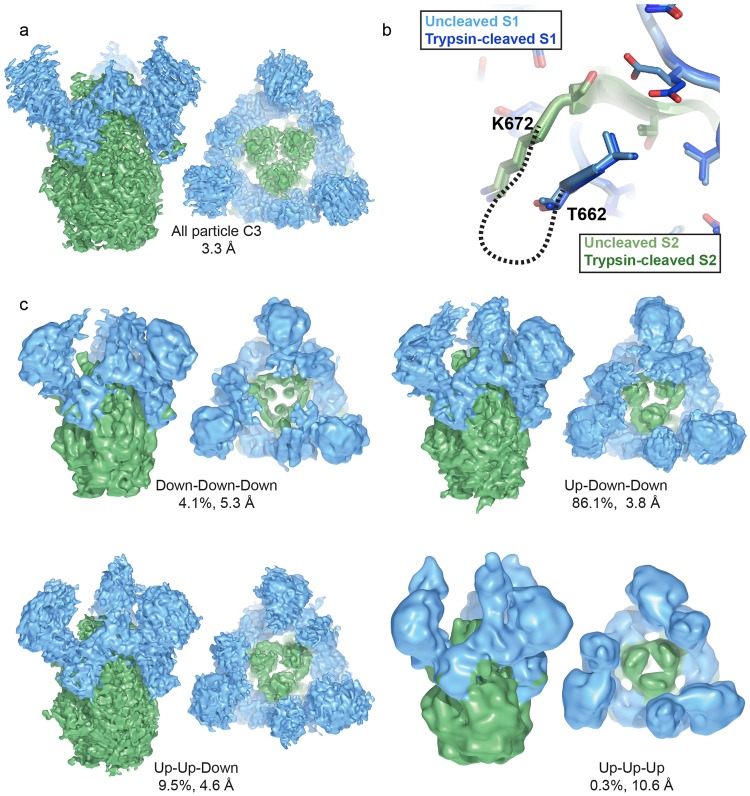
Severe acute respiratory syndrome coronavirus (SARS-CoV) emerged in 2002 as a highly transmissible pathogenic human betacoronavirus. The viral spike glycoprotein (S) utilizes angiotensin-converting enzyme 2 (ACE2) as a host protein receptor and mediates fusion of the viral and host membranes, making S essential to viral entry into host cells and host species tropism. As SARS-CoV enters host cells, the viral S is believed to undergo a number of conformational transitions as it is cleaved by host proteases and binds to host receptors. We recently developed stabilizing mutations for coronavirus spikes that prevent the transition from the pre-fusion to post-fusion states. Here, we present cryo-EM analyses of a stabilized trimeric SARS-CoV S, as well as the trypsin-cleaved, stabilized S, and its interactions with ACE2. Neither binding to ACE2 nor cleavage by trypsin at the S1/S2 cleavage site impart large conformational changes within stabilized SARS-CoV S or expose the secondary cleavage site, S2'.
严重急性呼吸综合征冠状病毒(SARS-CoV)于 2002 年出现,是一种高度可传播的致病性人β冠状病毒。病毒刺突糖蛋白(S)利用血管紧张素转换酶 2(ACE2)作为宿主蛋白受体,并介导病毒和宿主膜的融合,使 S 成为病毒进入宿主细胞和宿主种属嗜性的关键。当 SARS-CoV 进入宿主细胞时,病毒 S 被认为会经历多次构象转变,因为它被宿主蛋白酶切割并与宿主受体结合。我们最近开发了冠状病毒刺突的稳定突变,以防止从预融合状态向融合后状态的转变。在这里,我们展示了冷冻电镜分析稳定的三聚体 SARS-CoV S,以及胰蛋白酶切割的稳定 S 及其与 ACE2 的相互作用。与 ACE2 的结合或在 S1/S2 切割位点被胰蛋白酶切割都不会在稳定的 SARS-CoV S 内引起大的构象变化,也不会暴露次要切割位点 S2'。