Lin Han, Chen Yu, Shi Jianlin
State Key Laboratory of High Performance Ceramics and Superfine Microstructures Shanghai Institute of Ceramics Chinese Academy of Sciences Shanghai 200050 P. R. China.
University of Chinese Academy of Sciences Beijing 100049 P. R. China.
Adv Sci (Weinh). 2018 Jul 19;5(10):1800518. doi: 10.1002/advs.201800518. eCollection 2018 Oct.
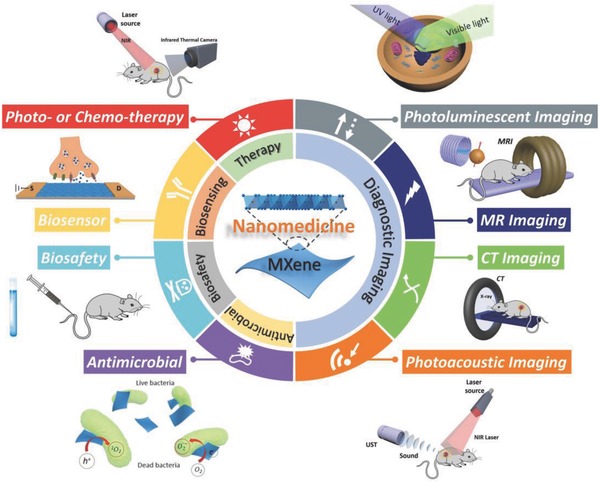
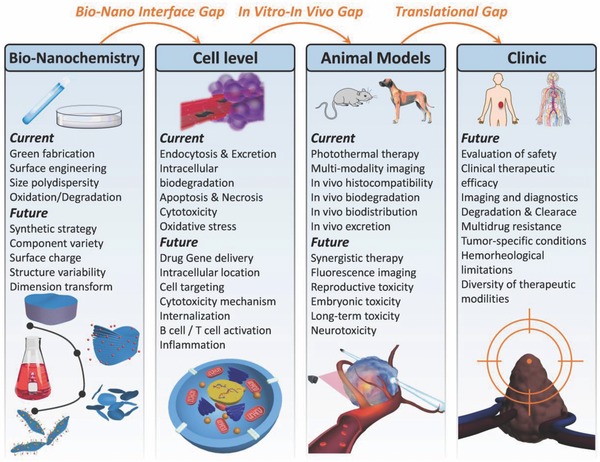
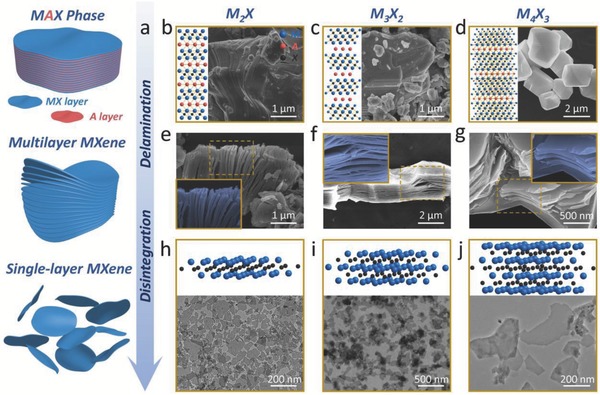
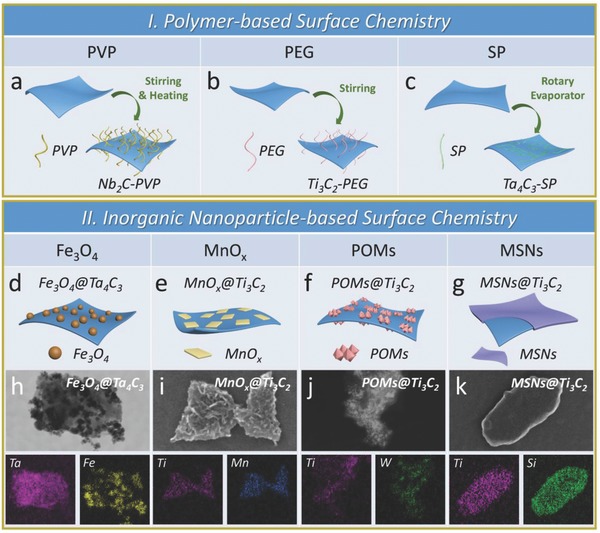
Great and interdisciplinary research efforts have been devoted to the biomedical applications of 2D materials because of their unique planar structure and prominent physiochemical properties. Generally, ceramic-based biomaterials, fabricated by high-temperature solid-phase reactions, are preferred as bone scaffolds in hard tissue engineering because of their controllable biocompatibility and satisfactory mechanical property, but their potential biomedical applications in disease theranostics are paid much less attention, mainly due to their lack of related material functionalities for possibly entering and circulating within the vascular system. The emerging 2D MXenes, a family of ultrathin atomic nanosheet materials derived from MAX phase ceramics, are currently booming as novel inorganic nanosystems for biologic and biomedical applications. The metallic conductivity, hydrophilic nature, and other unique physiochemical performances make it possible for the 2D MXenes to meet the strict requirements of biomedicine. This work introduces the very recent progress and novel paradigms of 2D MXenes for state-of-the-art biomedical applications, focusing on the design/synthesis strategies, therapeutic modalities, diagnostic imaging, biosensing, antimicrobial, and biosafety issues. It is highly expected that the elaborately engineered ultrathin MXenes nanosheets will become one of the most attractive biocompatible inorganic nanoplatforms for multiple and extensive biomedical applications to profit the clinical translation of nanomedicine.
由于二维材料独特的平面结构和突出的理化性质,人们在其生物医学应用方面投入了巨大的跨学科研究力量。一般来说,通过高温固相反应制备的陶瓷基生物材料,因其可控的生物相容性和令人满意的力学性能,在硬组织工程中作为骨支架备受青睐,但其在疾病诊疗中的潜在生物医学应用却很少受到关注,主要原因是它们缺乏可能进入血管系统并在其中循环的相关材料功能。新兴的二维MXenes是一类源自MAX相陶瓷的超薄原子纳米片材料,目前作为用于生物和生物医学应用的新型无机纳米系统正在蓬勃发展。金属导电性、亲水性以及其他独特的理化性能使二维MXenes能够满足生物医学的严格要求。本文介绍了二维MXenes在最先进生物医学应用方面的最新进展和新范例,重点关注设计/合成策略、治疗方式、诊断成像、生物传感、抗菌以及生物安全问题。人们高度期望精心设计的超薄MXenes纳米片将成为最具吸引力的生物相容性无机纳米平台之一,用于多种广泛的生物医学应用,以推动纳米医学的临床转化。