Ogawa Akiko, Takakura Keito, Sano Katsuhiko, Kanematsu Hideyuki, Yamano Takehiko, Saishin Toshikazu, Terada Satoshi
Department of Chemistry and Biochemistry, National Institute of Technology, Suzuka College, Suzuka 510-0294, Japan.
D&D Corporation, Yokkaichi 512-1211, Japan.
Antibiotics (Basel). 2018 Oct 22;7(4):91. doi: 10.3390/antibiotics7040091.
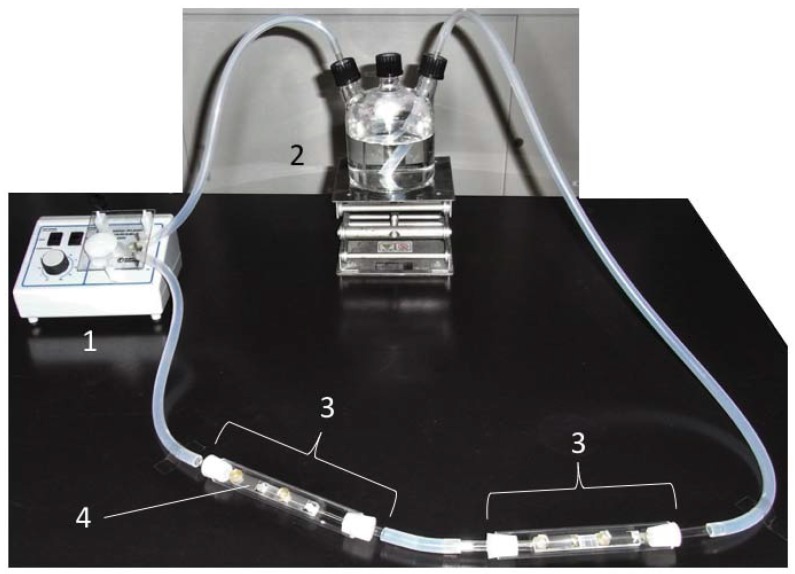
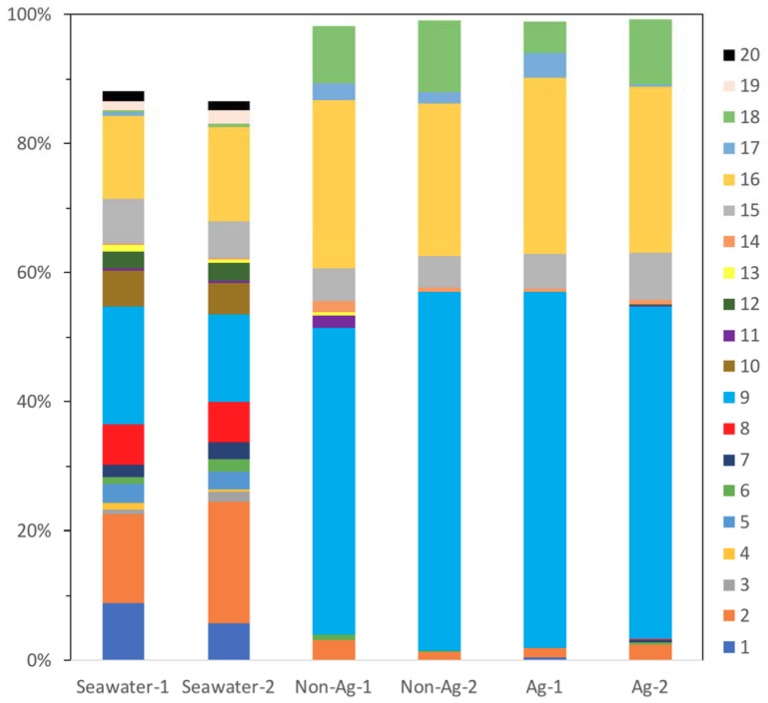
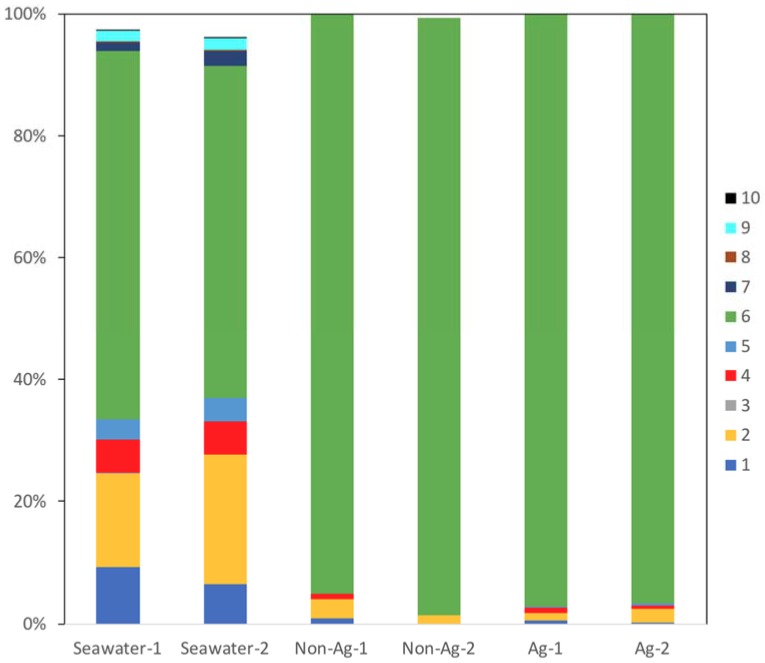
Previously, we demonstrated that silver nanoparticle-dispersed silane-based coating could inhibit biofilm formation in conditions where seawater was used as a bacterial source and circulated in a closed laboratory biofilm reactor. However, it is still unclear whether the microbiome of a biofilm of silver nanoparticle-dispersed silane-based coating samples (Ag) differs from that of a biofilm of non-dispersed silane-based coating samples (Non-Ag). This study aimed to perform a microbiome analysis of the biofilms grown on the aforementioned coatings using a next-generation sequencing (NGS) technique. For this, a biofilm formation test was conducted by allowing seawater to flow through a closed laboratory biofilm reactor; subsequently, DNAs extracted from the biofilms of Ag and Non-Ag were used to prepare 16S rRNA amplicon libraries to analyze the microbiomes by NGS. Results of the operational taxonomy unit indicated that the biofilms of Non-Ag and Ag comprised one and no phyla of archaea, respectively, whereas Proteobacteria was the dominant phylum for both biofilms. Additionally, in both biofilms, Non-Ag and Ag, was the primary bacterial group involved in early stage biofilm formation, whereas was primarily involved in late-stage biofilm formation. These results indicate that silver nanoparticles will be unrelated to the bacterial composition of biofilms on the surface of silane-based coatings, while they control biofilm formation there.
此前,我们证明了分散有银纳米颗粒的硅烷基涂层在以海水作为细菌来源并在封闭的实验室生物膜反应器中循环的条件下能够抑制生物膜形成。然而,分散有银纳米颗粒的硅烷基涂层样品(Ag)的生物膜微生物群与未分散的硅烷基涂层样品(非Ag)的生物膜微生物群是否存在差异仍不清楚。本研究旨在使用下一代测序(NGS)技术对在上述涂层上生长的生物膜进行微生物群分析。为此,通过让海水流经封闭的实验室生物膜反应器进行生物膜形成试验;随后,从Ag和非Ag生物膜中提取的DNA用于制备16S rRNA扩增子文库,以通过NGS分析微生物群。操作分类单元的结果表明,非Ag和Ag的生物膜分别包含一个古菌门和没有古菌门,而变形菌门是两种生物膜的主要门类。此外,在非Ag和Ag这两种生物膜中, 是参与生物膜早期形成的主要细菌类群,而 主要参与生物膜后期形成。这些结果表明,银纳米颗粒与硅烷基涂层表面生物膜的细菌组成无关,而它们在那里控制生物膜形成。