Department of Mechanical and Aerospace Engineering, University of California, San Diego, CA 92093, USA.
Biomolecules. 2018 Oct 23;8(4):120. doi: 10.3390/biom8040120.
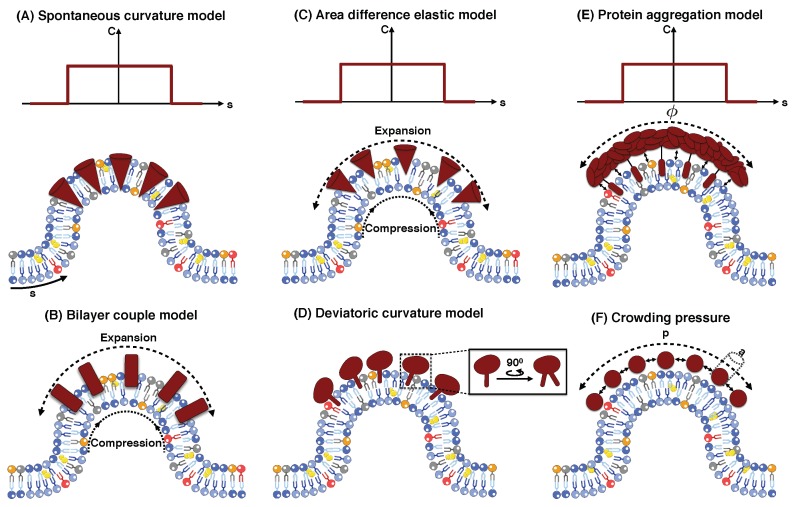
To alter and adjust the shape of the plasma membrane, cells harness various mechanisms of curvature generation. Many of these curvature generation mechanisms rely on the interactions between peripheral membrane proteins, integral membrane proteins, and lipids in the bilayer membrane. Mathematical and computational modeling of membrane curvature generation has provided great insights into the physics underlying these processes. However, one of the challenges in modeling these processes is identifying the suitable constitutive relationships that describe the membrane free energy including protein distribution and curvature generation capability. Here, we review some of the commonly used continuum elastic membrane models that have been developed for this purpose and discuss their applications. Finally, we address some fundamental challenges that future theoretical methods need to overcome to push the boundaries of current model applications.
为了改变和调整等离子体膜的形状,细胞利用各种曲率产生机制。许多这些曲率产生机制依赖于外周膜蛋白、整合膜蛋白和双层膜中的脂质之间的相互作用。膜曲率产生的数学和计算建模为这些过程的物理基础提供了深刻的见解。然而,在对这些过程进行建模时面临的挑战之一是确定合适的本构关系,这些关系描述了包括蛋白质分布和曲率产生能力在内的膜自由能。在这里,我们回顾了为此目的而开发的一些常用的连续弹性膜模型,并讨论了它们的应用。最后,我们讨论了未来理论方法需要克服的一些基本挑战,以推动当前模型应用的边界。