State Key Laboratory of Oncology in South China, Collaborative Innovation Center for Cancer Medicine, Sun Yat-sen University Cancer Center, 651 Dongfeng East Road, Guangzhou 510060, China; Guangdong Esophageal Cancer Institute, 651 Dongfeng East Road, Guangzhou 510060, China.
Guangdong Esophageal Cancer Institute, 651 Dongfeng East Road, Guangzhou 510060, China; Department of Thoracic Oncology, Sun Yat-sen University Cancer Center, 651 Dongfeng East Road, Guangzhou 510060, China.
EBioMedicine. 2018 Nov;37:110-124. doi: 10.1016/j.ebiom.2018.10.043. Epub 2018 Oct 23.
Dysregulation of the cell cycle has been implicated in esophageal squamous cell carcinoma (ESCC) progression. This study aimed to evaluate the role of miR-424 in cell cycle regulation and ESCC proliferation.
The role of miR-424 in cell proliferation was evaluated in vitro and in vivo. Transcriptional activation of miR-424 was determined using chromatin immunoprecipitation, and binding of miR-424 to targets was verified using miRNA ribonucleoprotein complex immunoprecipitation.
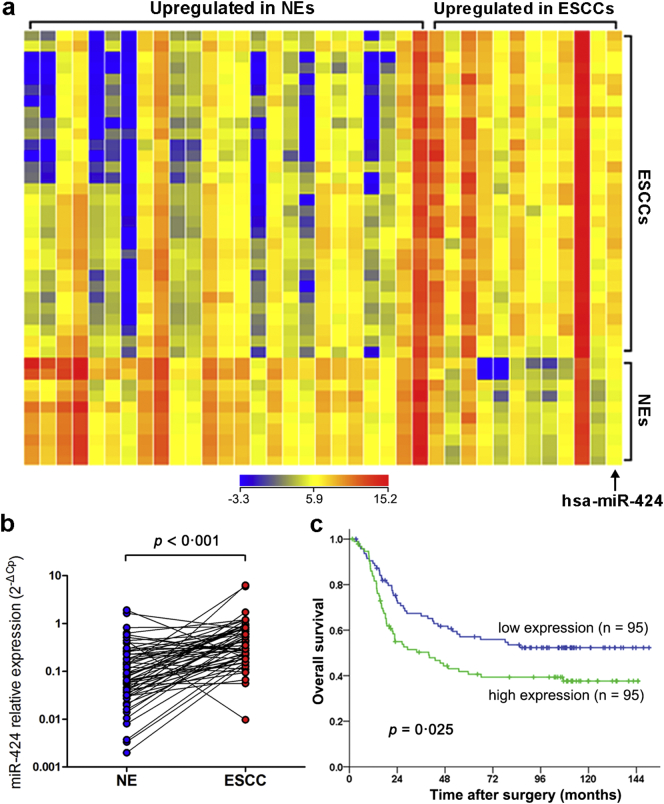
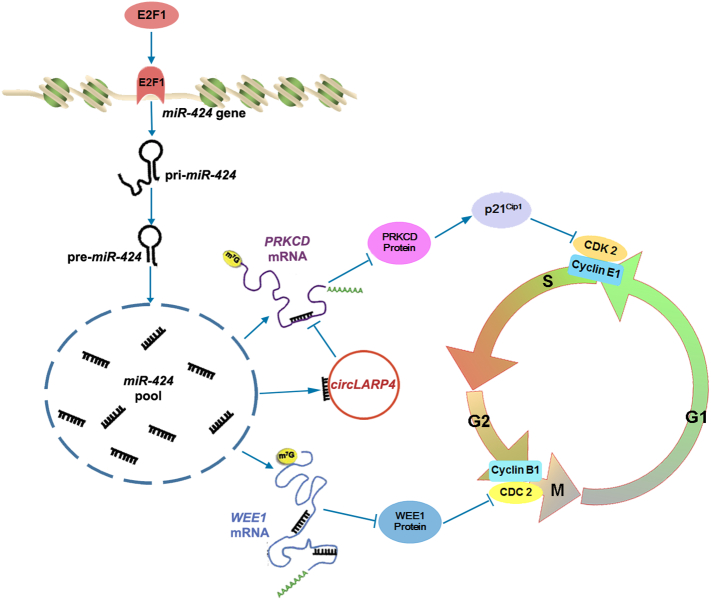
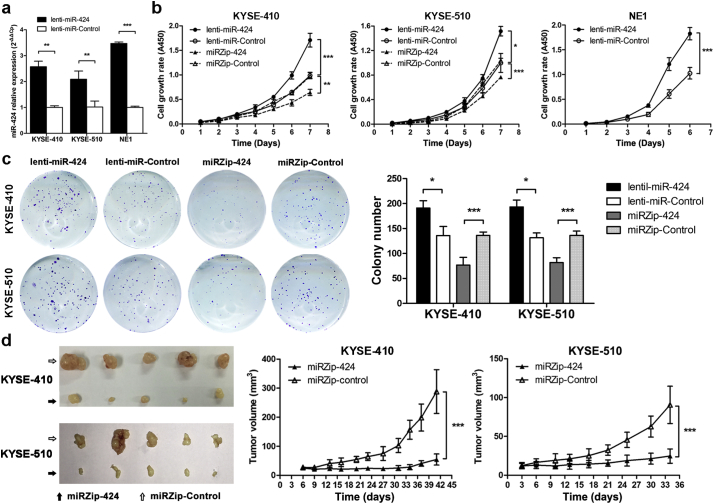
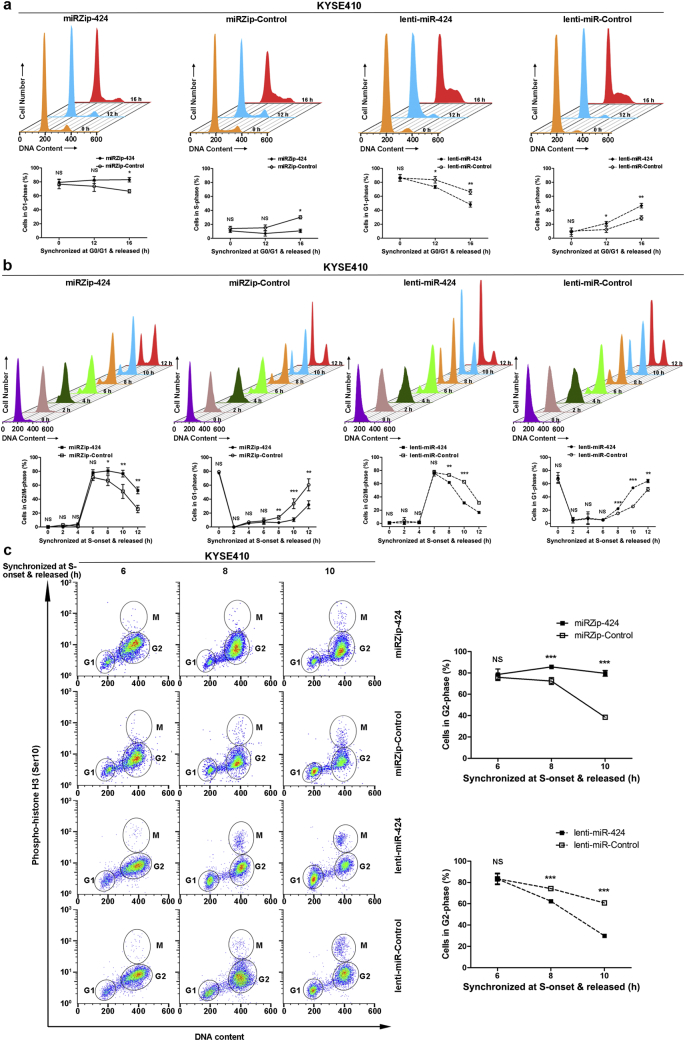
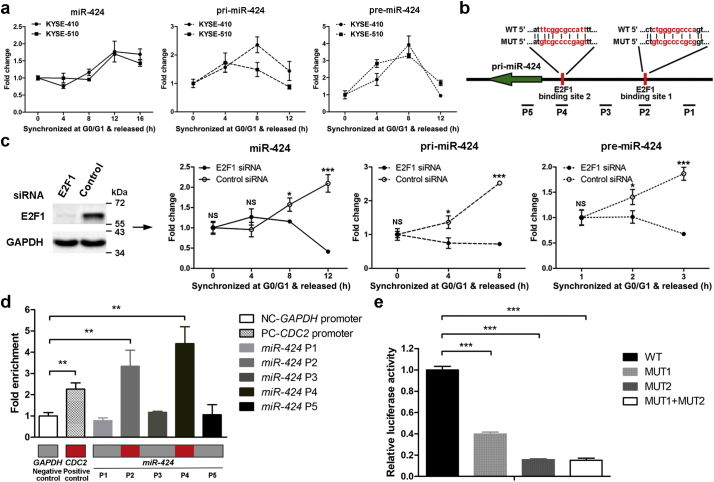
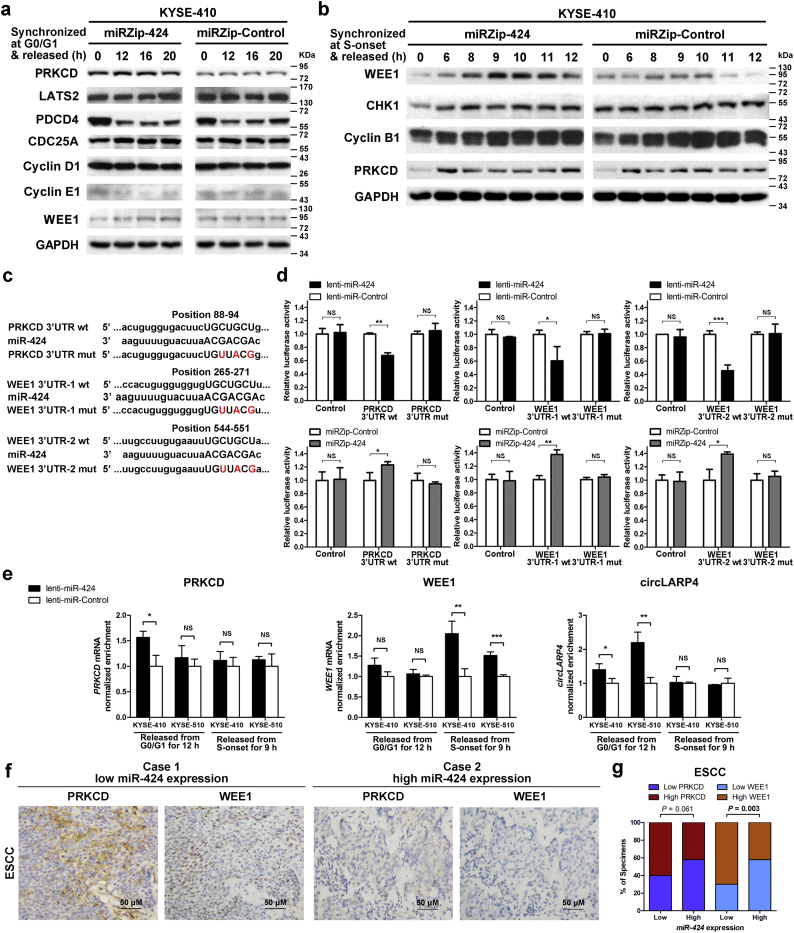
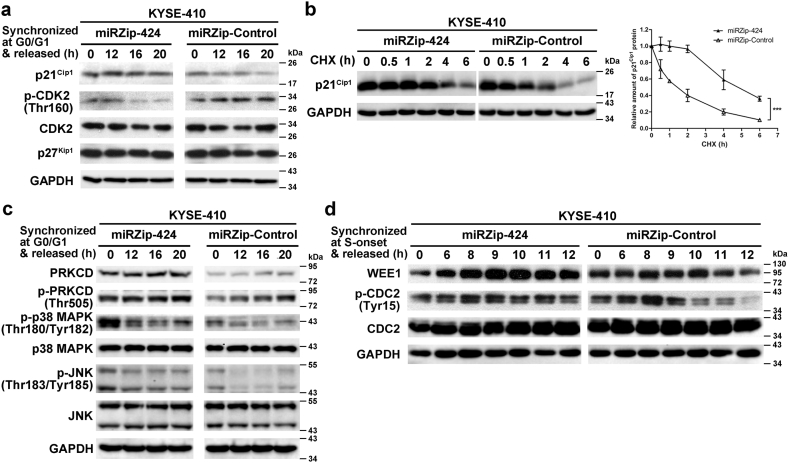
miR-424 was upregulated and correlated with poor survival in ESCC patients. Repression or overexpression of miR-424 respectively decreased or increased ESCC cell proliferation in vitro and in vivo. miR-424 expression is transcriptionally regulated by E2F1 and increased during G1/S transition. Knockdown or overexpression of miR-424 respectively inhibited or promoted both G1/S and G2/M cell cycle transitions in ESCC cells, and these effects were mediated by two newly identified miR-424 targets, PRKCD and WEE1, respectively. Consequently, elevation of PRKCD by miR-424 knockdown led to enhanced stability of the p21 protein via increased activation of PRKCD and downstream p38 MAPK and JNK signaling to block CDK2 activation and G1/S transition, while elevated WEE1 maintained CDC2 in an inactive state to block G2/M transition. However, circLARP4 could sponge the binding of miR-424 to PRKCD, thus compromising the regulation of G1/S progression by miR-424.
miR-424 coordinates a previously unknown, multilayered regulation of ESCC cell cycle progression to promote ESCC proliferation, and may be used as a novel prognostic marker and an effective therapeutic target for ESCCs. FUND: National Natural Science Foundation of China.
细胞周期失调与食管鳞状细胞癌(ESCC)的进展有关。本研究旨在评估 miR-424 在细胞周期调控和 ESCC 增殖中的作用。
在体外和体内评估 miR-424 对细胞增殖的作用。通过染色质免疫沉淀测定 miR-424 的转录激活,通过 miRNA 核糖核蛋白复合物免疫沉淀验证 miR-424 与靶标的结合。
miR-424 在 ESCC 患者中上调,并与不良预后相关。miR-424 的抑制或过表达分别降低或增加了 ESCC 细胞的体外和体内增殖。miR-424 的表达受 E2F1 的转录调控,并在 G1/S 转换期间增加。miR-424 的敲低或过表达分别抑制或促进 ESCC 细胞的 G1/S 和 G2/M 细胞周期转换,这些作用分别由两个新鉴定的 miR-424 靶标 PRKCD 和 WEE1 介导。因此,miR-424 下调导致 PRKCD 的升高,通过增加 PRKCD 及其下游 p38 MAPK 和 JNK 信号的激活来稳定 p21 蛋白,从而阻止 CDK2 的激活和 G1/S 转换,而升高的 WEE1 使 CDC2 保持非活性状态,从而阻止 G2/M 转换。然而,circLARP4 可以与 miR-424 竞争结合 PRKCD,从而损害 miR-424 对 G1/S 进展的调控。
miR-424 协调了一个未知的、多层次的 ESCC 细胞周期进展调控,以促进 ESCC 的增殖,并且可以作为 ESCC 的一种新的预后标志物和有效的治疗靶点。
国家自然科学基金。