Department of Comparative Endocrinology, Medical University of Lodz, Lodz, 90-752, Poland.
Laboratory of Cell Cultures and Genomic Analysis, Medical University of Lodz, Lodz, 90-752, Poland.
Sci Rep. 2018 Oct 25;8(1):15772. doi: 10.1038/s41598-018-34049-8.
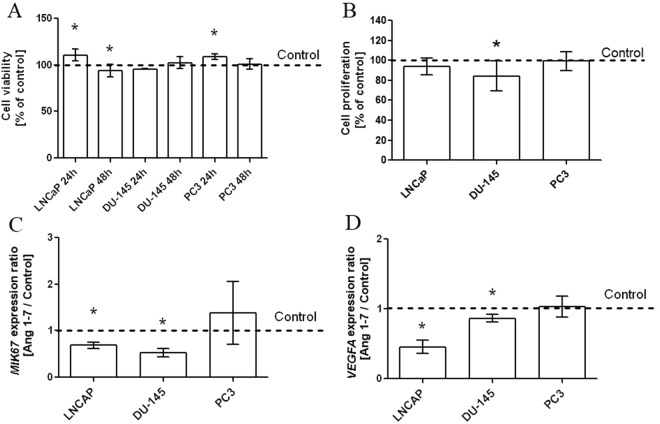
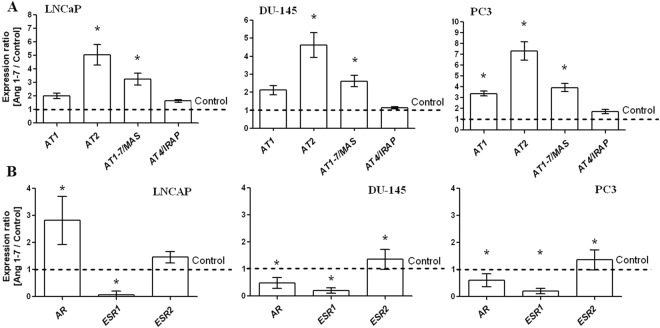
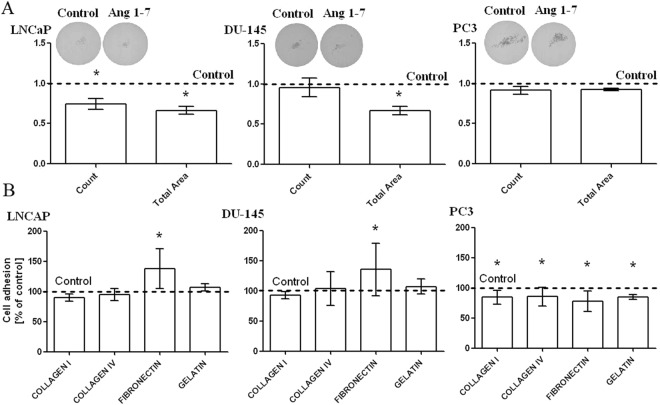
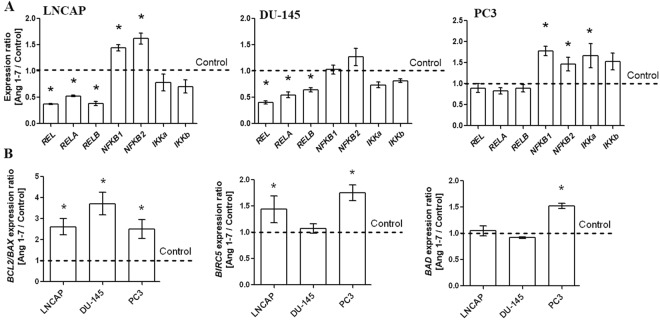
Angiotensin 1-7 (Ang1-7) is an endogenous bioactive component of the renin-angiotensin system (RAS). In addition to its cardiovascular properties, its anti-proliferative and anti-angiogenic traits are believed to play important roles in carcinogenesis. The present study examines the influence of Ang1-7 on processes associated with development and progression of prostate cancer cells. Our findings indicate that while Ang1-7 (1 nM; 48 h) can effectively reduce cell proliferation in DU-145, it can induce a significant decrease in the expression of MKI67 in LNCaP. In both cell lines we also observed a reduction in colony size in soft agar assay. A various changes in gene expression were noted after exposure to Ang1-7: those of anti- and pro-apoptotic agents and the NF-kB family of transcription factors, as well as mesenchymal cell markers and vascular endothelial growth factor A (VEGFA). In addition, Ang1-7 was found to modulate cell adhesion and matrix metallopeptidase (MMP) activity. Changes were also observed in the levels of angiotensin receptors and sex steroid hormone receptors. Ang1-7 reduced the levels of estrogen receptor alpha gene (ESR1) and increased the expression of estrogen receptor beta gene (ESR2) in all prostate cancer cells; it also up-regulated androgen receptor (AR) expression in androgen-sensitive cells but contradictory effect was observed in androgen- irresponsive cell lines. In summary, the results confirm the existence of complex network between the various elements of the local RAS and the molecular and cellular mechanisms of prostate cancerogenesis. The response of cancer cells to Ang1-7 appears to vary dependently on the dose and time of incubation as well as the aggressiveness and the hormonal status of cells.
血管紧张素 1-7(Ang1-7)是肾素-血管紧张素系统(RAS)的内源性生物活性成分。除了其心血管特性外,其抗增殖和抗血管生成特性被认为在肿瘤发生中发挥重要作用。本研究探讨了 Ang1-7 对前列腺癌细胞发展和进展相关过程的影响。我们的研究结果表明,虽然 Ang1-7(1 nM;48 小时)可以有效降低 DU-145 细胞的增殖,但它可以显著降低 LNCaP 中 MKI67 的表达。在这两种细胞系中,我们还观察到软琼脂试验中集落大小的减少。暴露于 Ang1-7 后观察到基因表达的各种变化:抗凋亡和促凋亡剂以及 NF-kB 转录因子家族,以及间充质细胞标志物和血管内皮生长因子 A(VEGFA)。此外,Ang1-7 被发现调节细胞黏附和基质金属蛋白酶(MMP)活性。血管紧张素受体和性激素激素受体的水平也发生了变化。Ang1-7 降低了所有前列腺癌细胞中雌激素受体α基因(ESR1)的水平并增加了雌激素受体β基因(ESR2)的表达;它还上调了雄激素受体(AR)在雄激素敏感细胞中的表达,但在雄激素不敏感细胞系中观察到相反的效果。总之,这些结果证实了局部 RAS 的各种成分与前列腺癌发生的分子和细胞机制之间存在复杂的网络。癌细胞对 Ang1-7 的反应似乎取决于剂量和孵育时间以及细胞的侵袭性和激素状态而有所不同。