Cui Jing, Sun Xiufen, Li Xiaojing, Ke Ma, Sun Jianping, Yasmeen Nafeesa, Khan Jamal Muhammad, Xin Hualei, Xue Shouyong, Baloch Zulqarnain
Qingdao Municipal Center for Disease Control and Prevention, Qingdao, China.
Qingdao Institute of Preventive Medicine, Qingdao, China.
Front Endocrinol (Lausanne). 2018 Oct 10;9:549. doi: 10.3389/fendo.2018.00549. eCollection 2018.
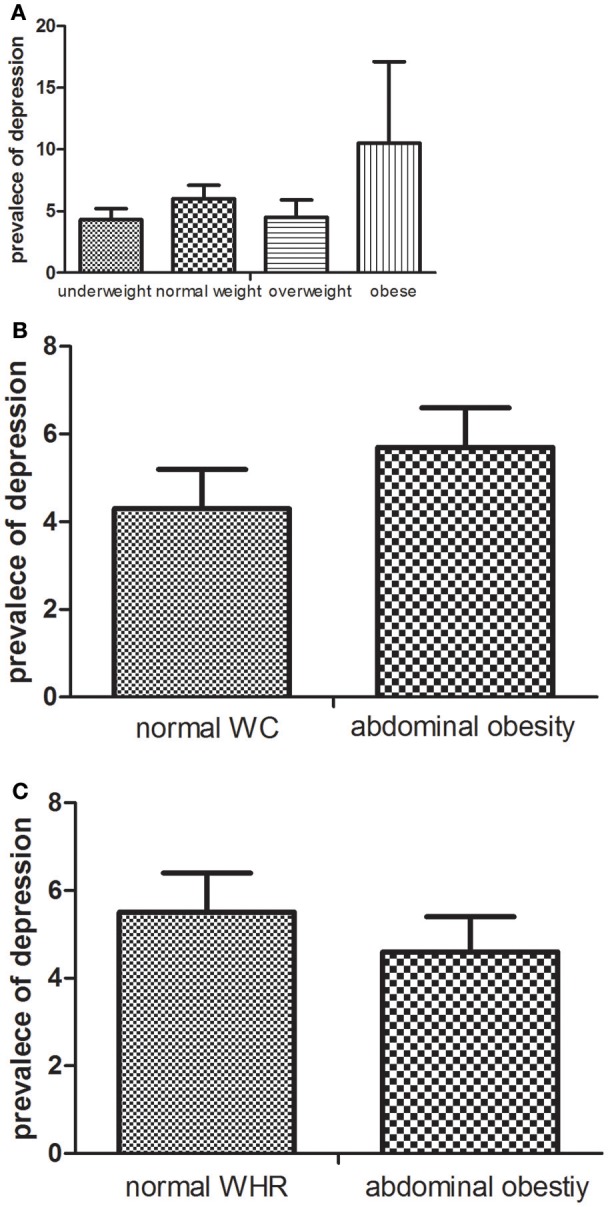
This study was designed to investigate the perceived relationship between body weight and depression risk in a Chinese population in Qingdao, China. A population-based cross-sectional survey was performed with 4,573 participants (between 35 and 74 years) from the year 2009 to 2012 in Qingdao, China. We applied the Zung self-rating depression scale to ascertain the level of depression in participants. The associations between different indicators of obesity [body mass index (BMI), waist circumference (WC), and waist-to-hip ratio (WHR)] and depression were assessed by logistic regression based on the Chinese criteria of obesity. Sensitivity analysis was done based on the Asian and WHO criteria of obesity. The Zung scores for the 243 participants (5.2%) were over 45 and they were entitled as depression. Furthermore, multivariable logistic analyses revealed that being overweight [odds ratios (OR): 1.48, 95% confidence intervals [95% CI]: 1.08-2.03] and having abdominal obesity (WC category in Chinese criteria) (OR: 1.47, 95% CI: 1.08-2.00) were often associated with a higher risk for depression compared to normal weight subjects. Sensitivity analysis revealed that abdominal obesity (Asian criterion) (OR: 1.41, 95% CI: 1.03-1.91) was a significant risk factor for depression. Similarly, being overweight (WHO criterion) (OR: 1.39, 95% CI: 1.03-1.87) was an obvious risk factor for depression. Being overweight and having abdominal obesity (WC category) were found to be linked with a higher risk of depression. However, abdominal obesity (WHR category) was not associated with depression.
本研究旨在调查中国青岛人群中体重与抑郁风险之间的感知关系。2009年至2012年期间,在中国青岛对4573名年龄在35至74岁之间的参与者进行了一项基于人群的横断面调查。我们应用zung自评抑郁量表来确定参与者的抑郁水平。根据中国肥胖标准,通过逻辑回归评估不同肥胖指标[体重指数(BMI)、腰围(WC)和腰臀比(WHR)]与抑郁之间的关联。基于亚洲和世界卫生组织的肥胖标准进行敏感性分析。243名参与者(5.2%)的zung评分超过45分,他们被认定为抑郁。此外,多变量逻辑分析显示,与正常体重受试者相比,超重[比值比(OR):1.48,95%置信区间[95%CI]:1.08 - 2.03]和腹部肥胖(中国标准中的WC类别)(OR:1.47,95%CI:1.08 - 2.00)往往与更高的抑郁风险相关。敏感性分析显示,腹部肥胖(亚洲标准)(OR:1.41,95%CI:1.03 - 1.91)是抑郁风险的一个重要因素。同样,超重(世界卫生组织标准)(OR:1.39,95%CI:1.03 - 1.87)是抑郁的一个明显风险因素。超重和腹部肥胖(WC类别)被发现与更高的抑郁风险相关。然而,腹部肥胖(WHR类别)与抑郁无关。