School Chemical Engineering, University of Birmingham, Edgbaston, Birmingham B15 2TT, UK.
Department of Chemical and Process Engineering, University of Strathclyde, James Weir Building, 75 Montrose Street, Glasgow G1 1XJ, UK.
Int J Mol Sci. 2018 Oct 25;19(11):3321. doi: 10.3390/ijms19113321.
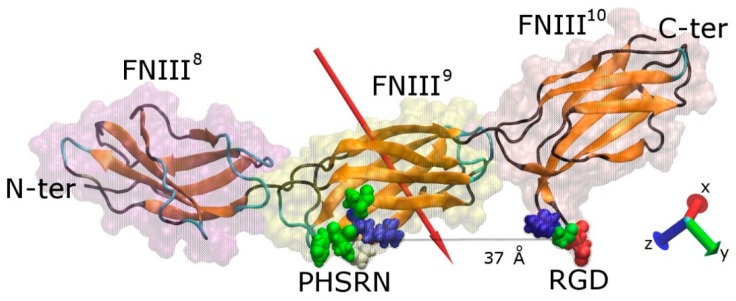
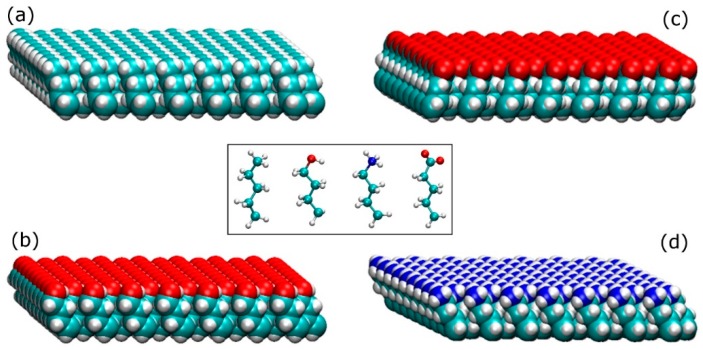
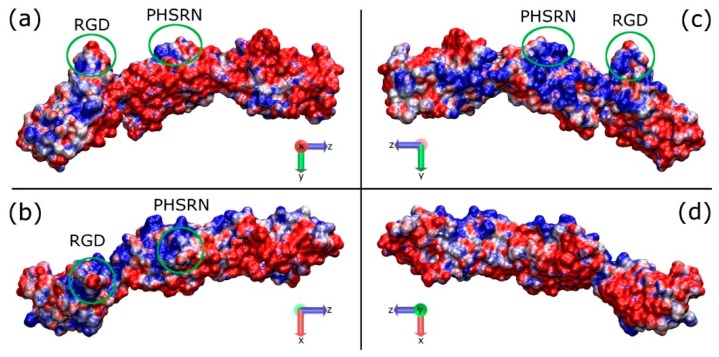
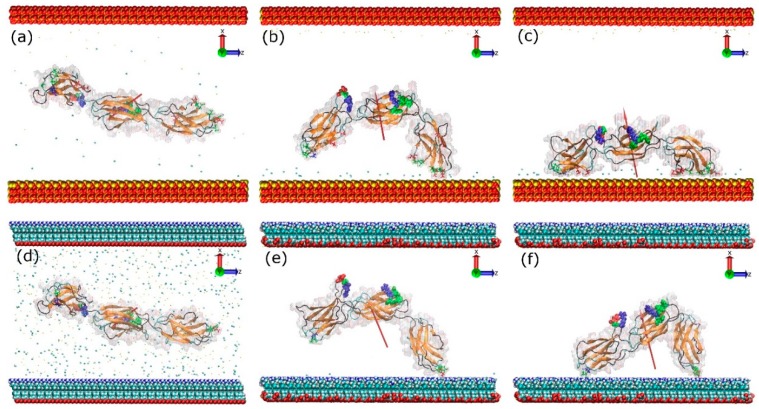
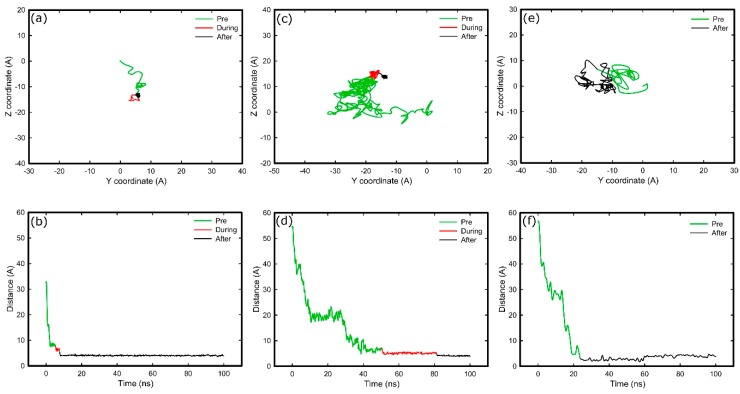
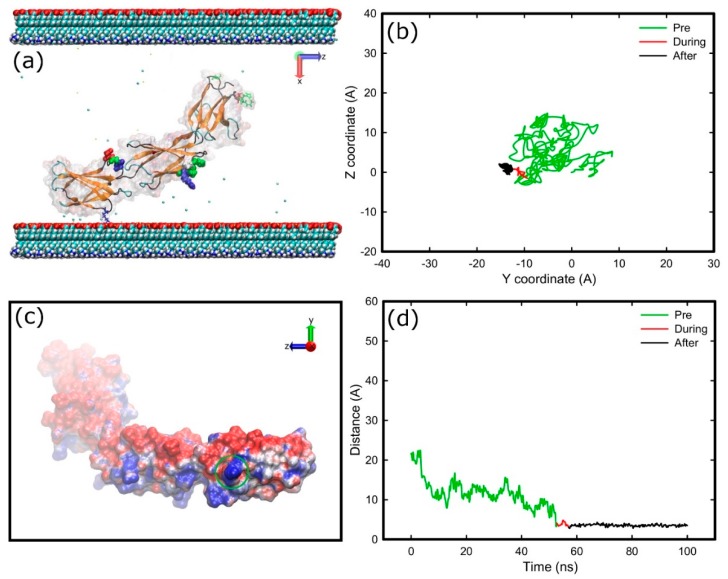
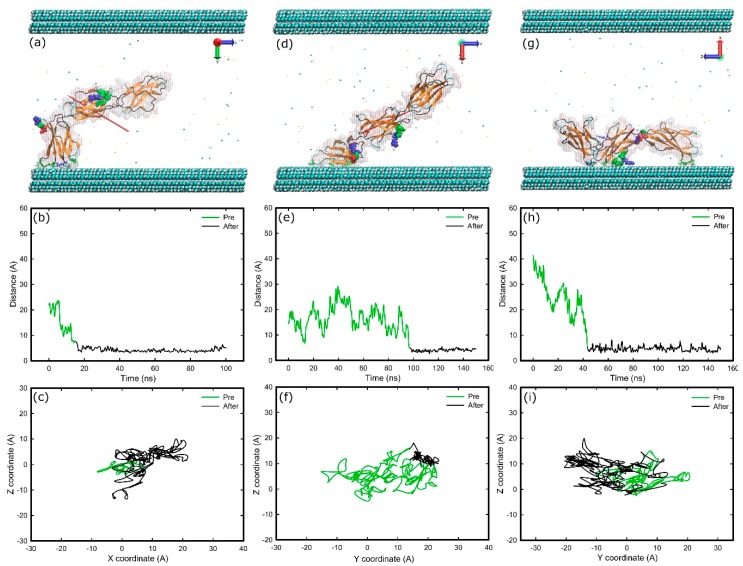
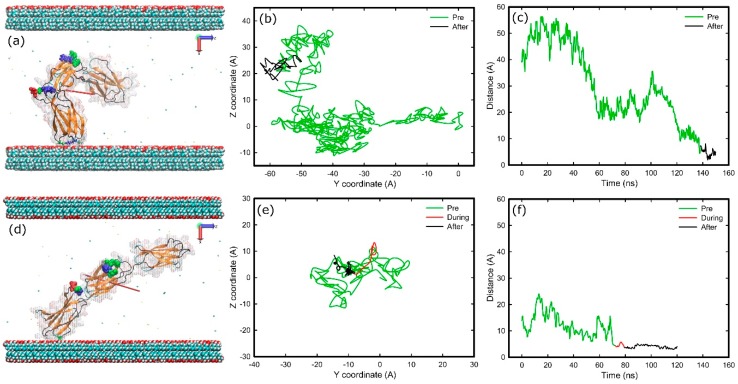
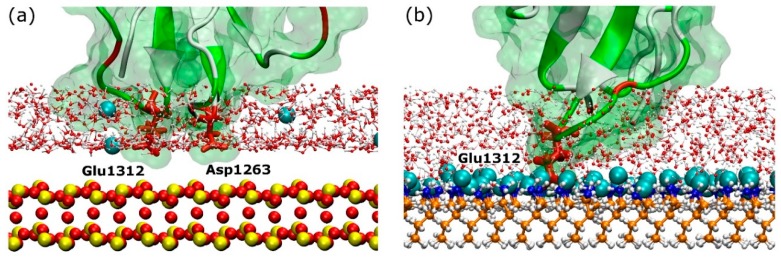
The effect of surface chemistry on the adsorption characteristics of a fibronectin fragment (FNIII) was investigated using fully atomistic molecular dynamics simulations. Model surfaces were constructed to replicate self-assembled monolayers terminated with methyl, hydroxyl, amine, and carboxyl moieties. It was found that adsorption of FNIII on charged surfaces is rapid, specific, and driven by electrostatic interactions, and that the anchoring residues are either polar uncharged or of opposing charge to that of the targeted surfaces. On charged surfaces the presence of a strongly bound layer of water molecules and ions hinders FNIII adsorption. In contrast, adsorption kinetics on uncharged surfaces are slow and non-specific, as they are driven by van der Waals interactions, and the anchoring residues are polar uncharged. Due to existence of a positively charged area around its cell-binding region, FNIII is available for subsequent cell binding when adsorbed on a positively charged surface, but not when adsorbed on a negatively charged surface. On uncharged surfaces, the availability of the fibronectin fragment's cell-binding region is not clearly distinguished because adsorption is much less specific.
采用全原子分子动力学模拟研究了表面化学对纤连蛋白片段(FNIII)吸附特性的影响。构建模型表面以复制用甲基、羟基、胺和羧基基团封端的自组装单分子层。结果表明,FNIII 在带电表面上的吸附快速、特异且由静电相互作用驱动,并且锚定残基要么是不带电的极性残基,要么与目标表面的电荷相反。在带电表面上,存在强烈结合的水分子和离子层会阻碍 FNIII 的吸附。相比之下,在不带电表面上的吸附动力学缓慢且非特异性,因为它们由范德华相互作用驱动,并且锚定残基是不带电的极性残基。由于其细胞结合区域周围存在带正电荷的区域,因此 FNIII 吸附在带正电荷的表面上时可用于随后的细胞结合,但吸附在带负电荷的表面上时则不行。在不带电的表面上,由于吸附的特异性较差,纤连蛋白片段的细胞结合区域的可用性并不明显区分。