1 MRC Integrative Epidemiology Unit Population Health Sciences Bristol Medical School University of Bristol United Kingdom.
2 MRC Unit for Lifelong Health and Ageing at UCL London United Kingdom.
J Am Heart Assoc. 2018 Aug 21;7(16):e007459. doi: 10.1161/JAHA.117.007459.
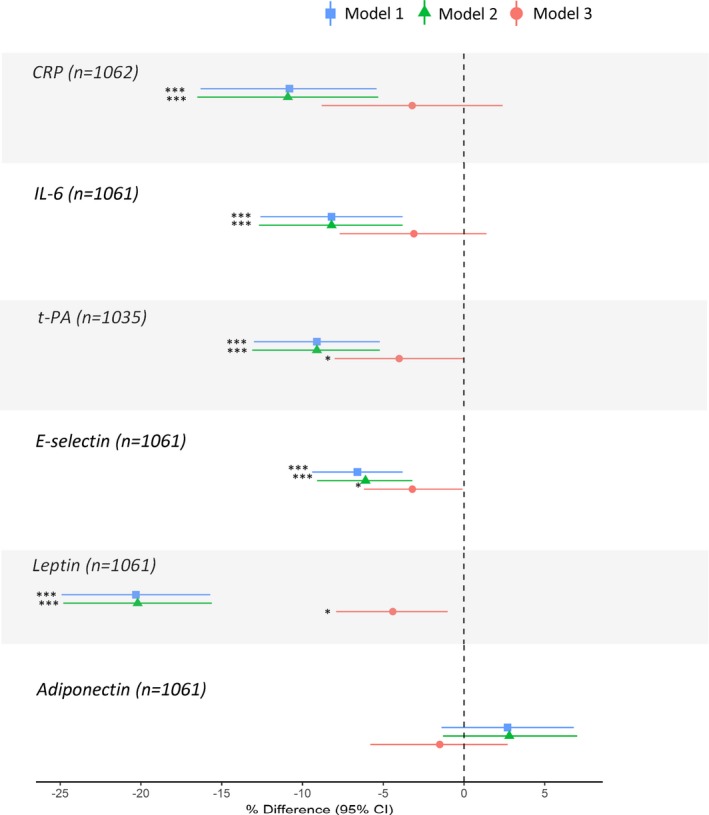
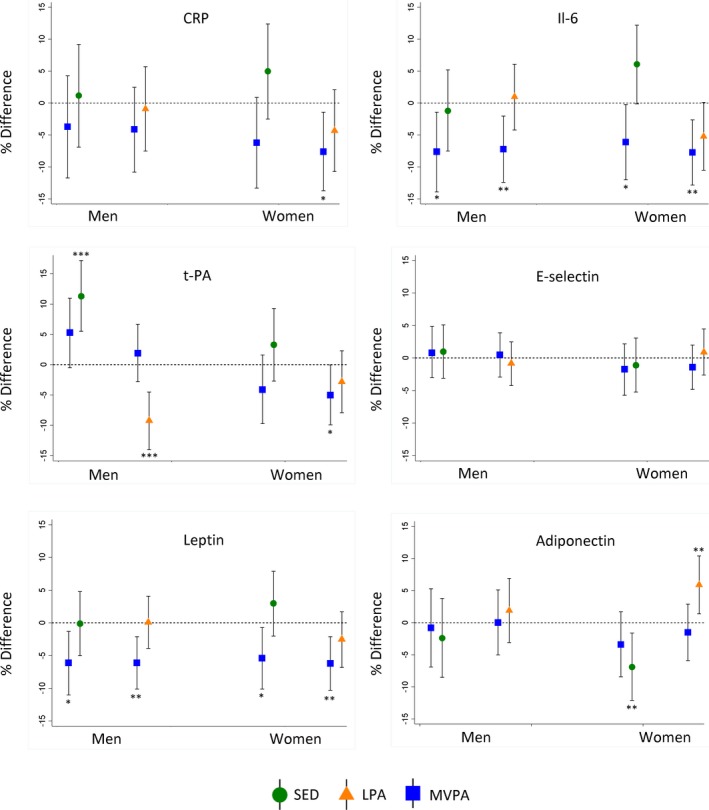
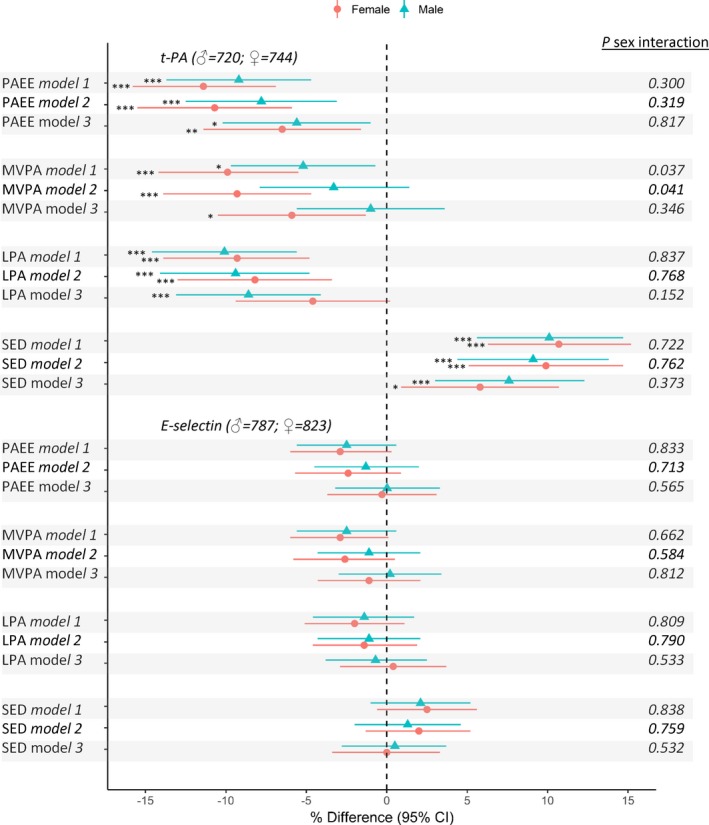
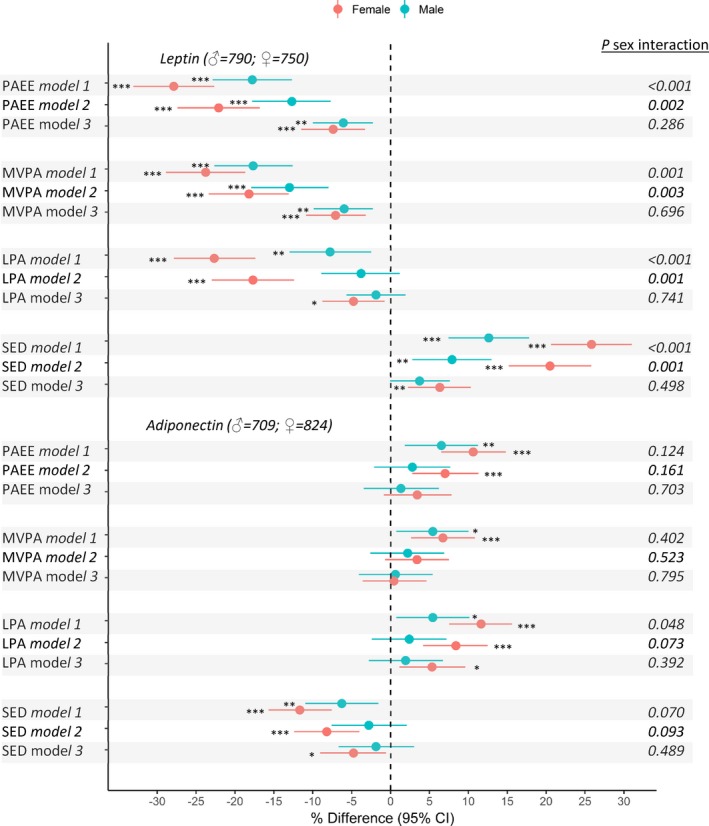
Background We examined associations of objectively measured physical activity ( PA ) and sedentary time with cardiovascular disease biomarkers at age 60 to 64 years. This included investigation of sex differences and the extent to which associations may be mediated by adiposity. Methods and Results Participants were 795 men and 827 women aged 60 to 64 years from the Medical Research Council National Survey of Health and Development. Combined heart rate and movement sensors worn for 5 consecutive days were used to derive overall PA energy expenditure, kJ /kg per day) and time spent sedentary (<1.5 metabolic equivalent of tasks), in light PA (1.5-3 metabolic equivalent of tasks) and moderate-to-vigorous intensity PA (>3 metabolic equivalent of tasks). Linear regression models were used to relate each PA parameter to inflammatory (C-reactive protein, interleukin-6), endothelial (tissue-plasminogen activator, E-selectin) and adipokine (leptin, adiponectin) markers extracted from fasting blood samples. Greater time in light PA and moderate-to-vigorous intensity PA and less sedentary time were associated with more favorable biomarker levels. For C-reactive protein, interleukin-6, and leptin, these differences were greater among women than men. For example, % differences (95% confidence intervals) in leptin for men and women per SD increases in sedentary time: 7.9 (2.7, 13.0) and 20.6 (15.3, 25.8); light intensity PA : -3.8 (-8.9, 12.7) and -17.7 (-23.1, -12.4), moderate-to-vigorous intensity PA : -12.9 (-17.9, -8.0) and -18.3 (-23.4, -13.1). Fat mass mediated a greater proportion of these associations in women than men. Conclusions Greater light PA and moderate-to-vigorous intensity PA and less sedentary time in early old age were associated with more favorable cardiovascular biomarker profiles. Fat mass partially mediated these associations but more strongly in women than men, which explained sex differences.
我们研究了 60 至 64 岁时的身体活动(PA)和久坐时间与心血管疾病生物标志物之间的关联。这包括对性别差异的调查以及这些关联可能通过肥胖程度介导的程度。
参与者是 795 名年龄在 60 至 64 岁的男性和 827 名女性,来自医学研究委员会国民健康与发展调查。使用连续佩戴 5 天的心率和运动传感器,得出总 PA 能量消耗(kJ/kg/天)和久坐时间(<1.5 代谢当量任务)、轻 PA(1.5-3 代谢当量任务)和中高强度 PA(>3 代谢当量任务)。线性回归模型用于将每个 PA 参数与炎症(C 反应蛋白、白细胞介素-6)、内皮(组织纤溶酶原激活物、E-选择素)和脂肪因子(瘦素、脂联素)标志物相关联,这些标志物从空腹血样中提取。更多的轻 PA 和中高强度 PA 时间和更少的久坐时间与更有利的生物标志物水平相关。对于 C 反应蛋白、白细胞介素-6 和瘦素,这些差异在女性中大于男性。例如,男性和女性的瘦素差异(95%置信区间):久坐时间每增加 1 个标准差:7.9(2.7,13.0)和 20.6(15.3,25.8);轻强度 PA:-3.8(-8.9,12.7)和-17.7(-23.1,-12.4),中高强度 PA:-12.9(-17.9,-8.0)和-18.3(-23.4,-13.1)。脂肪量在女性中比男性更多地介导这些关联。
老年早期的轻 PA 和中高强度 PA 增加和久坐时间减少与更有利的心血管生物标志物谱相关。脂肪量部分介导了这些关联,但在女性中比男性更强,这解释了性别差异。