Ahmadi-Abhari Sara, Sabia Severine, Shipley Martin J, Kivimäki Mika, Singh-Manoux Archana, Tabak Adam, McEniery Carmel, Wilkinson Ian B, Brunner Eric J
Research Department of Epidemiology and Public Health, University College London, London, United Kingdom
Research Department of Epidemiology and Public Health, University College London, London, United Kingdom.
J Am Heart Assoc. 2017 Aug 7;6(8):e005974. doi: 10.1161/JAHA.117.005974.
Physical activity is associated with reduced cardiovascular disease risk, mainly through effects on atherosclerosis. Aortic stiffness may be an alternative mechanism. We examined whether patterns of physical activity and sedentary behavior are associated with rate of aortic stiffening.
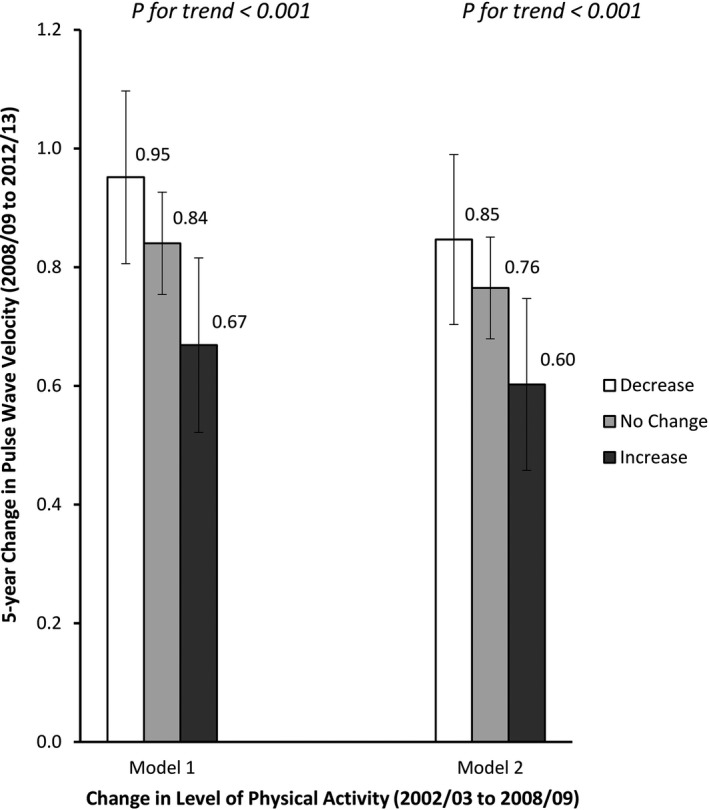
Carotid-femoral pulse wave velocity (PWV) was measured twice using applanation tonometry at mean ages 65 (in 2008/2009) and 70 (in 2012/2013) years in the Whitehall-II study (N=5196). Physical activity was self-reported at PWV baseline (2008/2009) and twice before (in 1997/1999 and 2002/2003). Sedentary time was defined as sitting time watching television or at work/commute. Linear mixed models adjusted for metabolic and lifestyle risk factors were used to analyze PWV change. Mean (SD) PWV (m/s) was 8.4 (2.4) at baseline and 9.2 (2.7) at follow-up, representing a 5-year increase of 0.76 m/s (95% CI 0.69, 0.83). A smaller 5-year increase in PWV was observed for each additional hour/week spent in sports activity (-0.02 m/s [95% CI -0.03, -0.001]) or cycling (-0.02 m/s [-0.03, -0.008]). Walking, housework, gardening, or do-it-yourself activities were not significantly associated with aortic stiffening. Each additional hour/week spent sitting was associated with faster PWV progression in models adjusted for physical activity (0.007 m/s [95% CI 0.001, 0.013]). Increasing physical activity over time was associated with a smaller subsequent increase in PWV (-0.16 m/s [-0.32, -0.002]) compared with not changing activity levels.
Higher levels of moderate-to-vigorous physical activity and avoidance of sedentary behavior were each associated with a slower age-related progression of aortic stiffness independent of conventional vascular risk factors.
身体活动与心血管疾病风险降低相关,主要通过对动脉粥样硬化的影响。主动脉僵硬度可能是另一种机制。我们研究了身体活动模式和久坐行为是否与主动脉僵硬度增加速率相关。
在白厅二期研究(N = 5196)中,使用压平式眼压计在平均年龄65岁(2008/2009年)和70岁(2012/2013年)时两次测量颈股脉搏波速度(PWV)。身体活动情况在PWV基线(2008/2009年)以及之前两次(1997/1999年和2002/2003年)进行自我报告。久坐时间定义为看电视或工作/通勤时的坐姿时间。采用针对代谢和生活方式风险因素进行调整的线性混合模型分析PWV变化。基线时平均(标准差)PWV(m/s)为8.4(2.4),随访时为9.2(2.7),5年增加了0.76 m/s(95%可信区间0.69, 0.83)。每周每增加一小时用于体育活动(-0.02 m/s [95%可信区间 -0.03, -0.001])或骑自行车(-0.02 m/s [-0.03, -0.008]),PWV的5年增加幅度较小。步行、家务、园艺或自己动手活动与主动脉僵硬度无显著关联。在针对身体活动进行调整的模型中,每周每增加一小时久坐与PWV进展加快相关(0.007 m/s [95%可信区间0.001, 0.013])。与不改变活动水平相比,随着时间推移增加身体活动与随后PWV的较小增加相关(-0.16 m/s [-0.32, -0.002])。
较高水平的中度至剧烈身体活动以及避免久坐行为均与年龄相关的主动脉僵硬度进展较慢相关,且独立于传统血管危险因素。