Massachusetts General Hospital Clinical Trials Network and Institute (CTNI), Harvard Medical School, Boston, MA, USA.
University of Pennsylvania Perelman School of Medicine and the Corporal Michael Crescenz Veterans Affairs Medical Center, Philadelphia, PA, USA.
Mol Psychiatry. 2020 Jul;25(7):1580-1591. doi: 10.1038/s41380-018-0284-1. Epub 2018 Oct 29.
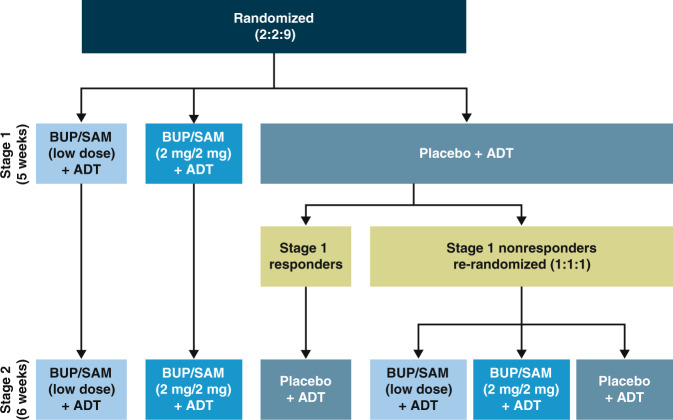
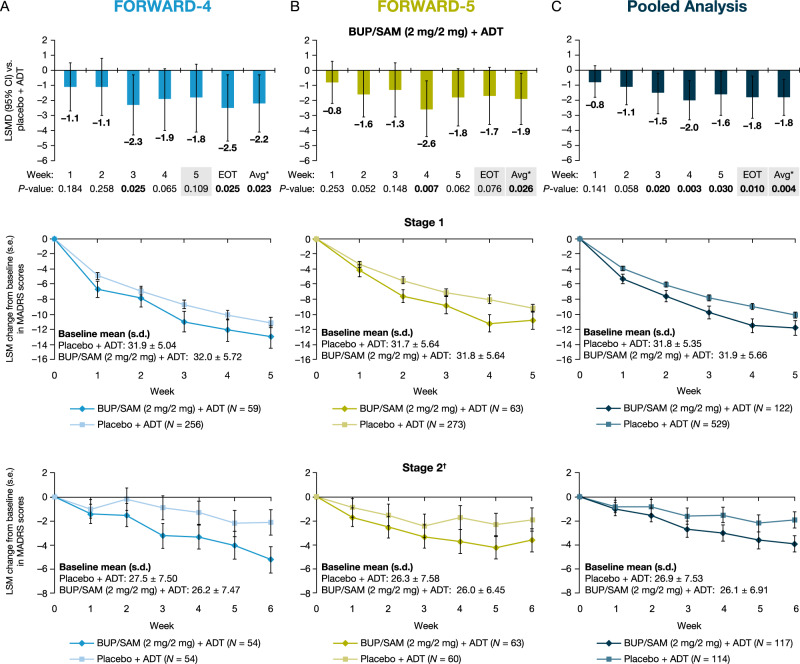
The endogenous opioid system is thought to play an important role in the regulation of mood. Buprenorphine/samidorphan (BUP/SAM) combination is an investigational opioid system modulator for adjunctive treatment of major depressive disorder (MDD). To confirm results from early studies, we report the efficacy and safety of BUP/SAM as adjunctive treatment in patients with MDD and an inadequate response to antidepressant therapy (ADT) in FORWARD-4 and FORWARD-5: two phase 3, randomized, double-blind, placebo-controlled studies that utilized the same sequential parallel-comparison design. Efficacy was measured using the Montgomery-Åsberg Depression Rating Scale (MADRS). FORWARD-5 achieved the primary endpoint and demonstrated that adjunctive BUP/SAM 2 mg/2 mg was superior to placebo (average difference change from baseline to week 3 through end of treatment [EOT] in MADRS-6 and -10 versus placebo: -1.5, P = 0.018; -1.9, P = 0.026, respectively). FORWARD-4 did not achieve the primary endpoint (change from baseline in MADRS-10 at week 5 versus placebo: -1.8, P = 0.109), although separate analyses showed significant treatment differences at other timepoints using traditional, regulatory-accepted endpoints such as reduction in MADRS-10 at EOT. The pooled analysis of the two studies demonstrated consistently greater reduction in MADRS-10 scores from baseline for BUP/SAM 2 mg/2 mg versus placebo at multiple timepoints including EOT and average change from baseline to week 3 through EOT (-1.8, P = 0.010; -1.8, P = 0.004, respectively). The overall effect size (Hedges' g) in the pooled analyses for MADRS-10 change from baseline to EOT was 0.22. Overall, BUP/SAM was generally well tolerated, with most adverse events (AEs) being mild or moderate in severity. The most common AEs, occurring in ≥5% of patients in the BUP/SAM 2 mg/2 mg treatment group, which was more frequently than the placebo group, included nausea, constipation, dizziness, vomiting, somnolence, fatigue, and sedation. There was minimal evidence of abuse, and no evidence of dependence or opioid withdrawal by AEs or objective measures. This report describes adjunctive BUP/SAM 2 mg/2 mg combination, a therapy with a novel opioidergic mechanism of action, as a potential new treatment option for patients with MDD who have an inadequate response to currently available ADT.
内源性阿片系统被认为在调节情绪方面发挥着重要作用。丁丙诺啡/纳洛酮(BUP/SAM)组合是一种研究性的阿片系统调节剂,用于辅助治疗重度抑郁症(MDD)。为了证实早期研究的结果,我们报告了 BUP/SAM 作为辅助治疗对 MDD 患者的疗效和安全性,这些患者对抗抑郁治疗(ADT)反应不足。FORWARD-4 和 FORWARD-5 是两项 3 期、随机、双盲、安慰剂对照研究,采用相同的序贯平行比较设计。疗效采用蒙哥马利-Åsberg 抑郁评定量表(MADRS)进行测量。FORWARD-5 达到了主要终点,并证明辅助 BUP/SAM 2mg/2mg 优于安慰剂(从基线到治疗结束(EOT)的第 3 周和第 10 周 MADRS-6 和 -10 与安慰剂相比的平均变化:-1.5,P=0.018;-1.9,P=0.026,分别)。FORWARD-4 未达到主要终点(第 5 周时与安慰剂相比,MADRS-10 从基线的变化:-1.8,P=0.109),尽管单独分析显示,使用传统的、监管部门接受的终点,如 EOT 时 MADRS-10 的减少,在其他时间点有显著的治疗差异。两项研究的汇总分析显示,与安慰剂相比,BUP/SAM 2mg/2mg 在多个时间点,包括 EOT,从基线到第 3 周的平均变化,MADRS-10 评分的降低始终更大(-1.8,P=0.010;-1.8,P=0.004,分别)。汇总分析中 MADRS-10 从基线到 EOT 的变化的总体效应大小(Hedges'g)为 0.22。总体而言,BUP/SAM 通常具有良好的耐受性,大多数不良事件(AE)的严重程度为轻度或中度。最常见的 AE 发生在 BUP/SAM 2mg/2mg 治疗组≥5%的患者中,比安慰剂组更频繁,包括恶心、便秘、头晕、呕吐、嗜睡、疲劳和镇静。几乎没有滥用的证据,也没有通过 AE 或客观测量发现依赖或阿片戒断的证据。本报告描述了 BUP/SAM 2mg/2mg 联合治疗,这是一种具有新型阿片类作用机制的治疗方法,作为对目前可用 ADT 反应不足的 MDD 患者的潜在新治疗选择。