Bhivandkar Siddhi, Sarfraz Zouina, Jain Lakshit, Bachu Anil, Malo Palash Kumar, Hsu Michael, Ayub Shahana, Poudel Laxmi, Kumar Harendra, Loh Hanyou, Tazin Faria, Ahmed Saeed, Suzuki Joji
Department of Psychiatry, Boston University Medical Center/Boston University School of Medicine, Boston, MA, USA.
Department of Psychiatry, Fatima Jinnah Medical University, Lahore, Pakistan.
J Clin Med Res. 2024 Mar;16(2-3):46-55. doi: 10.14740/jocmr5050. Epub 2024 Mar 16.
Emerging research indicates buprenorphine, used in management of opioid use disorder, has attracted interest for its potential in treating a variety of psychiatric conditions. This meta-analysis aimed to determine the efficacy of buprenorphine in treating symptoms of depression.
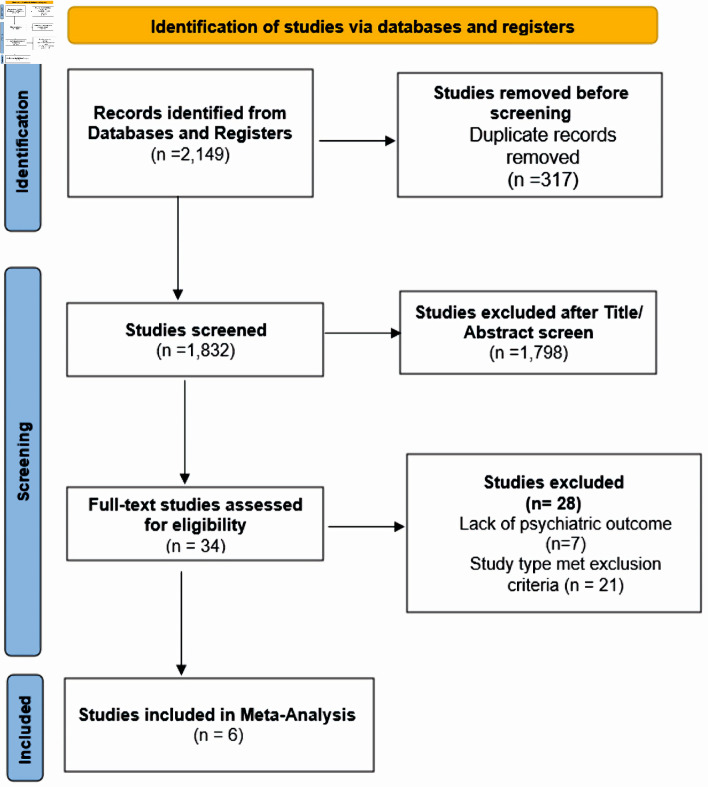
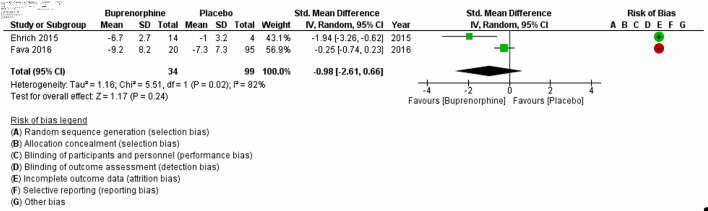
Using Preferred Reporting Items for Systematic Reviews and Meta-Analysis (PRISMA) guidelines, a search was conducted of several databases until April 25, 2022, for English language articles related to buprenorphine and its use in treating various mental health conditions. Standardized mean differences (SMDs) and its 95% confidence intervals (CIs) were reported for the Hamilton Rating Scale for Depression (HAM-D) and the Montgomery-Asberg Depression Rating Scale (MADRS) scores. Statistical analyses were performed using Cochrane RevMan 5.
Of the 1,347 identified studies, six clinical trials were included. MADRS-10 least square mean difference (LSMD) inter-group assessment favored buprenorphine over placebo, but it lacked statistical significance. Similarly, MADRS scores as well as HAM-D inter-group assessment were in favor of buprenorphine, however, were not statistically significant. These findings suggest a potential therapeutic role for buprenorphine in treating depression, albeit with caution due to the observed lack of statistical significance and the potential for confounding factors.
Preliminary evidence suggests potential efficacy of buprenorphine at lower doses in improving improving outcomes specifically related to depression. However, due to limitations in statistical significance and possible confounding factors, entail cautious interpretation. Further rigorous research is needed to investigate the long-term effects, optimal dosing, and determine the role of adjuvant drug therapy.
新出现的研究表明,用于治疗阿片类物质使用障碍的丁丙诺啡因其在治疗多种精神疾病方面的潜力而受到关注。这项荟萃分析旨在确定丁丙诺啡治疗抑郁症症状的疗效。
按照系统评价和荟萃分析的首选报告项目(PRISMA)指南,对多个数据库进行检索,直至2022年4月25日,以查找与丁丙诺啡及其在治疗各种心理健康状况中的应用相关的英文文章。报告了汉密尔顿抑郁评定量表(HAM-D)和蒙哥马利-阿斯伯格抑郁评定量表(MADRS)评分的标准化平均差(SMD)及其95%置信区间(CI)。使用Cochrane RevMan 5进行统计分析。
在1347项已识别的研究中,纳入了6项临床试验。MADRS-10最小二乘均数差(LSMD)组间评估显示丁丙诺啡优于安慰剂,但缺乏统计学意义。同样,MADRS评分以及HAM-D组间评估也支持丁丙诺啡,但无统计学意义。这些发现表明丁丙诺啡在治疗抑郁症方面可能具有治疗作用,尽管由于观察到缺乏统计学意义和潜在的混杂因素,需谨慎对待。
初步证据表明,较低剂量的丁丙诺啡在改善与抑郁症相关的结局方面可能具有疗效。然而,由于统计学意义的局限性和可能的混杂因素,需要谨慎解读。需要进一步进行严格的研究,以调查其长期影响、最佳剂量,并确定辅助药物治疗的作用。